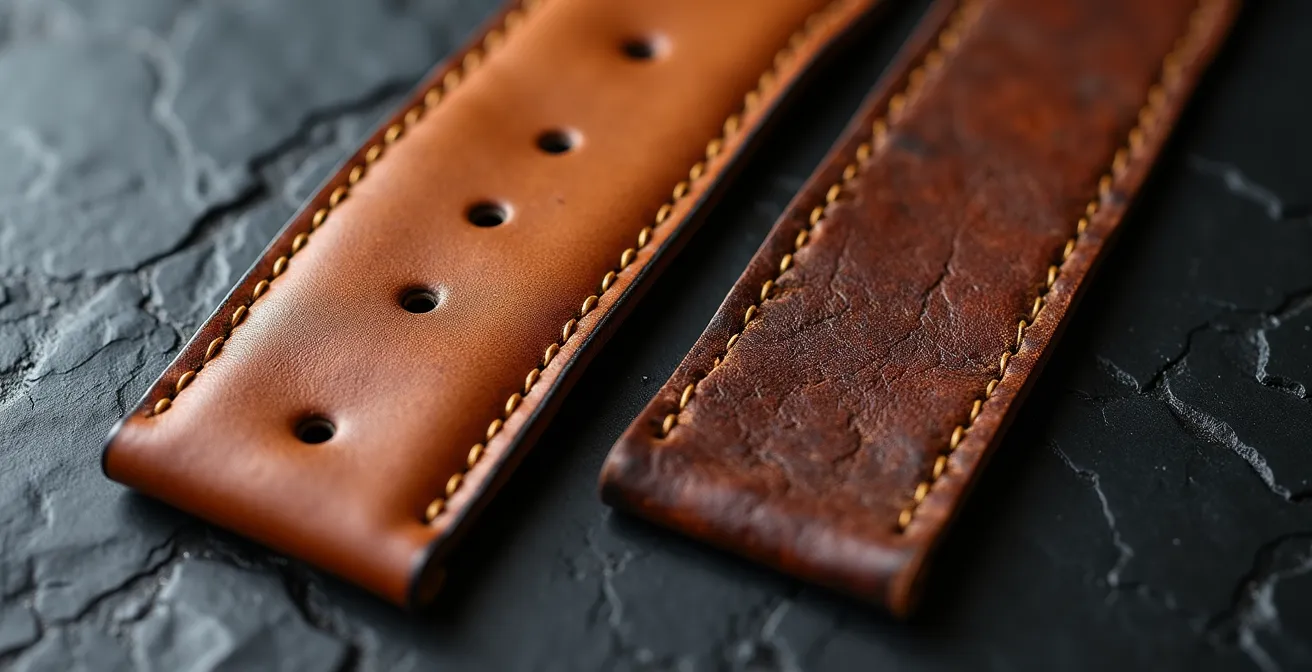
A quality full-grain leather belt is a decade-long investment, not a disposable accessory that fails within a year.
- ‘Genuine Leather’ is a misleading marketing term for low-grade material specifically processed to have a short lifespan.
- The secret to longevity lies in understanding the material’s need to rest and be nourished correctly, just like skin.
Recommendation: Prioritise a full-grain, vegetable-tanned belt from a single hide, and ensure it is sized to fasten on the third (middle) hole for a perfect, lasting fit.
You’ve seen it before. That belt you bought, the one that looked so sharp and promising, is now a sad, cracked shadow of its former self. The surface is peeling, it has sagged into a permanent, unflattering curve, and it looks cheaper than the day you bought it. This experience is so common that most men assume it’s just the nature of belts. They are temporary accessories, destined for the bin after a year or so of service. We’ve been taught to look for the “Genuine Leather” stamp as a mark of quality, but this is often the very source of the problem.
The truth is, a real leather belt shouldn’t just last; it should evolve. It should mould to your body, develop a unique character, and tell a story through its patina. It is not a disposable item but a foundational piece of your wardrobe, a companion for a decade or more. The key isn’t simply buying “real leather”; it’s about understanding the language of the material itself. It’s about seeing the belt not as a static object, but as a living piece of craftsmanship that requires a partnership of understanding and care.
This guide is written from an artisan’s perspective. We won’t just repeat the tired old rules. Instead, we will delve into the very fibres of the leather. We’ll decode the misleading labels that plague high-street shops, understand the architectural importance of width and fit, explore the soul of different tanning methods, and learn the simple rituals that grant a belt its incredible longevity. Forget what you think you know; it’s time to learn how to choose a belt that won’t betray you.
To guide you on this journey, this article breaks down the essential knowledge every man needs to invest in a belt that will stand the test of time. Explore the sections below to become an expert in your own right.
Summary: Decoding the Craft of a Long-Lasting Leather Belt
- Why ‘Genuine Leather’ is often a marketing scam?
- How to determine the ideal width for a suit vs. jeans?
- Vegetable or chrome tanning: which patinas better over time?
- The mistake of wearing the same belt every day that breaks the fiber
- Dryness problem: how to nourish the leather without staining your trousers?
- How to match the metals of your watch with your cufflinks?
- Why a £20 alteration is better than a poorly-fitted £500 suit?
- Where to start: the 3 foundational pieces of sartorial style
Why ‘Genuine Leather’ is often a marketing scam?
The term “Genuine Leather” feels reassuring, doesn’t it? It sounds authentic, premium. In reality, it is one of the most brilliant and deceptive marketing terms in the fashion industry. While technically made from real animal hide, it represents one of the lowest grades available. It’s the industry’s way of selling you the leftover scraps while making you feel like you’ve bought a quality product. In fact, many artisan leather belt makers reveal that even expensive, big-name branded belts often don’t last much more than a year precisely because they use these inferior materials.
To understand this, you must picture a cowhide. It’s thick, with multiple layers. The top layer, with all its natural grain, scars, and character, is called Full-Grain. This is the strongest, most durable, and most desirable part of the hide. Below that is Top-Grain, which has been sanded to remove imperfections. And at the very bottom are the weaker, less dense layers. “Genuine Leather” is typically made from these lower layers or, even worse, from multiple layers of low-quality leather scraps glued together and painted to look uniform. This composite construction is inherently weak, prone to stretching, cracking, and peeling, which explains why these belts fail so quickly.
The difference in longevity and quality is not subtle; it’s exponential. A belt made from a single piece of full-grain leather has its natural fibre structure intact, allowing it to be both strong and supple. It will break in, not break down. The table below illustrates the stark reality of what you’re actually buying.
| Leather Type | Quality Grade | Lifespan | Price Range | Characteristics |
|---|---|---|---|---|
| Full Grain | Highest | 10-20+ years | £80-£150 | Natural grain, develops patina, extremely durable |
| Top Grain | Good | 5-10 years | £40-£80 | Sanded surface, uniform appearance, less durable |
| Genuine Leather | Low | 6-18 months | £15-£30 | Made from scraps, heavily processed, prone to cracking |
| Bonded Leather | Lowest | 3-6 months | Under £20 | Ground scraps with adhesive, peels quickly |
Ultimately, a “Genuine Leather” belt is designed for a quick sale, not a long life. It is an accessory built with planned obsolescence in its very fibres. Opting for full-grain is the single most important decision you can make in your quest for a belt that lasts.
How to determine the ideal width for a suit vs. jeans?
Beyond the material itself, the width of a belt is a crucial detail that signals its purpose and dramatically affects your overall look. It’s not a matter of personal preference but a code of sartorial grammar. Using the wrong width is like using the wrong punctuation; it instantly looks out of place to a discerning eye. The primary rule is simple: the more formal the outfit, the slimmer and more discreet the belt should be.
For formal and business attire—think a classic suit for the City of London or smart trousers for a wedding—the belt serves a subtle, unifying role. As experts at Tanner Bates note, “Dress belts are designed to be worn with formal or professional attire. Typically, they are around 1.25 inches wide to fit through the smaller belt loops on formal trousers.” This slender profile is elegant and does not draw undue attention, allowing the suit’s tailoring to take centre stage. The buckle should also be smaller and more polished, often in silver or a subtle brass.
As you move towards casual wear, the belt’s role changes. With jeans, chinos, or corduroys, the belt can be a more expressive part of the outfit. A wider belt, typically 1.5 to 1.75 inches, provides the visual balance needed for heavier fabrics like denim. The hardware can be larger and more rugged, like a solid brass buckle that complements the sturdier nature of the clothing. This is particularly true for British country style, where a wider 1.5-inch belt is a perfect match for tweed and corduroy trousers.
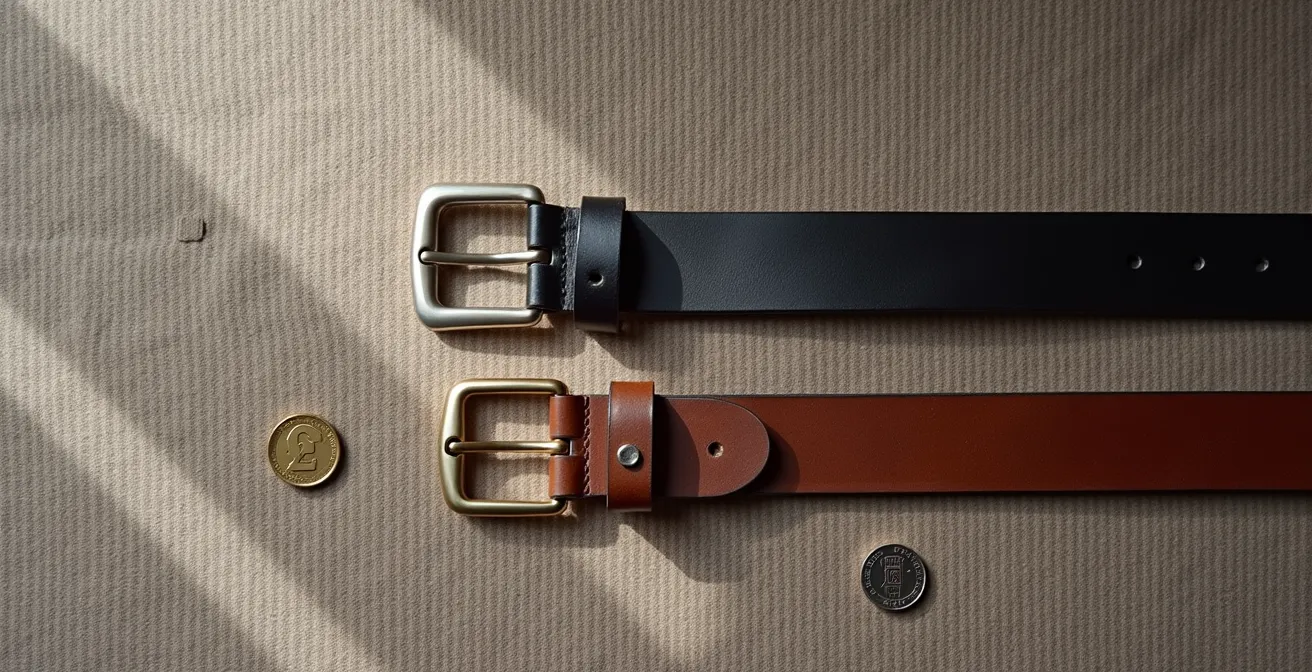
As the image above demonstrates, the difference is distinct. The slimmer belt is about refinement and elegance, while the wider belt communicates a sense of robustness and casual confidence. Choosing the correct width is a non-negotiable step towards a polished and context-appropriate appearance. Always check the loop size on your trousers before buying; they are the ultimate arbiter of what width is appropriate.
Vegetable or chrome tanning: which patinas better over time?
If full-grain is the king of leather grades, then vegetable tanning is the soul of its character. The tanning process is what transforms a raw hide into the stable, durable material we know as leather. The two dominant methods, vegetable tanning and chrome tanning, produce profoundly different results in feel, smell, and, most importantly, how they age. While chrome tanning is faster and cheaper, making it the choice for over 90% of the world’s leather, it is vegetable-tanned leather that develops the rich, beautiful patina that defines a truly great belt.
Vegetable tanning is an ancient, organic process. It uses natural tannins found in tree bark, wood, and other plants. It is a slow, patient dialogue between the hide and the tannins, a method that respects the material’s natural fibres. A prime example of this heritage exists in Devon at the J. & F.J. Baker tannery, a site used for tanning since Roman times. Here, the traditional oak bark tanning process is a long, gentle immersion that can take up to 14 months to complete. This slow process results in a leather that is firm yet supple, with a distinctive sweet, earthy smell. It is alive with natural variations and ready to absorb the story of its wearer.
Chrome tanning, by contrast, is a modern industrial process using chromium salts. It can be completed in as little as a day. While it produces a soft, uniform leather that is often more water-resistant from the start, this consistency comes at a cost. The chemical process fundamentally alters the hide’s fibres, making them less capable of developing a patina. A chrome-tanned belt will often look its best the day you buy it. A vegetable-tanned belt, however, is just beginning its journey. With every wear, with exposure to sunlight and the oils from your hands, it will darken, soften, and develop a unique lustre. This is the patina—the visual story of your life, embedded in the leather. For an artisan, and for anyone who values objects with soul, there is no comparison.
The mistake of wearing the same belt every day that breaks the fiber
We’ve established that a full-grain, vegetable-tanned belt is a remarkable material. But even the finest material has its limits if not treated with a basic level of respect. The single most common mistake that drastically shortens a belt’s life is wearing the exact same one, day in and day out. We tend to think of leather as an inert, tough material, but it’s more accurate to think of it as skin. It is a natural, fibrous structure that absorbs moisture, stretches under tension, and needs time to recover.
Throughout the day, your belt is under constant stress. It’s bent, twisted, and pulled. More importantly, it absorbs moisture and perspiration from your body. If it’s not given time to dry out completely and rest, these trapped moisture particles weaken the leather’s intricate fibre structure. The leather loses its resilience, begins to sag permanently into the shape it was last worn, and eventually, the fibres start to crack and break under the strain. This is particularly true around the hole you use most frequently and where the leather folds over the buckle.
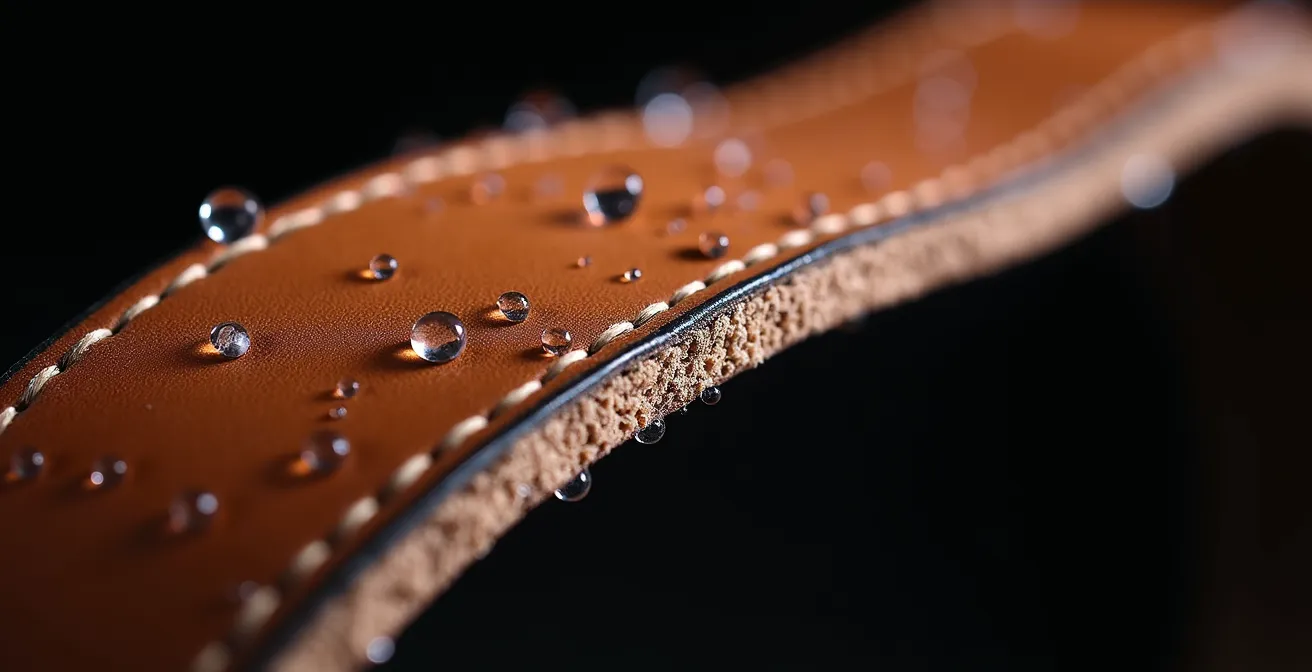
The solution is surprisingly simple: rotation. Just as you wouldn’t wear the same pair of leather shoes every single day, you should give your belt a day off. Having two or three quality belts that you alternate between allows each one the crucial 24-48 hours it needs to fully dry, breathe, and return to its natural shape. This simple act of resting the leather preserves the integrity of its fibres. In fact, leather experts confirm that rotating just two or three belts can easily double or even triple the functional lifespan of each one. It’s the difference between a belt that gives up in a couple of years and one that is still serving you faithfully a decade later.
Think of it not as an inconvenience, but as a partnership. By giving your belt time to rest, you are preserving the very structure that gives it its strength and longevity, ensuring it remains a reliable part of your wardrobe for years, not months.
Dryness problem: how to nourish the leather without staining your trousers?
Just as leather needs to rest, it also needs to be nourished. Over time, the natural oils within the hide will dry out, especially in the variable British climate of central heating and damp air. A dry belt becomes brittle, its surface feels rough, and it’s far more susceptible to cracking. Regular conditioning is the answer, but many men are hesitant, fearing the greasy residue will transfer onto their expensive suit trousers or favourite chinos. This is a valid concern, born from improper technique.
The secret to nourishing leather without creating a mess lies not in the product you use, but in the process you follow. It requires patience. Applying a conditioner and immediately wearing the belt is a recipe for disaster. The leather needs time to actually absorb the nourishment. Any excess left on the surface is what causes stains. A quality conditioner—like Renapur balm or traditional dubbin, both excellent choices readily available in the UK—should be applied sparingly. The real magic happens in the curing and buffing stages.
As one British artisan from Sam Brown London puts it, a quality belt “will look better in six months’ time, rather than be destined for the bin.” This is only possible with proper care. By following a professional method, you feed the fibres from within, restoring their suppleness and lustre without leaving a greasy film. This ritual, performed once or twice a year, is all it takes to keep your investment in peak condition.
Action Plan: The Professional Method for Conditioning Your Belt
- Clean First: Wipe the belt with a clean, damp cloth to remove any surface dirt or dust. Let it air dry completely, away from direct heat.
- Apply Sparingly: Using your fingers or a soft cloth, apply a very thin, even layer of a quality leather conditioner. A little goes a long way.
- Let It Cure: This is the crucial step. Allow the belt to rest for at least 6-8 hours, or ideally overnight. This gives the leather time to fully absorb the oils.
- Buff Thoroughly: Once cured, use a clean, dry cloth or a horsehair brush to buff the entire surface of the belt vigorously. This removes any unabsorbed excess and creates a protective, non-greasy finish.
- The White Cloth Test: To be absolutely sure, rub a clean white cloth firmly on the belt. If any colour or residue transfers, continue buffing until it comes away clean.
This disciplined process ensures your belt gets the deep nourishment it needs to stay flexible and strong, while your clothing remains perfectly clean. It’s a small investment of time that pays huge dividends in the lifespan and beauty of your leather.
How to match the metals of your watch with your cufflinks?
Once you have invested in a quality belt, the next level of sartorial refinement is ensuring it harmonises with the other accessories in your ensemble. The most prominent of these are the metals: your belt buckle, your watch, and, on formal occasions, your cufflinks. The unspoken rule here is one of cohesion. While not as rigid as it once was, a considered approach to your metals elevates your look from simply “dressed” to “well put-together.”
For formal or professional settings, particularly in the traditional environment of the City of London, the rule is clear and should be followed: your metals should match. If you are wearing a watch with a silver or steel case, your belt buckle and cufflinks should also be silver-toned. If you are wearing a gold watch, your buckle and cufflinks should be gold-toned. This creates a clean, intentional, and polished aesthetic that signals attention to detail. A mismatch in this context can look accidental and jarring. Quality buckles, often made from solid brass, pewter, or nickel-plated brass from historic foundries in the Midlands, provide a resonant ‘clink’ that signals their quality, unlike the dull thud of cheap plated zinc alloy.
However, this rule has elegant exceptions, particularly as you move into more casual or rustic styles. In the context of British country style, mixing metals is not only acceptable but often desirable. A rugged steel field watch can pair beautifully with the warm tones of a solid brass buckle on a brown leather belt worn with tweed or corduroys. Here, the goal is not polished uniformity but a look of authentic, lived-in character. The key is to make the mix look intentional. Pairing a warm metal (brass, bronze, rose gold) with a cool metal (steel, silver, pewter) often works best.
The ultimate test is your own eye. Does the combination look cohesive and deliberate, or does it look like you got dressed in the dark? For formal business, stick to strict matching. For everything else, feel free to develop a more personal style, but always do it with intention.
Why a £20 alteration is better than a poorly-fitted £500 suit?
The principle that a perfect fit trumps an expensive label applies just as much to your belt as it does to your suit. You can own the most exquisite full-grain, vegetable-tanned belt in the world, but if it’s the wrong size, it will never look right and will wear out prematurely. The correct belt size isn’t just about holding your trousers up; it’s about balance, proportion, and preserving the integrity of the leather.
The golden rule is the “Third Hole Rule”. An ideally fitted belt should buckle comfortably in the middle hole (usually the third of five). This leaves you with a modest, elegant length of leather past the buckle—not a long, flapping “tail” nor a tiny stub that barely makes it through the first belt loop. This central fastening point ensures the pressure is evenly distributed and the belt looks aesthetically balanced. It also provides practical room for adjustment in either direction.
Many men buy belts that are too long, cinching them on the last or second-to-last hole. This creates an unsightly length of excess leather that hangs down and disrupts the clean lines of an outfit. Worse, it puts uneven stress on the belt. Conversely, a belt that is too short and buckled on the first hole puts immense strain on the leather and the buckle, leading to stretching and premature failure. Don’t fall into the trap of thinking a belt size corresponds directly to your trouser waist size. The standard formula is Trouser Waist Size + 2 inches = Your Belt Size.
Herein lies the hidden value: it is far better to buy a high-quality belt that is too long and have it professionally shortened than to settle for a poor-quality belt in the “right” size. As a testament to this, any reputable UK cobbler can professionally shorten and refinish a quality belt for around £10-£20. This small investment guarantees a perfect, bespoke fit that will make a £100 belt look better than a £300 one that’s poorly sized. Many high-quality belts are even constructed with screw-in buckles, making this adjustment even simpler.
Key Takeaways
- Full-Grain Is Non-Negotiable: It is the only grade of leather that offers true longevity and character. ‘Genuine Leather’ is a mark of inferior quality.
- Fit Is Paramount: A belt’s width must match the formality of the outfit, and its length should always fasten on the middle hole for balance and durability.
- Leather Is a Skin: It needs to rest between wears to recover its structure and requires occasional nourishment (with proper curing time) to prevent it from drying out and cracking.
Where to start: the 3 foundational pieces of sartorial style
Building a timeless and durable wardrobe can feel overwhelming, but it begins with a few key investments. These are the foundational pieces that anchor your entire style, the items worth spending a little more on because their quality and versatility will pay dividends for years. Rather than chasing fleeting trends, focus on three core elements that form the bedrock of a sophisticated sartorial style. When these are right, everything else falls into place.
The first, as we have explored, is an impeccable full-grain leather belt. This is not merely an accessory; it is a statement of intent. As the experts at Tanner Bates emphasise, “A good quality leather belt made from full-grain leather is an investment piece… not just in your wardrobe but yourself.” It is the central axis of your outfit, the piece that literally and figuratively holds everything together. Choosing one with the right material, fit, and tanning method sets the standard for the rest of your wardrobe.
The second foundational piece is a pair of high-quality, well-maintained leather shoes. Your belt and shoes are partners. When they are in harmony—in colour, texture, and level of formality—they create a powerful, cohesive visual line that makes you look taller and more put-together. Investing in Goodyear-welted shoes that can be resoled is the footwear equivalent of choosing a full-grain belt; it is an investment in longevity and timeless style.
Finally, the third piece is a perfectly tailored pair of trousers or a versatile suit. This is the canvas upon which your accessories shine. An expensive belt and shoes will look lost against ill-fitting, poor-quality trousers. The fit is everything. Whether it’s a pair of dark wool trousers, classic chinos, or a foundational navy suit, ensuring the tailoring is precise is what allows your other investment pieces to truly perform their function. These three elements—belt, shoes, and trousers—are the holy trinity of sartorial style. Get them right, and you have a foundation of quality and elegance that will last a decade.
Now that you possess the knowledge to choose wisely, the next step is to find an artisan or brand that shares these values. Invest in a piece that will tell a story alongside yours for years to come, and build a wardrobe founded on quality, not quantity.