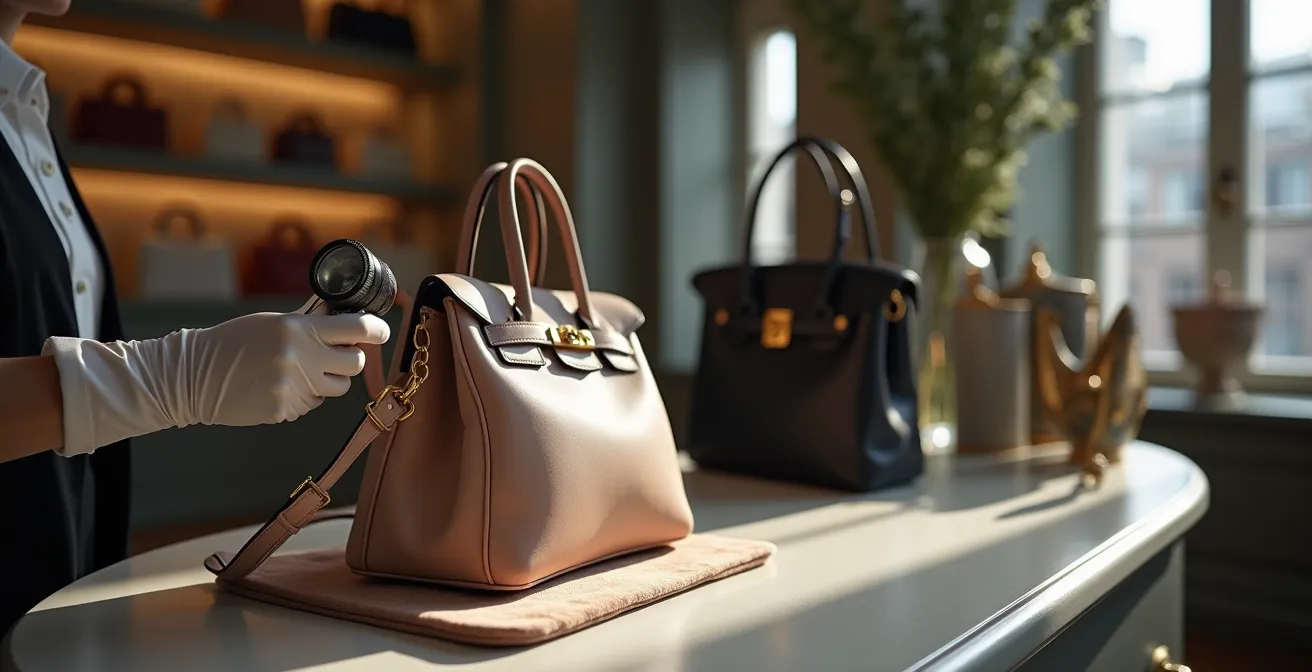
Investing in a pre-loved designer bag in London requires more than an eye for style; it demands the strategic mindset of a financial asset manager.
- Authentication goes beyond sight, using technology and even scent to unmask “superfakes” that fool the naked eye.
- A bag’s true value lies in its brand’s resale performance and limited-edition status, not just its retail price.
- Standard home insurance is a trap; it won’t cover your bag’s full value, making specialist cover non-negotiable.
Recommendation: Prioritise professional, tech-based authentication and secure specialist insurance *before* you buy to fully protect your asset.
The thrill is undeniable. You spot it across a curated Knightsbridge boutique: a vintage Hermès Kelly, its leather glowing softly under the lights. It’s the one. But as you reach for it, a cold wave of doubt washes over you. In a city like London, a global hub for luxury resale, how can you be absolutely certain it’s real? You’ve heard the standard advice, of course. “Check the stitching,” they say. “Feel the quality of the leather.” But in an era of “superfakes”—counterfeits so convincing they can fool even experienced eyes—these platitudes are not just outdated; they’re dangerous.
Buying a pre-loved designer handbag here isn’t merely a fashion purchase; it’s a significant financial investment. A misstep doesn’t just mean a style faux pas; it can mean a loss of thousands of pounds. This is why you must shift your perspective from that of a hopeful consumer to a discerning asset protector. The real keys to a smart purchase lie hidden from the average buyer. They are in the subtle olfactory signature of the bag, the specific market timing of your purchase, and the overlooked clauses in your home insurance policy.
This guide is designed to arm you with that professional mindset. We will move far beyond generic tips to decode the complex signals of authenticity and value in London’s unique market. We will explore how to identify investment-grade models, navigate the city’s best shopping spots, implement crucial care routines, and, most importantly, financially safeguard your new treasure against the unexpected. It’s time to learn how to buy with confidence, not just hope.
To help you navigate this complex world, this article breaks down the essential knowledge every savvy London buyer needs. The following sections will guide you step-by-step through the process of authenticating, selecting, and protecting your luxury handbag investment.
Summary: The Insider’s Handbook to London’s Luxury Resale Market
- Why the smell and symmetry of the stitching betray “Superfakes”
- How to choose a model that will retain 80% of its value on resale
- Vestiaire Collective or a physical boutique in Knightsbridge: where to find the rare gem?
- The mistake of storing a patent leather bag without its protective cover
- When to buy before the annual price increases of the major houses
- The online shopping error that costs amateur collectors £3,000
- Why the “Single Item Limit” leaves you without full reimbursement
- Why Standard Home Insurance Won’t Cover Your Luxury Jewellery Collection?
Why the smell and symmetry of the stitching betray “Superfakes”
In the world of high-end fakes, visual cues are no longer enough. Counterfeiters have mastered the look of luxury, but they consistently fail on the multisensory details. Your first, and perhaps most powerful, tool is your nose. An authentic luxury handbag has an olfactory signature—the rich, earthy scent of high-quality tanned leather. Superfakes, conversely, often exude a sharp, chemical odour from the cheap glues and synthetic materials used to cut costs. Trust this instinct; if it smells like a factory, it likely came from one.
Next, examine the stitching not just for neatness, but for its character. For brands like Hermès, the renowned saddle stitch is done by hand. This results in a subtle, almost imperceptible irregularity—a human touch that machines cannot perfectly replicate. The stitches will be slightly angled, not perfectly straight. Conversely, many fakes use machines that produce a flawless, uniform line of stitching, which ironically becomes the giveaway. For machine-stitched bags from houses like Chanel, look for an incredibly high stitch count per inch. Fakers often reduce this count to save time and money, resulting in a less durable and less refined finish.
However, relying solely on your senses is a high-stakes gamble. The modern investor delegates this critical task to technology. London’s top consignment stores have moved beyond the magnifying glass to embrace AI-powered authentication, which offers a definitive verdict.
Your Action Plan: Leveraging Tech for Authentication in London
- Assess AI Services: Research London services like Love Luxury, which uses Entrupy technology for microscopic-level analysis and provides verified certificates.
- Get a Professional Quote: Contact The Handbag Clinic for their authentication services, starting from just £34.95, which can be done via photo or in-store assessment.
- Compare Technologies: Look into boutiques like Sign of the Times in Chelsea, which combine machine learning authentication with the final verification of a human expert for dual-layer security.
- Analyse the Cost-Benefit: Compare the cost of a digital certificate (£35-£75) against the peace of mind it provides, versus a traditional Bond Street appraisal which can exceed £200.
- Demand Documentation: For any high-value piece, insist on a written authentication report that includes detailed photo documentation, creating an undisputed record of provenance.
Ultimately, these subtle cues are the fingerprints of true craftsmanship. Learning to read them is your first line of defence, but using professional, tech-based services is how you secure your investment like a professional.
How to choose a model that will retain 80% of its value on resale
A smart purchase in the pre-loved market is not about chasing trends; it’s about identifying assets with proven value retention metrics. While most designer goods depreciate the moment you leave the store, a select few defy this rule, acting more like art or fine wine. Your goal is to target these investment-grade pieces that consistently hold or even increase in value. This requires a shift from thinking “What’s in style?” to “What does the data say?”.

As the image suggests, assessing a bag’s condition is paramount to its value, but the model’s inherent market performance is the foundation. Some bags are simply blue-chip investments. The key is to study the resale market performance, where brands like Hermès and Chanel dominate due to their controlled scarcity and consistent price increases. Limited editions and collaborations are also strong contenders, as their rarity fuels intense demand among collectors. The data below from the UK market provides a clear picture of which models are assets versus those that are merely accessories.
This table, based on recent UK market data, illustrates the stark difference in performance between various luxury brands. According to an analysis of luxury resale statistics, certain models are not just purchases but appreciating assets.
| Brand & Model | Value Retention Rate | UK Market Performance |
|---|---|---|
| Goyard (All Models) | 104% | Appreciates above retail |
| Hermès Birkin/Kelly | 100% | Consistent demand |
| Chanel Classic Flap | 92% | Strong UK following |
| Louis Vuitton Limited Editions | 70-80% | Collaborations perform best |
| Celine Triomphe | 64% | Rising 16% year-on-year |
Case Study: The Power of Scarcity
The remarkable performance of miniature bags demonstrates this principle perfectly. The Louis Vuitton Speedy Mini HL, for example, has achieved a staggering 201% value retention. This success is not accidental; it is a direct result of limited production quantities, which makes these items incredibly difficult to source on the primary market. UK auction houses consistently report that these “micro bags” command premium prices, especially when sold with their original dust bags and receipts, which further validates their provenance and completeness.
By prioritising models with a track record of high value retention, you transform a luxury purchase into a strategic financial decision, ensuring your handbag is an asset that works for you.
Vestiaire Collective or a physical boutique in Knightsbridge: where to find the rare gem?
The London buyer is faced with a classic dilemma: the seemingly infinite digital shelf of an online marketplace versus the curated, tangible experience of a brick-and-mortar boutique. Platforms like Vestiaire Collective offer an unparalleled breadth of choice, connecting you to sellers globally. You might find a rare piece from a past season that’s long gone from stores. However, this convenience comes with a trade-off. You can’t touch, smell, or inspect the bag in person before purchase, placing your trust entirely in photos and the platform’s authentication process.
In contrast, London’s “Consignment Triangle”—the area encompassing Knightsbridge, Chelsea, and South Kensington—offers a different kind of luxury. Here, you can build a relationship with expert buyers. Boutiques like Sign of the Times provide a high-touch service, combining decades of experience with cutting-edge technology to guarantee authenticity. As they state themselves:
Having been in the business since 1976 you can trust SOTT to find you the bag of your dreams. We authenticate using the latest machine learning technology and are here to take all the stress out of what should be a truly enjoyable and luxurious purchase.
– Sign of the Times, London’s Chelsea luxury consignment boutique
This hands-on approach allows you to inspect the bag’s condition meticulously, feel the weight of the hardware, and verify its quality firsthand. For a first-time investor, this in-person validation is invaluable. To make the most of this experience, a strategic approach to your shopping trip is essential.
- Sign of the Times (Chelsea): Your primary destination for current season Hermès and Chanel, backed by robust machine learning authentication.
- Love Luxury (Multiple locations): A key stop for its focus on high-demand Hermès and exotic skins, with the assurance of Entrupy authentication.
- Designer Exchange (Knightsbridge since 2013): As the UK’s largest preloved retailer, it’s a must-visit for variety, featuring a ‘Double Lock Authentication’ process.
- Mapping Tip: Start your journey at Sloane Square, walk down the iconic King’s Road to Chelsea, and then loop back via Knightsbridge to cover the key boutiques efficiently.
- Timing is Everything: Visit on Tuesday to Thursday mornings to see new arrivals before the crowds. Avoid weekends if you desire personalised, unhurried service from the staff.
For the novice buyer, the peace of mind and expert guidance offered by a reputable London boutique often outweigh the vast but impersonal nature of online marketplaces. It’s about buying the seller before you buy the bag.
The mistake of storing a patent leather bag without its protective cover
Acquiring your investment-grade handbag is only half the battle; preserving its value is an ongoing commitment. The most common and costly mistake collectors make is improper storage. A bag left exposed on a shelf, particularly in London’s notoriously humid climate, is a ticking time bomb. Patent leather is especially vulnerable to colour transfer, while untreated vachetta leather on Louis Vuitton bags will darken unevenly if exposed to light and moisture. A simple dust bag is not just a branded accessory; it is your first and most effective line of defence.
This is where the financial implications become stark. A bag that has been stored improperly will show significantly more surface damage, from micro-scratches to discolouration. This damage directly erodes its resale value, potentially by hundreds or even thousands of pounds. Professional restoration can work wonders, but it comes at a cost. The goal is preservation, not restoration.
Case Study: The Financial Impact of Proper Care
The Handbag Clinic, a leading restoration service with a presence in Selfridges, provides a clear case for preventative care. Their data shows that a professional restoration service, which can cost around £500 for vintage Chanel or Hermès pieces, can increase the bag’s market value by £1,500-£2,000. Crucially, their analysis reveals that bags stored without dust bags exhibit 40% more surface damage, especially in a humid city like London. This damage often requires more extensive and costly restoration, turning a preventable issue into a significant expense.
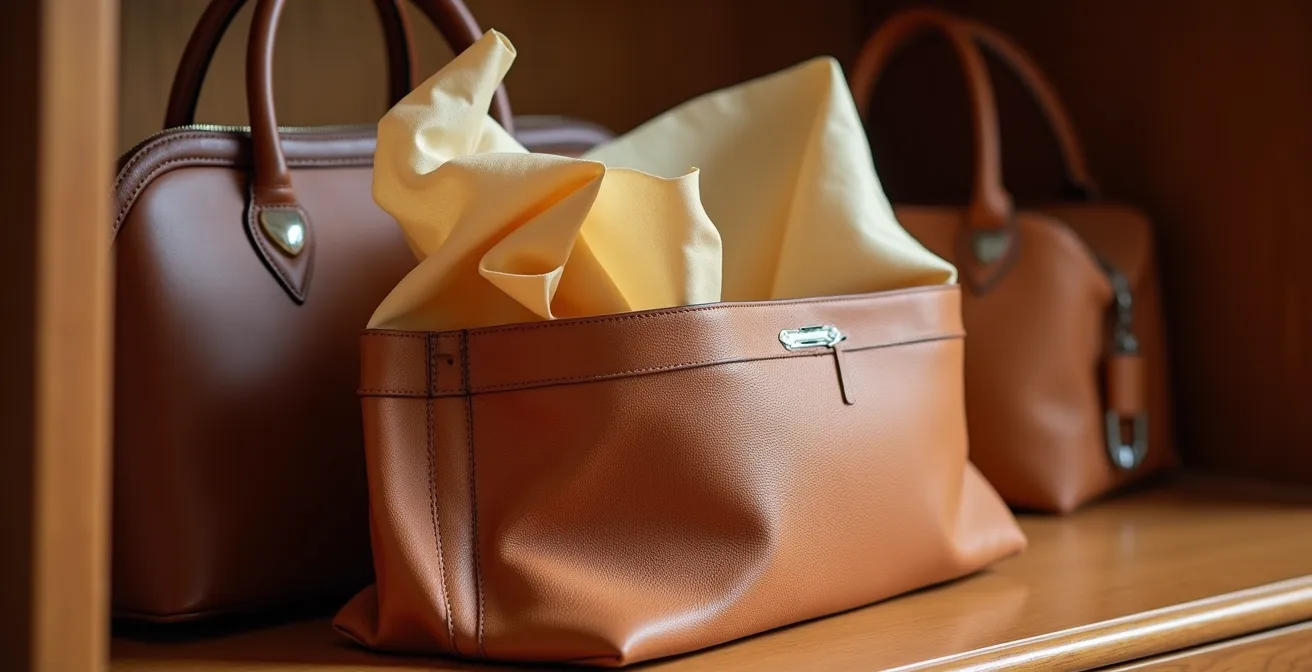
To avoid these pitfalls and maintain your bag in pristine, investment-grade condition, adopting a storage ritual specific to the UK climate is non-negotiable.
- Always store bags in their original dust bags or a breathable cotton alternative to prevent moisture from getting trapped.
- Stuff your bags with acid-free tissue paper to maintain their shape. Never use newspaper, as the ink can transfer and cause permanent stains.
- Invest in a dehumidifier for your storage area. London’s average 70% humidity can accelerate leather degradation and tarnish hardware.
- Store bags upright on a shelf. Never stack them or hang them by their handles, which causes permanent stretching and strain on the straps.
- Apply a quality leather conditioner, such as Lexol, sparingly every 3-4 months to keep the leather supple and prevent cracking.
By treating storage as an essential part of ownership, you are not just caring for a bag; you are actively protecting the future value of your financial asset.
When to buy before the annual price increases of the major houses
Strategic timing is a hallmark of the professional buyer. The world of luxury is not static; brands like Chanel and Hermès are known for implementing significant, often bi-annual, price increases. For the savvy investor, these scheduled hikes are not a threat but an opportunity. Buying a pre-loved, investment-grade bag just before a price increase can result in an instant boost to your asset’s value, as the entire market adjusts upwards in its wake.
The key is to understand the rhythm of the market. UK luxury brands typically announce their price adjustments in February and September. This creates a “golden window” of opportunity. In the two to three weeks following the announcement, the primary market prices have risen, but the pre-owned market often lags slightly before it fully recalibrates. This is the moment to act. Furthermore, post-Brexit dynamics have introduced a new layer of strategy: currency arbitrage.
Case Study: Post-Brexit Arbitrage and Market Timing
A detailed analysis of the UK luxury market reveals unique timing advantages. When the British Pound (GBP) strengthens against the Euro (EUR) by as little as 3-4%, London boutiques can temporarily offer better value than their Parisian counterparts, even without a VAT reclaim. Astute buyers actively track exchange rates on platforms like XE.com and time their purchases for when the GBP/EUR rate is favourable (e.g., above 1.18). This strategic timing, combined with purchasing before an annual price hike, maximizes the investment potential of the acquisition.
Even with aggressive price increases, the most sought-after bags maintain their desirability. Chanel, for example, demonstrates incredible resilience. This brand power means that buying a classic piece is a consistently strong move, as its value is buoyed by the ever-increasing retail price of new models.
By aligning your purchase with these market cycles and currency fluctuations, you are no longer just buying a handbag; you are executing a timed investment based on predictable financial events.
The online shopping error that costs amateur collectors £3,000
In the excitement of finding a deal on a European marketplace, many London-based buyers are falling into a costly post-Brexit trap. Before 2021, purchasing from a seller in Paris or Milan was seamless. Today, any item purchased from the EU with a value over £135 is subject to UK import duties, and the final bill can be a shocking surprise. This isn’t a small fee; it’s a 20% Value Added Tax (VAT), plus a handling fee from the courier (typically £12-£25) for processing the customs paperwork.
Let’s break down the “£3,000 mistake.” Imagine you find your dream bag on a European site for what seems like a reasonable £3,000. You make the purchase, and a week later, you receive a notice from Royal Mail or another courier. Before they can deliver your parcel, you must pay an additional £600 in VAT (20% of £3,000) plus a £25 handling fee. Your £3,000 bag has just become a £3,625 bag, instantly wiping out any perceived savings. For an amateur collector, this unexpected cost can be devastating.
Most designer handbags depreciate around 30% immediately when purchased new, similar to buying a new car. However, certain bags buck this trend entirely, with Hermès pieces selling for 120-150% of their original price.
– KYM London, UK authenticated luxury reseller market analysis
This quote underscores the importance of every pound spent. Wasting over £600 on unforeseen taxes is a critical error when the goal is investment. To avoid this costly mistake, you must be meticulous in your online purchasing strategy.
- Calculate the True Cost: Before clicking “buy” on any item from an EU seller, always add 20% for VAT and an estimated £25 handling fee to determine the final price.
- Prioritise UK Fulfilment: Favour platforms like Vestiaire Collective that have UK-based fulfilment centres. If an item is already in the UK, you will not face these import charges.
- Insist on Accurate Declarations: Never ask a seller to undervalue an item to avoid tax. This is illegal and risks your bag being seized by customs, resulting in a total loss and potential penalties.
- Use a Broker for High-Value Items: For exceptionally expensive pieces, consider using a specialist import broker who can manage the entire customs and duty process, ensuring full compliance and no surprises.
By being aware of these cross-border costs, you can shop globally from London with confidence, ensuring your great find remains a great investment.
Why the “Single Item Limit” leaves you without full reimbursement
You’ve authenticated and purchased your dream bag. You store it perfectly. But the biggest financial risk may be lurking in a document you’ve probably never read closely: your home insurance policy. A standard UK contents insurance policy is designed to cover everyday items, not high-value luxury goods. The critical clause to understand is the “Single Item Limit” (SIL). This is the maximum amount an insurer will pay out for any single item that is lost, stolen, or damaged, unless it has been specified separately.
This limit is often shockingly low, typically ranging from £1,000 to £2,000. This creates a dangerous “insurance gap” for any luxury handbag owner. If your £8,000 Chanel Classic Flap is stolen during a burglary, your standard policy might only reimburse you £1,500, leaving you with a staggering £6,500 loss. The emotional devastation is compounded by a severe financial blow you mistakenly thought you were protected from.
Case Study: The £4,000 Insurance Gap Reality
A recent analysis by GoCompare highlights this danger with a stark example. A £6,000 Hermès Constance bag stolen from a home would only receive a payout of £2,000 under a typical policy with that single item limit. The owner is left £4,000 out of pocket. The analysis points out that while adding ‘specified items’ coverage is an option, it is a crucial step that most policyholders overlook. It is your responsibility to inform the insurer, not their responsibility to ask.
Closing this insurance gap is not just advisable; it is an essential step in protecting your asset. Fortunately, securing proper coverage is a straightforward process if you know what to do.
- Review Your Policy Immediately: Find your current home insurance documents and identify the single item limit. It is usually found in the policy summary.
- Specify High-Value Items: Contact your insurer and list any bag worth more than the single item limit as a ‘specified item’. You must declare its value individually.
- Provide Proof of Value: To specify an item, you will need to provide evidence of its worth. This includes purchase receipts, professional valuation certificates, and detailed photographs.
- Consider Specialist Insurers: For a growing collection, it may be more cost-effective to use a specialist insurer like Assetsure, who offers policies designed for luxury goods, often with no excess on claims.
- Add ‘Personal Possessions’ Cover: Ensure your policy includes cover for items taken outside the home. This is vital for any bag you intend to use daily.
Treating your handbag as a specified asset for insurance purposes is the final, non-negotiable step in transforming it from a simple purchase into a fully protected investment.
Key takeaways
- True authentication goes beyond sight, leveraging technology and even scent to unmask sophisticated fakes.
- The smartest investments are in bags with proven high value-retention rates, turning a purchase into an appreciating asset.
- Standard home insurance is a trap; the ‘Single Item Limit’ means you must specify your bag or risk a massive financial loss.
Why Standard Home Insurance Won’t Cover Your Luxury Jewellery Collection?
The insurance pitfalls we’ve detailed for luxury handbags are not an isolated issue; they represent a fundamental flaw in how standard insurance policies treat all high-value personal items. If your £8,000 handbag is underinsured, it is almost certain that your luxury jewellery—be it a Cartier Love bracelet, a Rolex watch, or vintage family heirlooms—is facing the exact same, if not greater, financial risk. The principle of the Single Item Limit applies universally, and the total value of a jewellery collection can quickly and vastly exceed the paltry limits of a standard policy.
Insurers view these items as ‘high-risk’ due to their value and portability, and they are therefore often excluded from standard cover unless explicitly declared. The rising value of luxury goods has made this problem more acute. As one leading UK insurer noted, the value of what people carry with them has skyrocketed. Indeed, an analysis of 2024 UK insurance claims found that the average handbag claim has risen significantly.
The average handbag claim has risen to £1,940 in 2024, with one in five claims now exceeding £3,000. The everyday handbag has become a high-value item.
– Aviva UK, 2024 UK Insurance Claims Analysis
This trend is a clear warning sign for owners of any luxury goods. Relying on your default home insurance is an act of financial negligence. The only robust solution is to secure a policy designed for the specific nature of these assets. The difference between standard and specialist cover is not incremental; it is fundamental.
| Coverage Type | Standard Home Insurance | Specialist Collection Insurance |
|---|---|---|
| Single Item Limit | £1,000-£2,000 | Up to £100,000 |
| Total Valuables Limit | £7,500-£10,000 | £1million+ |
| Worldwide Coverage | Limited/Extra Cost | Included |
| Accidental Damage | Usually Excluded | Included |
| Annual Cost (£50k collection) | Not Available | £400-£600 |
Your journey into luxury ownership demands a parallel journey into financial responsibility. The final step is to conduct a full audit of your valuables and engage a specialist insurer to create a policy that provides ‘agreed value’ coverage, ensuring that in the event of a loss, you are made whole, not left with a fraction of your asset’s true worth.