In summary:
- Translate your vision into a practical mood board focusing on specific components, not just finished rings.
- Identify true manufacturers by asking about their on-site workshop and maker’s marks, avoiding simple resellers.
- Understand the cost and design implications of manufacturing choices like lost-wax casting versus hand-forging.
- Budget for stone setting as a separate, significant cost, especially for complex designs like pavé.
- Leverage “value arbitrage” tactics, such as accepting slight fluorescence in a diamond, to significantly reduce the stone’s price.
Stepping into Hatton Garden to commission a bespoke ring can feel intimidating. The sheer density of glittering windows and the weight of tradition can overwhelm even the most prepared buyer. Standard advice tells you to “set a budget” and “know the 4Cs,” but this is merely the ticket to entry. It doesn’t give you a seat at the table with the master craftsmen. Most articles talk about finding a reputable jeweller, but they fail to explain how to distinguish a true artisan manufacturer from a polished reseller with a high mark-up.
The common wisdom is to bring inspiration, but what does that truly mean? A Pinterest board of finished rings is a start, but it’s not the language a goldsmith speaks. The real conversation, the one that saves you money and results in a truly unique piece, happens on a much deeper level. It’s about deconstructing design into its core elements and understanding the specific, non-obvious trade-offs that create value.
This guide is your insider’s handbook. We will go beyond the platitudes to reveal the strategic decisions that separate a good-value, master-crafted piece from an overpriced, generic one. We’ll explore the ‘manufacturer’s DNA’—the tangible signs of a real workshop. We will delve into how a nuanced understanding of materials, like a diamond with slight fluorescence, can become your greatest budget ally. This isn’t just about buying a ring; it’s about mastering the art of commissioning jewellery in London’s most famous district. We’ll even touch upon the hallmarks of craftsmanship in related fields, like luxury watches, and the crucial final step of preserving your investment, because a true connoisseur’s knowledge is holistic.
This article will guide you through the critical checkpoints of the bespoke journey. Discover the questions you should be asking and the details you should be looking for to navigate Hatton Garden with the confidence of a seasoned diamond broker.
Contents: The Discerning Buyer’s Handbook to Hatton Garden
- Why bringing inspiration photos saves time and money?
- How to distinguish a true manufacturer from a simple reseller in Hatton Garden?
- Lost-wax casting or hand-forging: which technique for your design?
- The mistake of forgetting the cost of stone setting in the initial budget
- Budget problem: how a slightly fluorescent stone can reduce the price by 20%?
- Boutique officielle ou revendeur spécialisé : où acheter sans risque de blacklistage ?
- How to distinguish a hand-guillochéd dial from an industrial stamping?
- Laser Welding vs. Torch Soldering: Which Method Saves Your Antique Ring?
Why bringing inspiration photos saves time and money?
Arriving at a consultation with a folder of images seems obvious, but the strategic value is often misunderstood. It’s not about asking a jeweller to copy a design; it’s about providing a visual shorthand that accelerates the entire process. A jeweller can translate an image into technical specifications—band width, stone size, setting style—far quicker than they can interpret vague verbal descriptions. This efficiency directly translates into fewer design revisions and lower design-hour costs. However, the most effective inspiration goes beyond generic ring photos.
To truly collaborate with a craftsman, think in terms of design granularity. Instead of just one ring, bring images of architectural details from London landmarks like the Royal Arcade for structural ideas, or fabric swatches for texture. This provides a richer, more unique starting point. As the renowned Hatton Garden jeweller Harper Tait demonstrates in their collaborative 4-step custom process, the goal is to tell a personal story through the design, not replicate an existing one. Building a mood board that captures a feeling, an era, or a texture invites the jeweller to become a creative partner, leading to a more personal and often more cost-effective result.
This focused approach allows you to have a much more specific conversation about cost. You can ask questions like, “This is the profile I love, but what’s the price difference between a 2.5mm and a 1.9mm band width?” This is the language of value arbitrage.
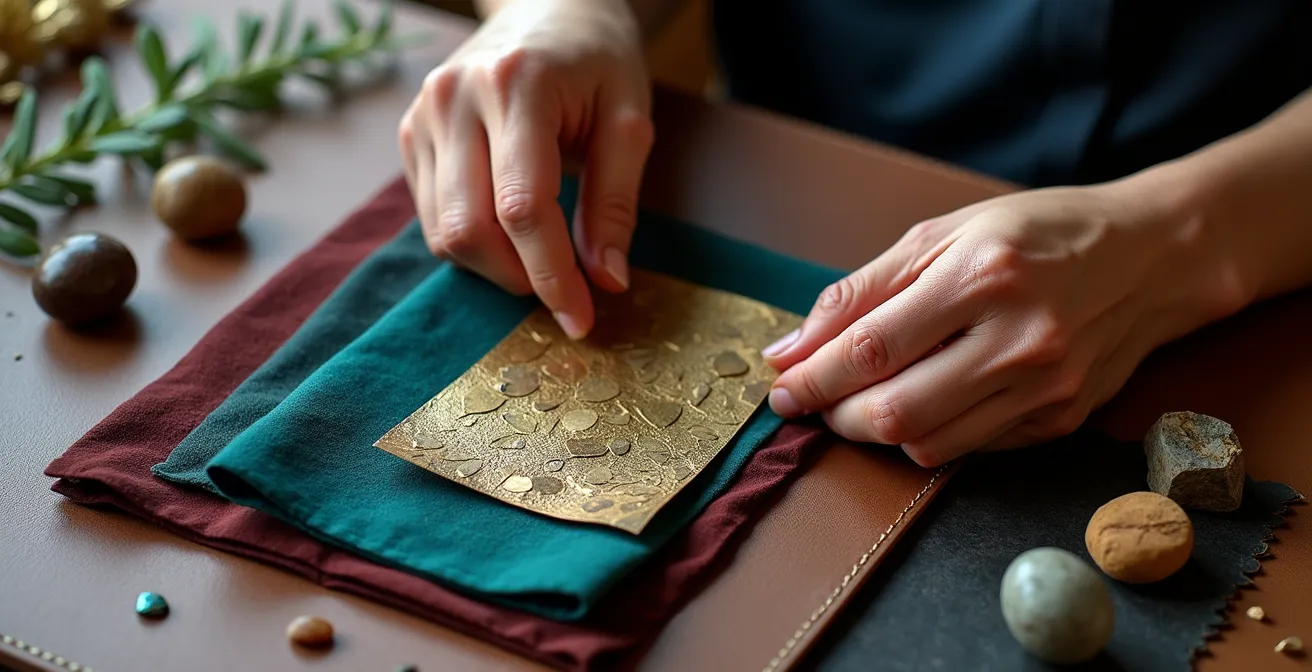
As you can see, the most productive consultations are built on a foundation of specific visual components. A collection of textures, shapes, and finishes allows the jeweller to understand your aesthetic DNA and propose solutions that perfectly match your vision and budget. By preparing this way, you move from being a passive customer to an active director of your project.
How to distinguish a true manufacturer from a simple reseller in Hatton Garden?
Hatton Garden has two main types of businesses: true manufacturers with on-site workshops and retail-fronted resellers who outsource production. While both can sell beautiful jewellery, dealing directly with the maker offers significant advantages in customisation, quality control, and often, price. A reseller adds a layer of communication and a mark-up, whereas a manufacturer gives you direct access to the artisan. Spotting the manufacturer’s DNA is a key skill for any discerning buyer.
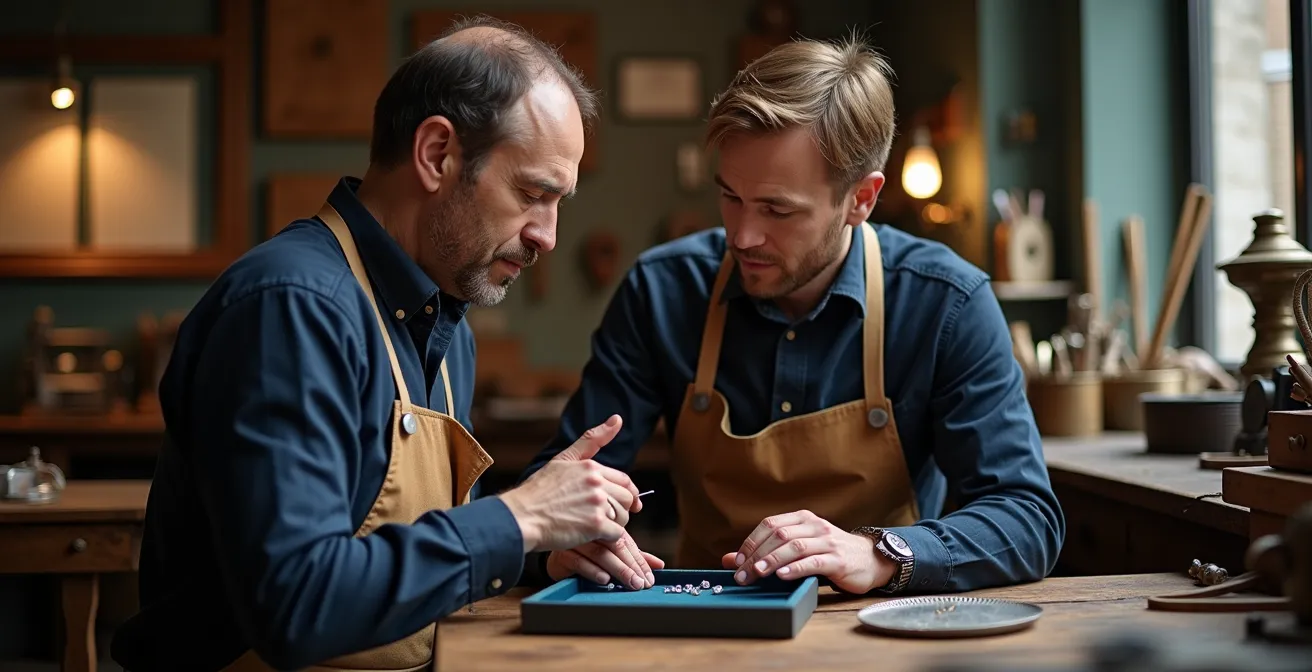
The first clue is sensory. A real workshop has a distinct atmosphere; you might hear the faint hum of a polishing motor or the rhythmic tap of a hammer. The air often smells of metal and polishing compounds. A silent, pristine showroom is a potential red flag. Ask directly, “Is your workshop on-site?” A true maker will be proud to discuss their craft space. Look for physical evidence of production: benches with well-worn tools, sketches, and wax models. Some, like the private studio Blackacre, build their entire reputation on this in-house, deeply personal design journey, setting them apart from purely commercial operations.
The definitive proof, however, is in the hallmarking. Ask to see their maker’s mark (also known as a sponsor’s mark), a unique set of initials registered with an Assay Office. For pieces made in London, you should also look for the iconic leopard’s head of the London Assay Office. A genuine manufacturer will be able to explain these marks with expertise and pride. A reseller may be vague or need to “check with the workshop,” indicating a disconnect from the creation process.
Your Checklist: Key Questions to Identify True Hatton Garden Manufacturers
- Ask ‘Is your workshop on-site?’ – True makers will proudly discuss their craft space.
- Listen for ambient sounds of polishing motors or hammering – complete silence is a red flag.
- Request to see their maker’s mark and an explanation of the London Assay Office hallmarks.
- Look for the iconic leopard’s head mark, which is specific to jewellery assayed in London.
- Ask to see process documentation: sketches, CAD renderings, wax models, or work-in-progress shots.
Lost-wax casting or hand-forging: which technique for your design?
Once you’ve found your manufacturer, the next technical decision is how your ring will be made. The two primary methods are lost-wax casting (often aided by CAD/3D printing) and traditional hand-forging. Neither is inherently “better,” but each is suited to different designs, timelines, and budgets. Understanding this choice is fundamental to controlling the outcome and cost of your bespoke piece.
Lost-wax casting is the go-to method for complex, intricate, or organic designs. If your vision includes detailed filigree, delicate vintage patterns, or sculptural shapes, casting is the most effective and often the only feasible technique. The process involves creating a perfect wax model of the ring (either hand-carved or 3D-printed from a CAD file), which is then encased in plaster and burnt out to create a mould for molten metal. This allows for unparalleled detail and the creation of multiple identical pieces if needed.
Hand-forging, by contrast, is the art of working metal directly. A jeweller will heat, hammer, bend, and file a piece of precious metal wire or ingot into its final shape. This technique is ideal for simpler, classic designs like solitaires and wedding bands. Forging creates a very dense and durable metal structure. For minimalist designs, it can sometimes be more cost-effective as it bypasses the CAD design and 3D printing stages. Your choice will depend entirely on the structural needs of your desired design.
The following table, based on an analysis of bespoke manufacturing techniques, breaks down the key differences to help you discuss the options with your jeweller.
| Technique | Best For | Timeline | Cost Factor |
|---|---|---|---|
| Lost-Wax Casting (CAD) | Intricate designs, vintage filigree, organic shapes | 3-4 weeks | More cost-effective for complex designs |
| Hand-Forging | Simple solitaires, classic bands, minimalist designs | 2-3 weeks | Often cheaper for simple bands (bypasses CAD process) |
The mistake of forgetting the cost of stone setting in the initial budget
One of the most common and costly mistakes in commissioning a bespoke ring is treating the budget as a single lump sum. A savvy buyer understands that the final price is an assembly of components: the metal, the main stone, and the labour. Within that labour, stone setting is a distinct, specialised skill and a separate line item on your invoice. Overlooking this can lead to a budget blowout, especially with complex designs.
The cost of setting is not trivial. It’s a function of time, risk, and complexity. A simple four-prong solitaire setting for a diamond is the baseline. However, the price escalates dramatically for more intricate work. A pavé setting, which involves setting dozens of tiny stones, requires immense precision and hours of a master setter’s time. A halo can add hundreds of pounds to the final cost. According to workshop price lists, London stone setting fees can range from £70-£150 for a standard solitaire but can easily exceed £500 for a complex pavé halo.
Furthermore, the type of stone impacts the price. Setting a robust diamond carries less risk than setting a fragile emerald, which can chip under pressure. An experienced setter will factor this risk premium into their fee. To avoid surprises, you must ask for a line-item breakdown of all costs. Confirm if the quote includes setting for *all* stones and whether the setting is done in-house or outsourced, as this can also affect the price and timeline.

The setter’s work is the final, crucial step that secures your investment and brings the design to life. It is a testament to the highest level of craftsmanship. Budgeting for it explicitly from the start ensures your design ambitions don’t clash with financial reality at the final hurdle.
Budget problem: how a slightly fluorescent stone can reduce the price by 20%?
When working with a tight budget, the default advice is to compromise on the 4Cs—usually colour or clarity. However, a far more sophisticated strategy of value arbitrage involves a fifth, often misunderstood characteristic: fluorescence. Diamond fluorescence is the glow, typically blue, that some diamonds emit when exposed to ultraviolet (UV) light. In the past, it was viewed negatively, creating a market inefficiency that a smart buyer can exploit today.
The key insight is that for colourless diamonds (in the D-F range), the presence of medium to strong blue fluorescence can make the stone appear even whiter in certain lighting conditions, counteracting any faint yellow tints. Yet, because of historical market prejudice, these stones are often discounted. According to a detailed market analysis by diamond educators, colorless diamonds with fluorescence can sell at up to a 15% discount compared to their non-fluorescent counterparts. In some cases, for stones with very strong fluorescence, this discount can approach 20%. For a buyer, this is a pure win: you get a stone that looks visually identical or even better, for a significantly lower price.
This principle of finding value where others don’t look extends to other areas. The rise of high-quality lab-grown diamonds, now widely available from top dealers in Hatton Garden, offers another path. These stones are chemically and optically identical to mined diamonds but can offer cost savings of 40-60%. This allows a buyer to either get a much larger or higher-quality stone for the same budget or reinvest the savings into a more complex setting or higher-purity metal. By understanding these market nuances, you move beyond being a simple buyer and become a strategic investor in your own piece.
Boutique officielle ou revendeur spécialisé : où acheter sans risque de blacklistage ?
While your journey might start with a ring, the world of luxury craftsmanship often extends to horology. Here, too, London presents a landscape of official boutiques and independent specialists, particularly in areas like the Burlington Arcade. The question of where to buy a high-end watch is not just about price; it’s about your future relationship with the brand. Buying from an “Official Boutique” or an “Authorised Dealer” (AD) guarantees authenticity and, crucially, places you on the brand’s official client list.
This is vital for highly sought-after models where demand far outstrips supply. Building a purchase history with an AD is often the only way to get access to exclusive or limited-edition pieces in the future. Buying from an unauthorised or “grey market” dealer might offer an immediate discount on a less popular model, but it comes with a risk. The watch’s warranty might not be honoured by the brand, and you will have no official purchase history. For certain high-end brands, being found to have flipped a watch bought from an AD can even lead to being “blacklisted,” effectively cutting you off from future purchases.
A specialised independent reseller, however, is different from a grey market dealer. They may be the best source for rare, vintage, or discontinued models that are no longer available through official channels. The key is transparency and expertise. A reputable specialist will have in-house watchmakers, offer their own warranty, and provide detailed provenance. For a new model from a current collection, the AD is the safest path. For a unique vintage piece, a trusted specialist is your best ally.
How to distinguish a hand-guillochéd dial from an industrial stamping?
As you develop an eye for craftsmanship, you begin to notice the subtle details that signify true luxury. In watchmaking, one of the most revered and often imitated crafts is guilloché, a traditional technique of engraving intricate, repetitive patterns onto a surface. A genuine hand-turned guilloché dial is a work of art, while an industrial stamping is a mere imitation. Knowing the difference is a definitive “craftsmanship tell”.
The primary distinction lies in the quality of the lines and the play of light. A dial engraved by hand on a rose engine lathe has lines that are incredibly sharp, clean, and deep. When you tilt the watch in the light, the patterns come alive with a mesmerising, almost liquid shimmer. The intersecting lines create crisp, geometric points. The effect is one of unmatched depth and precision. Famous artisans like Vacheron Constantin or Breguet are masters of this art, and their dials have a visual richness that cannot be faked.
Industrial stamping, on the other hand, presses a pattern into a soft metal dial. The process rounds and softens the edges of the lines. They lack the sharpness and depth of true guilloché. The play of light is duller, and the patterns can appear flat or muddy by comparison. While a high-quality stamping can still be attractive, it lacks the soul and the dynamic, three-dimensional quality of the hand-made original. When examining a watch, look for the sharpness of the pattern’s peaks and valleys. If they are crisp and catch the light with vibrant energy, you are likely looking at the real thing.
Key Takeaways
- True value comes from mastering insider trade-offs, not just negotiating on the final price.
- Distinguishing a true manufacturer from a reseller by looking for on-site workshops and maker’s marks is your most powerful move.
- Budget for stone setting as a separate, critical cost, and ask for a line-item breakdown to avoid surprises.
Laser Welding vs. Torch Soldering: Which Method Saves Your Antique Ring?
Your journey into the world of fine jewellery doesn’t end at the point of purchase. It extends into a lifetime of care and, eventually, preservation. This is especially true for antique pieces, whose delicate structures and unique patinas require a master’s touch. When it comes to repair, particularly for resizing or fixing a fragile setting, the choice between traditional torch soldering and modern laser welding is a critical one that can determine the survival of the piece.
Traditional torch soldering involves using a flame to heat a large area of the ring to melt solder and join metal parts. While effective for robust, modern pieces, it’s a high-risk procedure for antiques. The extensive heat can damage delicate filigree, discolour or even crack heat-sensitive stones like emeralds or opals that are close to the join, and destroy the original patina that gives the piece its character. The “heat-affected zone” is large and difficult to control.
Laser welding, in contrast, is a technology of immense precision. It uses a focused beam of light to melt a tiny, targeted point of metal, creating a strong weld with a minimal heat-affected zone. A skilled operator can rebuild a worn-down prong right next to a fragile antique gemstone without ever having to un-set it. This makes it the superior—and often only—safe method for repairing intricate antique jewellery, preserving both its structural integrity and its historical character. For any piece with delicate details or heat-sensitive stones, insisting on laser welding is non-negotiable for a safe and invisible repair.
Apply these insider principles on your next visit to Hatton Garden. By doing so, you can move beyond the surface-level negotiation and engage with artisans on their own terms, commissioning a piece with confidence, clarity, and the assurance of true value.