From a UK investment perspective, neither lab-grown nor natural diamonds perform well as a store of value compared to alternative assets, due to massive initial depreciation and poor market liquidity.
- Lab-grown diamonds offer a low entry cost but suffer from extreme value loss (up to 90%), making their secondary market value almost negligible.
- Natural diamonds, while retaining more relative value, incur a higher absolute cash loss upon resale and are illiquid assets subject to Capital Gains Tax.
Recommendation: For pure financial growth, a tax-efficient Stocks & Shares ISA is superior. For a tangible luxury asset that holds value, select Swiss timepieces like Rolex offer significantly better liquidity and appreciation potential in the London market.
When considering a significant purchase like a diamond, the conversation often splits into two camps: the timeless allure of a natural, earth-mined stone versus the modern, ethical appeal of its lab-grown counterpart. For a UK-based couple or investor, this decision is frequently framed around romance, ethics, and budget. The common advice suggests natural diamonds are a “better investment” because they hold value, while lab-grown stones are an affordable, conscious choice.
However, this perspective is fundamentally flawed when viewed through a serious financial lens. The critical mistake is treating a diamond purchase like a typical investment without scrutinizing its actual performance as an asset class. To make an informed decision, one must move beyond the showroom sales pitch and analyse these stones as a UK investor would: by evaluating their true total cost of ownership, market liquidity, depreciation curve, and performance against more viable alternative assets.
What if the key to this decision isn’t choosing the “right” diamond, but understanding that from a purely financial standpoint, both might be the wrong asset? This analysis will deconstruct the value proposition of each type of diamond, compare them to other luxury goods like high-end watches, and benchmark them against a standard UK investment vehicle like a Stocks & Shares ISA. We will explore the financial realities that jewellers rarely discuss, providing a clear framework for allocating your capital wisely.
This guide provides a clear-eyed, data-driven comparison to help you understand the true financial implications of your choice. Explore the sections below to delve into the critical factors that determine real-world value in the UK luxury market.
Summary: Lab-Grown vs. Mined Diamonds: An Investment Analysis
- Why does a lab-grown diamond lose 90% of its value on immediate resale?
- How does the Kimberley Process sometimes fail to guarantee “conflict-free”?
- Can an untrained eye tell the difference between Moissanite and Diamond?
- The mistake of unknowingly buying a “glass-filled” sapphire.
- The size issue: choosing a stone just under the carat mark (0.90ct) to save 20%.
- Rolex or Patek Philippe: which brand offers the best liquidity in London?
- The mistake of believing “100% recycled” means infinitely recyclable.
- Why Invest in Luxury Timepieces Instead of ISA Savings Accounts?
Why does a lab-grown diamond lose 90% of its value on immediate resale?
The primary financial shock for owners of lab-grown diamonds comes from their precipitous depreciation. Unlike assets that appreciate or hold their value, a lab-grown diamond is best understood as a consumer durable good, much like a car; its value plummets the moment it leaves the showroom. The core reason is one of supply and demand. As technology improves, the cost to produce lab diamonds continues to fall, and supply is theoretically infinite. This creates a secondary market where there is no incentive to buy a used lab diamond when a new one with identical specifications can be purchased for a comparable, or even lower, price.
This isn’t a minor dip in value. While natural diamonds also face significant depreciation from retail prices, the curve for lab-grown stones is far steeper. Projections from recent market data reveal that lab diamonds may retain only 30-40% of their purchase price by 2025, compared to 60-80% for their natural counterparts. This means a lab diamond purchased for £2,000 today might only be worth £600-£800 on the secondary market in a year’s time, if a buyer can be found at all. The market is not structured to support resale, with few jewellers willing to buy back stones they cannot sell at a profit against ever-cheaper new inventory.
Case Study: The Reality of Lab Diamond Resale
Consider the real-world example of Sarah, who purchased a 2-carat, F-colour, VS1 lab-grown diamond for her engagement ring in the UK for approximately £1,900 ($2,400) in early 2023. When her circumstances changed 18 months later, she sought to sell the stone to cover expenses. After approaching multiple jewellers in London and online marketplaces, the highest offer she received was £250. This represents a staggering 87% loss of value, demonstrating the typical depreciation pattern and the lack of a robust secondary market for these stones in the UK.
This financial reality positions lab-grown diamonds as a purchase for aesthetic and ethical value, but not financial retention. The “investment” is in the enjoyment of the piece, not in the stone as a tangible asset. For anyone factoring resale value into their decision, this immediate and profound loss is the most critical data point to consider.
How does the Kimberley Process sometimes fail to guarantee “conflict-free”?
For decades, the primary ethical concern for diamond buyers has been “blood diamonds”—stones sold to fund wars and rebel movements. The Kimberley Process Certification Scheme (KPCS) was established in 2003 to combat this by certifying rough diamond shipments as ‘conflict-free’. While it has had considerable success in reducing the trade of overt conflict diamonds, from an investor’s and a conscious consumer’s perspective, its guarantee is dangerously narrow and contains significant loopholes.
The scheme’s definition of a conflict diamond is limited to stones used by rebel groups to fight legitimate governments. It does not cover human rights abuses, violence, or environmental degradation perpetrated by the governments themselves. This means that diamonds mined in conditions of state-sanctioned violence, forced labour, or unsafe working environments can still be certified as “conflict-free” and legally enter the global market, including the UK. Critics argue the KPCS provides a veneer of ethical assurance while ignoring a wide spectrum of harm.
Furthermore, the physical risks of mining remain a significant ethical consideration that the KPCS does not address. Even in well-regulated mines, the process is inherently dangerous. According to workplace safety statistics that show at least one documented injury per 1,000 workers annually, the human cost of extraction is non-zero. While this is a separate issue from armed conflict, it forms part of a broader ethical calculation for buyers weighing the true impact of their purchase. The term “conflict-free” can therefore create a false sense of comprehensive ethical purity, masking other serious concerns inherent in the natural diamond supply chain.
Can an untrained eye tell the difference between Moissanite and Diamond?
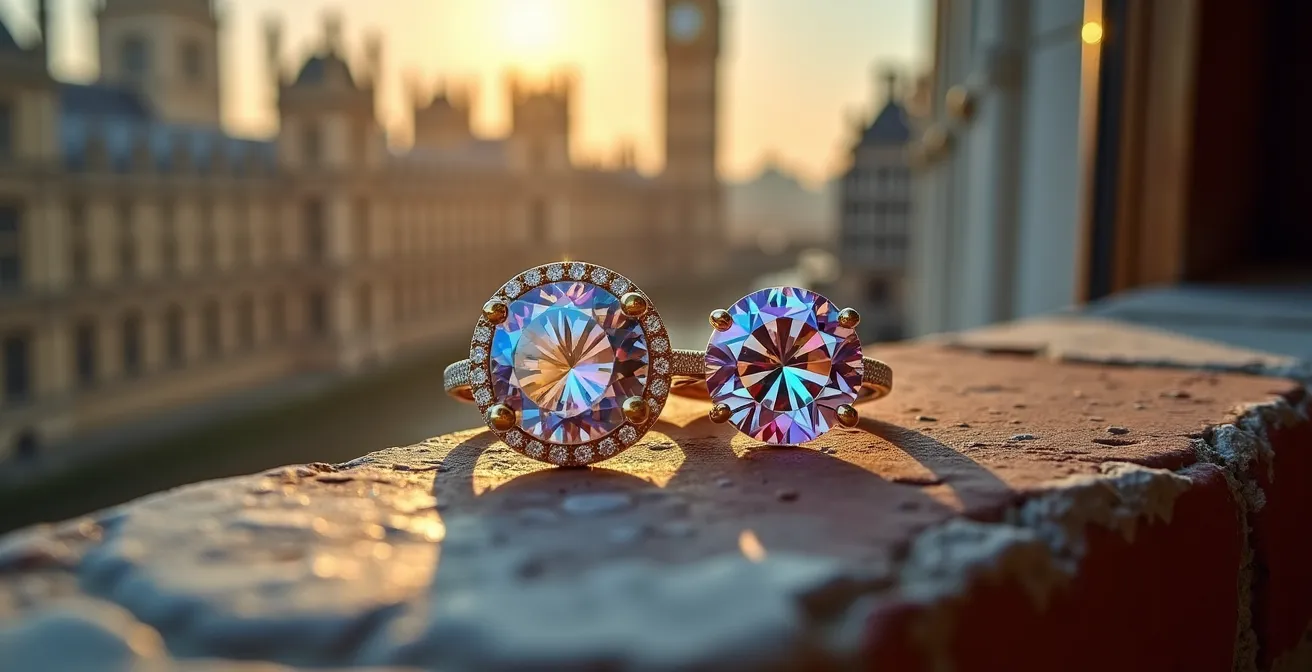
For the average person, distinguishing a high-quality moissanite from a diamond with the naked eye is exceptionally difficult, if not impossible. Both stones are white, highly durable, and brilliant. However, they are chemically and optically distinct, and these differences become apparent under specific conditions or with a trained eye. The most notable visual distinction is how they handle light. Moissanite exhibits a phenomenon known as double refraction and has a higher refractive index, resulting in more “fire” or rainbow-coloured flashes of light.
This “disco-ball” effect is a key giveaway for gemologists. In fact, optical measurements demonstrate that moissanite has 2.5 times more fire dispersion than a diamond. While some find this enhanced sparkle appealing, others may feel it looks artificial compared to the more balanced white-light brilliance of a diamond. An untrained eye might perceive moissanite simply as a very “sparkly” stone, without necessarily identifying it as a non-diamond.
Where the difference becomes stark is in the financial and insurance appraisal. From an asset perspective, they exist in entirely different leagues. Moissanite is significantly less expensive and, like lab diamonds, has negligible resale value. This financial distinction is clearly reflected in the cost of insuring the stone in the UK.
The following table illustrates the difference in insurance costs and requirements, a crucial factor in the total cost of ownership for any UK buyer. While the upfront cost of moissanite is lower, its appraisal and coverage reflect its status as a diamond simulant, not an alternative store of value.
| Factor | Diamond | Moissanite |
|---|---|---|
| Insurance Cost | £250-300/year for 2ct | £50-60/year for 2ct equivalent |
| Appraisal Requirement | Certified gemologist required | Standard jeweler appraisal accepted |
| Coverage Type | Full replacement value | Actual cash value |
| UK Insurers | All major providers | Requires jewelry rider |
The mistake of unknowingly buying a “glass-filled” sapphire.
While the diamond debate focuses on origin (mined vs. lab), the world of coloured gemstones like sapphires, rubies, and emeralds presents a different and arguably more treacherous landscape for the uninformed buyer: undisclosed treatments. A common and highly problematic treatment is lead-glass filling in rubies and sapphires. This process involves filling fractures and cavities within a low-quality stone with high-refractive-index glass to improve its apparent clarity and colour. The result is a stone that looks far more valuable than it is, but its durability and value are severely compromised.
A glass-filled sapphire is not a true, solid gemstone. It is a composite material that is highly susceptible to damage from heat, ultrasonic cleaners, and even common household chemicals. The value of such a stone is a tiny fraction of an untreated or even heat-treated sapphire of similar appearance. The critical mistake for a UK buyer is purchasing such a stone without full disclosure, often at an inflated price that doesn’t reflect its low quality and fragile nature. This is not a niche problem; it is prevalent in the lower-to-mid-range market.
Fortunately, UK consumers have strong legal protections. The Consumer Rights Act 2015 mandates that goods must be “as described.” If a sapphire is sold as natural without disclosing that it is glass-filled, the buyer is entitled to a full refund. To avoid this pitfall, buyers must insist on a report from a reputable, independent gemological laboratory like GCS (Gemmological Certification Services) in London. The hallmark from the Assay Office only certifies the metal of the jewellery, not the gemstone. A proper lab report will identify the stone and explicitly detail any treatments, including glass-filling, giving the buyer a true picture of what they are purchasing and its genuine market value.
The size issue: choosing a stone just under the carat mark (0.90ct) to save 20%.
In the diamond market, not all weights are created equal. Prices do not increase in a smooth, linear fashion with carat weight; instead, they jump significantly at certain “magic” size thresholds, most notably at the full 1.00-carat mark. This market phenomenon creates a powerful saving strategy for savvy buyers: purchasing a diamond that is just shy of these magic sizes. A 0.90-carat diamond can cost 15-25% less than a 1.00-carat diamond of the exact same quality (colour, clarity, and cut), yet the visual difference in size is often imperceptible to the naked eye.
This price discrepancy is purely psychological, driven by the consumer desire to own a “one-carat diamond.” From an investment or value perspective, exploiting this inefficiency is a logical move. You acquire a stone that looks virtually identical to a more expensive one, effectively getting more for your money. The same principle applies at other thresholds like 0.50ct, 1.50ct, and 2.00ct. Choosing a 1.40ct stone over a 1.50ct, for example, can yield similar significant savings.

This strategy is equally effective for both natural and lab-grown diamonds. While market analysis shows lab diamonds cost 30-60% less than natural diamonds overall, the price jumps at carat marks still apply within their own pricing structure. For a buyer focused on maximising visual impact for their budget, “buying shy” is one of the most effective tactics. It separates the emotional appeal of a round number from the physical reality of the stone, allowing for a more rational allocation of capital without compromising on the perceived size and beauty of the final piece of jewellery.
Rolex or Patek Philippe: which brand offers the best liquidity in London?
When we shift the investment conversation from diamonds to luxury Swiss timepieces, the financial dynamics change dramatically. Unlike diamonds, certain watches from top-tier brands like Rolex and Patek Philippe are not just Veblen goods; they are highly liquid assets with a globally established and transparent secondary market. For a UK investor, liquidity—the ability to convert an asset to cash quickly and with minimal loss of value—is a paramount concern. In the London market, both brands perform exceptionally well, but they offer different liquidity profiles.
Rolex, particularly its steel sports models like the Submariner, GMT-Master II, and Daytona, offers unparalleled liquidity. The demand for these models consistently outstrips supply at the retail level, creating a robust secondary market where pre-owned pieces often trade at or significantly above their original retail price. For an investor in London, selling a popular Rolex model can be as simple as walking into a reputable dealer in the Burlington Arcade or Hatton Garden and receiving a wire transfer the same day. The market is broad, deep, and highly active.
Patek Philippe represents the pinnacle of haute horlogerie and also boasts a strong secondary market, especially for its iconic Nautilus and Aquanaut lines. However, its market is thinner and more specialised. While the appreciation potential can be even greater for certain rare references, the buyer pool is smaller and more discerning. Selling a high-value Patek may take longer and require a more specialised dealer or auction house (like Phillips or Christie’s in London) to achieve the best price. The liquidity is excellent, but not as immediate as with a mass-market luxury item like a steel Rolex.
From a pure liquidity standpoint in London, Rolex has the edge due to its wider market appeal and trading volume. However, both stand in stark contrast to diamonds, which are notoriously illiquid. Before investing in any luxury good, a thorough financial assessment is crucial.
Investment Comparison Checklist for UK Buyers
- Compare Absolute Loss: Don’t just look at percentage loss. A lab diamond bought for £1,200 might lose £800 (66%), while a natural diamond bought for £8,000 might lose £3,200 (40%). The absolute cash loss on the natural stone is 4x higher.
- Factor in Capital Gains Tax (CGT): In the UK, profits from selling personal possessions (‘chattels’) worth more than £6,000 are subject to CGT. This applies to watches and jewellery, reducing your net return.
- Consider Currency Exposure: The pre-owned watch market is often priced in GBP in London, while the global diamond trade is priced in USD. This introduces currency risk into your diamond ‘investment’.
- Benchmark Against ISAs: Remember that any gains within a Stocks & Shares ISA are completely tax-free. A luxury good must significantly outperform the market to compete on a post-tax basis.
- Analyse Total Cost of Ownership: Include secure storage and specialised insurance costs, which are not required for an ISA, in your calculation of the asset’s net return.
The mistake of believing “100% recycled” means infinitely recyclable.
The marketing narrative around lab-grown diamonds often centres on their superior environmental credentials compared to mining. While this is largely true, the conversation is often oversimplified. Terms like “eco-friendly,” “sustainable,” or “recycled” can be misleading if not properly scrutinised. It’s crucial for a discerning buyer to look at the specific data points rather than accepting marketing buzzwords at face value.
The primary environmental advantage of lab diamonds lies in drastically reduced land disruption and energy consumption. As the expert analysis firm Frost & Sullivan notes, the impact on local ecosystems is minimal.
Diamond-growing facilities ‘are often located in areas that have a negligible impact on the environment and have almost no impact on biodiversity in the area of operation.’ On average they disrupt just 0.07 square feet of land per carat and only 1 pound of mineral waste.
– Frost & Sullivan, Environmental Impact Study
On the energy front, the difference is also significant. While producing a diamond in a lab is an energy-intensive process, it is still far more efficient than large-scale mining operations. Data confirms the disparity: energy efficiency data shows it takes roughly 36 kWh to produce one carat in a lab, compared to a range of 66-80 kWh for the equivalent weight from a mine. However, the key question becomes the source of that energy. A lab facility powered by coal has a much different carbon footprint than one powered by renewables.
The term “recycled” also requires clarification. Recycled gold is a strong environmental choice, as gold can be melted down and reformed infinitely with no loss of quality. Diamonds, however, are not “recycled” in the same way. A “recycled diamond” is simply a pre-owned stone that has been removed from a piece of jewellery and reset. While this is the most sustainable option of all as it requires no new production, it is not what “lab-grown” implies. Understanding these nuances allows a buyer to move beyond greenwashing and make a choice based on a clear-eyed assessment of the environmental facts.
Key Takeaways
- Depreciation is Absolute: Lab-grown diamonds lose the most value relative to purchase price, but natural diamonds can result in a larger absolute cash loss on resale.
- Liquidity is King: From an investment standpoint, the ability to sell an asset quickly for a fair price is crucial. In the UK luxury market, select watches vastly outperform all diamonds in liquidity.
- Tax Matters: Standard UK investments like ISAs offer tax-free growth, a significant advantage that tangible assets like jewellery and watches, which are subject to CGT, cannot match.
Why Invest in Luxury Timepieces Instead of ISA Savings Accounts?
After analysing the poor value retention of diamonds and the superior liquidity of luxury watches, the final question for a UK investor is stark: should you allocate capital to any of these tangible assets over a conventional, tax-efficient financial product? The answer, from a pure wealth-growth perspective, is almost always no. A Stocks & Shares ISA offers a combination of potential growth, diversification, and tax advantages that no luxury good can replicate.
The allure of a tangible asset is its physical presence and the enjoyment it provides. However, this “emotional dividend” comes at a steep financial price. As an investment, a diamond—whether mined or lab-grown—is fundamentally flawed. Industry insiders often confirm that diamonds experience a 70% immediate loss from their retail price upon resale, a write-down no sane investor would tolerate in a stock. While certain Rolex models have shown impressive appreciation, this is not guaranteed and represents a highly concentrated, undiversified bet.
A direct comparison of a £15,000 investment over five years in the UK market makes the hierarchy of returns painfully clear. The table below models the potential outcomes, factoring in typical depreciation, appreciation, and tax treatment for each asset class. It serves as the ultimate bottom line for anyone weighing these options as a financial decision.
This analysis, based on a comparative investment model, shows the stark reality. The ISA, benefiting from market growth and zero tax on gains, is the unambiguous winner for financial return. The Rolex performs admirably for a luxury good, holding its value and even appreciating, while both diamond types result in a significant net loss.
| Investment Type | Initial Cost | 5-Year Value | Tax Treatment (UK) | Liquidity |
|---|---|---|---|---|
| Natural Diamond (1.5ct G/VS2) | £15,000 | £6,000-£9,000 | Subject to CGT | Poor |
| Lab Diamond (4ct G/VS2) | £15,000 | £1,500-£3,000 | Subject to CGT | Very Poor |
| Rolex Submariner | £15,000 | £16,000-£18,000 | Subject to CGT | Excellent |
| Stocks & Shares ISA | £15,000 | £19,500-£22,500 | Tax-free | Good |
Ultimately, the decision rests on your primary goal. If the objective is to acquire a beautiful object for personal enjoyment, a lab-grown diamond offers tremendous value. If the goal is purely financial growth and wealth preservation, the logical path lies with traditional, tax-advantaged investment vehicles. For those seeking to blend enjoyment with a store of value, the pre-owned Swiss watch market presents a far more compelling case than any diamond.
Frequently Asked Questions About Gemstone Purchases in the UK
What certification should UK buyers look for in coloured stones?
Buyers should seek independent gemological reports from reputable labs like GCS (Gemmological Certification Services) in London or other internationally accredited institutions. It’s critical to understand that the UK Assay Office hallmark only certifies the purity of the precious metal (e.g., gold, platinum) in the setting, not the identity or quality of the gemstones themselves.
How does the Consumer Rights Act 2015 protect gemstone buyers?
The Consumer Rights Act 2015 provides significant protection by stipulating that all products must be ‘as described’. If a gemstone is sold with a misleading description—for example, a sapphire sold as “natural” that is later found to contain glass filling—the buyer has a statutory right to claim a full refund from the seller for misrepresentation.
What is the difference in treatment disclosure requirements?
UK law, enforced by Trading Standards, requires sellers to provide full and transparent disclosure of any treatments that significantly affect the value or durability of a gemstone. This includes common treatments like glass filling in rubies, fracture filling in emeralds, or any other enhancement that is not permanent and stable under normal wear.