The true preservation of an antique ring depends not on the repair itself, but on a deep understanding of its original materials and craftsmanship.
- Conventional torch soldering introduces excessive heat, which can permanently damage brittle Victorian alloys and fragile settings.
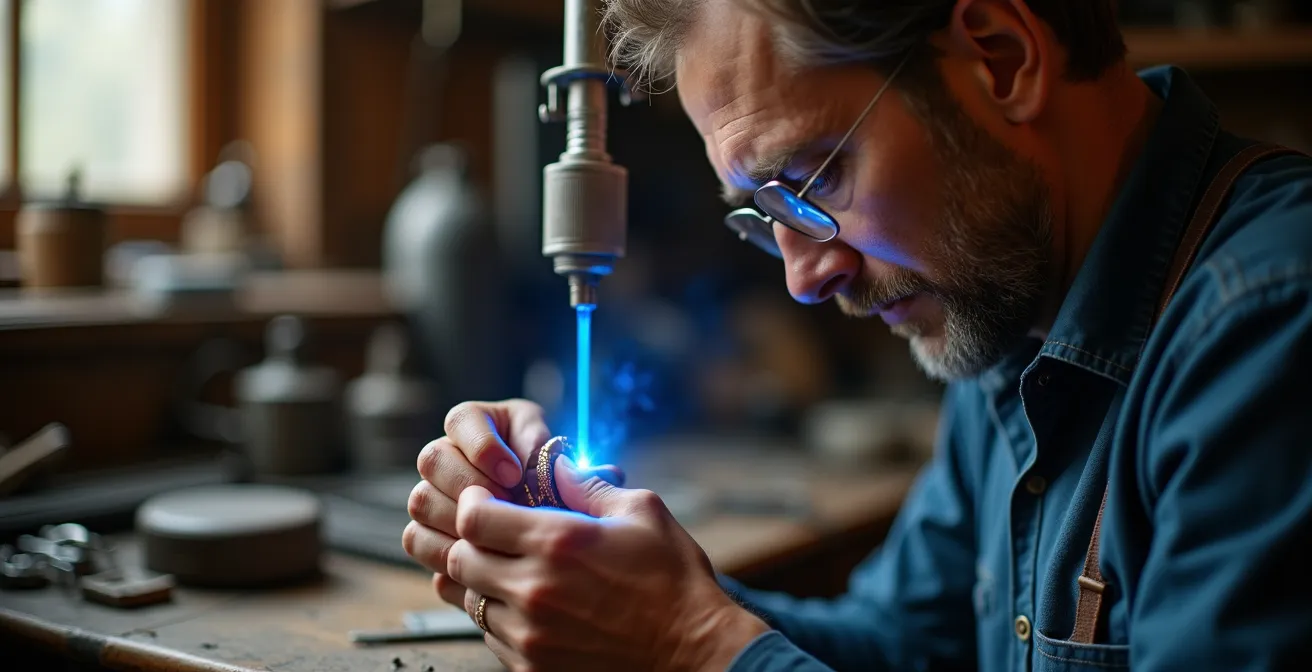
- Laser welding offers microscopic precision, allowing for seamless repairs that respect the piece’s historical and material integrity.
Recommendation: Always entrust an heirloom to a specialist restorer equipped with laser technology and proven experience with period-specific jewellery.
That moment of discovery is a heart-stopping one: a bent shank, a missing claw, a broken link on a cherished piece of family jewellery. The ring passed down from your great-grandmother, a delicate testament to Victorian or Edwardian artistry, is now silent and unwearable. The immediate impulse is to seek a repair. Yet, this is where the greatest danger lies. Most people assume any jeweller can fix it, but entrusting an antique to conventional methods is often the first step towards erasing its soul.
The common approach involves a jeweller’s torch, a tool of brute force heat that has been used for centuries. While effective for modern, robust pieces, for antique jewellery it’s a profound risk. The conversation is rarely about the unique metallurgy of 9-carat gold from 1890 or the fragility of Art Deco filigree. But what if the key to a successful restoration wasn’t simply choosing a tool, but adopting a philosophy of preservation? What if the goal was not just to “fix” the break, but to perform a seamless, almost invisible suture that honours the original craftsman’s intent?
This is the fundamental difference between crude repair and sympathetic restoration. The answer lies in understanding the material science of a bygone era and applying a modern technology that works in harmony with it. This guide delves into why the controlled energy of a laser is often the only appropriate choice for saving an antique ring, moving beyond the simple question of tool to the more important one of heritage. We will explore the specific vulnerabilities of antique metals, the techniques for invisible repairs, and how to identify a true specialist worthy of your trust.
Contents: Laser Welding vs Torch Soldering for Antique Rings
- Why 9-carat Victorian gold becomes brittle with time?
- How to recreate a period-correct claw without the repair being visible?
- Local workshop or specialist restorer: who to entrust with a 1920s piece?
- The mistake of requesting a full polish that erases the jewel’s history
- When to check your diamond claws to prevent loss?
- The storage error that dries out your movement’s oils
- The mistake of polishing a vintage case that destroys 40% of its value
- Why Wearing Fine Jewellery in the Shower Destroys Settings Over Time?
Why 9-carat Victorian gold becomes brittle with time?
The warm, rosy glow of 9-carat Victorian gold is beautiful, but it holds a hidden vulnerability. Unlike modern 18-carat gold, which is 75% pure gold, 9-carat is only 37.5% gold, with the rest being a mix of alloys like copper and silver. Over a century, these other metals can react with the environment and each other, leading to a condition known as intergranular stress corrosion. The metal becomes porous and brittle on a microscopic level. It may look solid, but it has lost its ductility.
When you apply the intense, widespread heat of a traditional jeweller’s torch to this compromised material, you create a large Heat-Affected Zone (HAZ). This sudden thermal shock can cause the already-stressed metal to crack further or even melt unpredictably. Resizing an antique band or repairing a simple crack becomes a high-risk operation. Laser welding, by contrast, is the perfect solution for this delicate material science problem.
Case Study: Repairing a Hollow 9ct Gold Bracelet
A 9-carat yellow gold curb bracelet from the late Victorian period had a broken link. Due to its hollow construction, it was extremely vulnerable to torch soldering. The heat transfer from a flame would almost certainly have caused the delicate hollow links to melt and collapse. By using a laser welder, the repair was confined to the break itself. The heat transference was minimal, eliminating the risk of causing further damage and perfectly preserving the integrity of the surrounding original links.
This is possible because laser welding achieves a precision of 0.2mm, focusing a tiny, powerful beam of energy exactly where it’s needed and nowhere else. The HAZ is virtually non-existent, meaning the fragile, historic gold around the repair is left completely undisturbed. This isn’t just a neater repair; it’s a fundamental respect for the material’s aged integrity.
How to recreate a period-correct claw without the repair being visible?
A worn or broken claw on an antique engagement ring is a common and dangerous problem, threatening the loss of a precious stone. A traditional repair often involves a clumsy blob of solder, which is visually jarring and can damage the diamond or gemstone. A true restorer’s goal is to recreate the claw so perfectly that the repair is invisible, honouring the original craftsman’s intent.
This is achieved with a laser welder and a fine filler wire of a matching, period-correct alloy. The restorer uses the laser to add tiny beads of metal, one by one, slowly building up the claw to its original shape and strength. There is no messy solder, no foreign material, and no risk to the stone. The process is so controlled it can even replicate intricate details like the milgrain beaded edges found on Edwardian platinum rings.

As the image above illustrates, the laser allows for a level of detail that is simply impossible with a flame. This technique can be used to rebuild delicate filigree, repair worn settings, and fix breaks right next to heat-sensitive stones without any need to remove them from the piece. This non-invasive approach is crucial for maintaining the piece’s authenticity.
An expert in the field confirms the profound impact this has on a jewel’s worth. As jeweller Mr. Calcote of the Ganoksin community notes, this capability changes everything for high-value antiques:
You can repair missing bridgework in antique filigree pieces without solder. With a torch, you just can’t do a nice job [with this type of repair]. For valuable antique jewelry, that ability can make a tremendous difference in the piece’s value.
– Calcote, Ganoksin Jewelry Making Community
Local workshop or specialist restorer: who to entrust with a 1920s piece?
When your car needs a basic service, you go to a local garage. When your classic E-Type needs an engine rebuild, you seek out a marque specialist. The same logic must be applied to antique jewellery. The friendly jeweller on the high street is likely skilled at resizing modern wedding bands and soldering silver chains. However, they are almost certainly not equipped, either with tools or knowledge, to handle the unique demands of a fragile 1920s Art Deco piece.
The primary reason for this is the significant investment required. A study of the industry reveals that the professional laser welding equipment costs upwards of £20,000. This is a capital expenditure that only a workshop with a dedicated focus on high-value and antique restoration can justify. A general repair jeweller will rely on their torch for all jobs, because that is the tool they have. This forces them to apply a one-size-fits-all solution to a problem that requires surgical precision.
A specialist restorer, often found in historic jewellery quarters like London’s Hatton Garden, builds their entire business around the principles of preservation. They understand period-correct alloys, hallmark preservation, and the subtle art of retaining a piece’s character. To ensure you are entrusting your heirloom to the right hands, particularly in the UK, a thorough vetting process is essential.
Your Vetting Checklist for a UK Jewellery Restorer
- Technology: Ask specifically if they use laser welding for antique pieces, mentioning its necessity for fragile filigree.
- Portfolio: Request to see clear examples of their previous restoration work on pieces from a similar era (e.g., Art Deco, Edwardian).
- Accreditation: Verify their membership in a respected trade body like The National Association of Jewellers (NAJ).
- Logistics: Inquire about their insured postal repair service. A trusted specialist will use Royal Mail Special Delivery for secure transit.
- Expertise: Ask if they have experience working with period-correct alloys and their methods for preserving original hallmarks during repair.
The mistake of requesting a full polish that erases the jewel’s history
One of the most common and tragic mistakes an owner of an antique piece can make is to ask a jeweller to “make it look new again.” This usually results in an aggressive polishing process using motorised wheels and abrasive compounds. While the intention is good, the outcome is destructive. This process strips away one of the most valuable attributes of an antique: its patina.
Patina is not dirt. It is the soft, gentle lustre that develops over decades of wear, a subtle oxidation that gathers in the recesses of the engraving and metalwork. This layer is the physical manifestation of the jewel’s history. Removing it is like sanding the character from a piece of antique furniture. An over-polished piece looks sterile and harsh; its sharp edges are softened, its crisp details blurred, and its story erased. A knowledgeable collector or buyer will instantly spot this and the piece’s value will be significantly diminished.
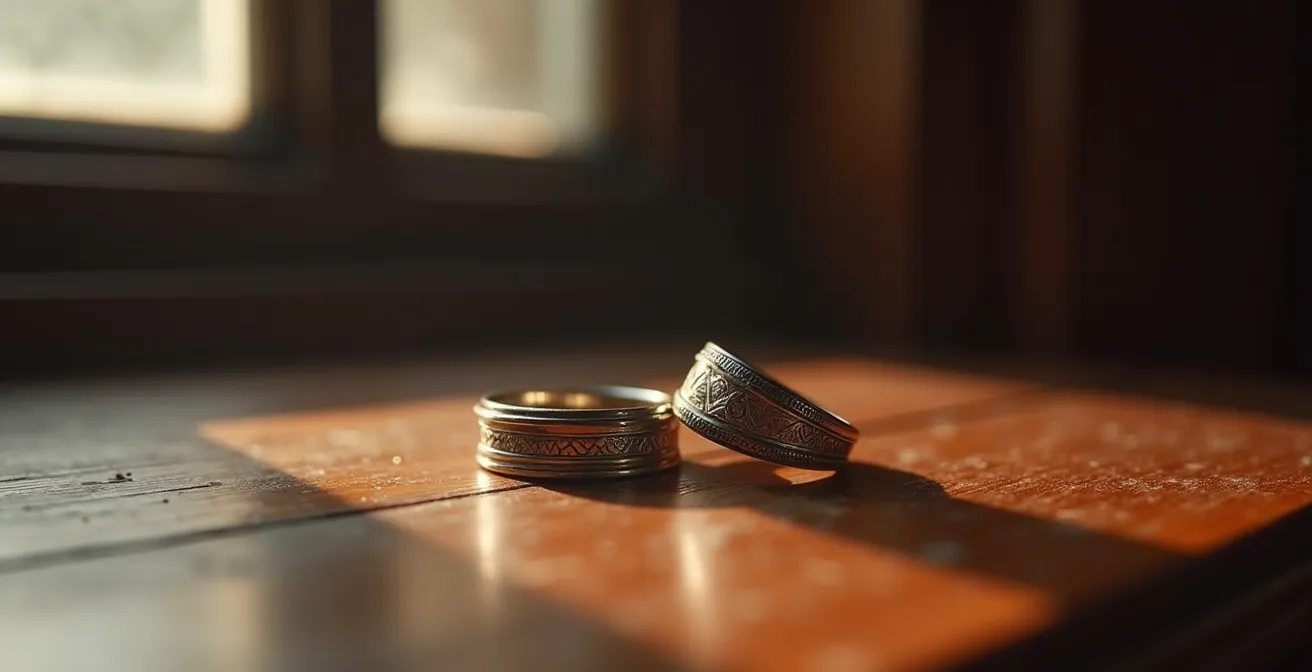
A sympathetic restoration involves a gentle, manual clean to remove dirt while carefully preserving the historic patina. The goal is to celebrate the age of the piece, not to hide it. This philosophy of non-destructive intervention extends to all aspects of the repair. For example, a major advantage of laser welding is that it allows repairs next to stones without having to un-set them, a disruptive process often required before torch work or aggressive polishing, which risks damaging the original setting and ruining the piece’s integrity.
When to check your diamond claws to prevent loss?
The tiny metal prongs, or claws, that hold your diamonds and gemstones are the single most important structural element of a ring. They are also the most vulnerable. Through daily wear, they can get snagged, bent, or simply wear down over time. Losing a family diamond because a claw failed is a preventable tragedy. Regular inspection is not just a recommendation; it’s an essential part of stewardship.
As a general rule, you should have the claws on any valuable or antique ring checked by a specialist at least once a year, or immediately after any significant impact or knock. You can do a preliminary check yourself by gently touching the stone to see if there is any movement, or by running a fine silk scarf over the setting – a worn or raised claw will snag the delicate fabric. However, only a professional with a loupe can properly assess the structural integrity of each prong.
In the United Kingdom, this check is often more than just good practice; it can be a condition of your insurance policy. For high-value items, specialist insurers have specific requirements to ensure the piece is being properly maintained.
UK Insurance Requirements for High-Value Jewellery
Historic London valuation firms, such as Hirschfelds of Hatton Garden, who have been valuing jewellery since 1875, work closely with specialist UK insurers like TH March. These insurers often stipulate in their policies for high-value antique and vintage jewellery that the item must undergo periodic condition checks by a qualified jeweller. Failure to do so, particularly to check the security of settings, could invalidate a claim in the event of a stone’s loss. This turns a simple maintenance check into a crucial part of securing your asset.
Therefore, a yearly check-up with a restorer is a small investment to protect against catastrophic loss. If a claw needs re-tipping, a laser welder can add new metal seamlessly without any risk to the stone, ensuring another generation of security.
The storage error that dries out your movement’s oils
While this principle is paramount for vintage watches, where dried oils can seize the entire mechanism, the underlying concept of environmental damage is directly applicable to certain types of antique jewellery. A stable environment is key to long-term preservation. Storing a piece in a location with extreme or fluctuating humidity and temperature, such as a stuffy attic or a damp basement, can be incredibly harmful.
This is especially true for jewellery containing organic materials. A string of antique pearls, for example, contains trace amounts of water and protein. If stored in an overly dry, heated environment (like a sealed safe with desiccant packets for too long), they can become brittle and prone to cracking. Similarly, opals, which have a high water content, can craze and lose their fire if they dry out.
Other historic materials like ivory, tortoise shell, and coral are all susceptible to drying, shrinking, and cracking in the wrong conditions. The ideal storage is a fabric-lined box, kept in a part of the house with stable temperature and moderate humidity. This avoids the kind of slow, creeping damage that, much like drying oils in a watch, compromises the material integrity of your heirloom over time.
The mistake of polishing a vintage case that destroys 40% of its value
In the world of high-end vintage watch collecting, polishing a case is a cardinal sin that can instantly destroy a huge portion of its market value. The sharp, well-defined bevels and edges on a watch case are hallmarks of its originality. Polishing rounds these edges, ruining the intended geometry and signaling to collectors that the piece has been poorly handled. This same exact principle applies to antique jewellery, where originality and crispness of detail are prized above a featureless mirror shine.
Consider a geometric Art Deco ring or a finely engraved Edwardian piece. The value lies in the precision of the lines and the depth of the hand-engraved details. An aggressive polish, as discussed earlier, will soften these lines and thin the metal, effectively blurring the very features that define its style and period. Worse still, it can partially or completely erase crucial hallmarks from the inside of the shank. These tiny stamps—indicating the maker, the assay office, the date, and the metal purity—are the piece’s birth certificate. Removing them severely impacts its provenance and value.
A specialist restorer will go to great lengths to work around hallmarks, often using laser welding for nearby repairs to avoid any heat damage to these critical marks. They understand that their job is to preserve the complete object, including its history, not just its form. Just as a watch collector wants to see the original case lines, a jewellery connoisseur wants to see the crispness of the original engraving and the clarity of the hallmarks.
Key Takeaways
- Laser vs. Torch: Laser welding is a precise, low-heat method for preserving antique jewellery’s integrity; a torch is a high-risk tool on fragile, historic metals.
- Patina is History: The soft lustre on an antique piece is valuable patina, not dirt. Aggressively polishing it destroys its character and value.
- Vet Your Specialist: Never entrust an heirloom to a general jeweller. Always use a specialist restorer with laser equipment and proven experience with period pieces, verified by a checklist.
Why Wearing Fine Jewellery in the Shower Destroys Settings Over Time?
It may seem harmless, but wearing your fine jewellery in the shower is one of the fastest ways to diminish its beauty and compromise its structural integrity. The most obvious issue is the build-up of soap, shampoo, and conditioner residue. This film coats both the metal and the gemstones, dulling their sparkle and creating a breeding ground for bacteria in the intricate gaps of the setting.
However, the more insidious damage is chemical and thermal. The sudden change in temperature from hot water can cause thermal shock in certain gemstones, leading to fractures. This is particularly dangerous for heat-sensitive stones like opals, pearls and emeralds, which are often found in antique pieces. Furthermore, the chemicals in soaps and even hard water minerals can slowly degrade the alloys in the metal over time.
This is especially critical when dealing with older repairs. As master welder Bob Staley explains, some historical solder jobs are inherently unstable and can be weakened by repeated chemical and thermal exposure.
White gold solder on platinum and white gold items themselves can be problematic… The zinc content of the solder “boils out” during the process of laser welding the platinum or gold because the zinc melts at a much lower temperature and cools at a different rate than the host metal.
– Bob Staley, The Art of Laser Welding
While this describes a welding issue, the principle of an unstable alloy applies. A poor-quality, zinc-heavy white gold solder from a past torch repair is more susceptible to corrosion from chemicals in the shower. Over time, this can weaken the join, leading to a catastrophic failure of the setting. The safest rule is simple: your jewellery should be the last thing you put on and the first thing you take off.
Protecting your heirloom is an act of stewardship. It requires not just care in wearing, but wisdom in maintenance. By choosing a philosophy of sympathetic restoration over simple repair, you ensure that the piece’s story, craftsmanship, and material integrity are passed on intact to the next generation. The choice between a laser and a torch is ultimately a choice between preservation and alteration. For a piece that holds your family’s history, the decision should be clear. To ensure your heirloom receives the respect and expertise it deserves, the essential next step is to seek a professional assessment from a proven specialist in antique jewellery restoration.