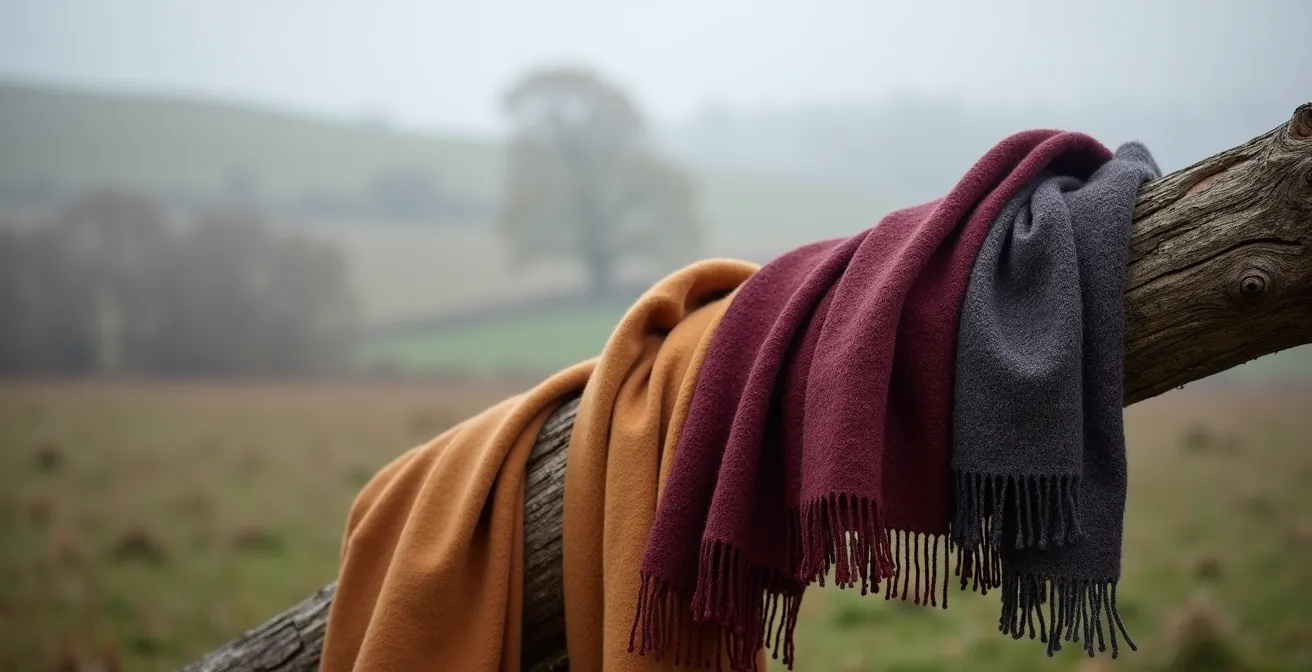
The secret to year-round scarf success in Britain isn’t owning more, but understanding the material science of how fibres handle damp and wind.
- Merino wool offers superior performance in damp conditions compared to warmer, but more delicate, cashmere.
- A curated three-scarf “wardrobe” (commuter, country, transitional) is more effective than a dozen mismatched accessories.
Recommendation: Prioritise a scarf’s water-resistance and breathability over its sheer thickness to stay genuinely comfortable in the UK’s fluctuating climate.
The classic British scenario: a crisp, sunny autumn morning gives way to a sudden, drizzly afternoon. You pull your cosy scarf tighter, only to find it becoming a damp, heavy weight around your neck. The daily battle with the UK’s capricious weather often leaves our best-laid sartorial plans in disarray. Many of us simply grab the thickest, woolliest scarf we own from September to April, believing that bulk equals warmth. We accumulate accessories that are perfect for a frosty, dry day but utterly fail in the face of persistent damp or a biting coastal wind.
This approach often leads to a wardrobe cluttered with scarves that are either too hot for the stuffy London Tube, too flimsy for a walk in the Peak District, or take days to dry after being caught in a shower. We treat them as simple fashion items, forgetting they are functional tools designed to protect us. The frustration of being uncomfortably damp or wrestling with a bulky, impractical accessory is a shared British experience.
But what if the key wasn’t about owning more scarves, but about understanding them better? The solution lies not in thickness, but in material science. It’s about knowing why one type of wool can shrug off a shower while another gets ruined, and why certain man-made fibres can be a godsend for transitional weather. This guide moves beyond generic style tips to offer a practical, expert-led strategy for building a minimalist, highly effective scarf wardrobe tailored specifically for the challenges of the English climate.
This article will delve into the specific properties of different materials, teach you techniques to combat the wind, and provide a clear roadmap to selecting and caring for a core collection of scarves that will see you through the year in comfort and style. Prepare to transform your relationship with this essential British accessory.
Summary: Mastering Seasonal Scarves for the UK Climate
- Why is cashmere warmer but less rain-resistant than merino wool?
- How to tie the ‘Parisian’ knot to protect the throat from the north wind?
- Twill de soie ou laine peignée : quel accessoire pour la mi-saison ?
- L’erreur de laver son écharpe en laine à la machine, même à froid
- Problème d’encombrement : 3 écharpes essentielles pour couvrir toute l’année britannique
- Pourquoi le Tencel et le Lyocell nécessitent un repassage à basse température ?
- Comment repérer le polyester qui fait transpirer dans les rayons des grandes chaînes ?
- Comment aérer et brosser vos vêtements pour espacer les lavages ?
Why is cashmere warmer but less rain-resistant than merino wool?
The choice between cashmere and merino wool is a classic dilemma for anyone investing in quality winter wear. While both are natural fibres celebrated for their warmth, their performance in the damp British climate is drastically different. The secret lies in their microscopic structure. Cashmere fibres are incredibly fine and hollow, trapping more air and providing superior insulation. In fact, some research shows cashmere can be 7-8 times warmer than standard sheep’s wool. This makes it unparalleled for dry, biting cold.
However, these delicate, fine fibres are cashmere’s Achilles’ heel in the rain. They absorb moisture quickly and can become waterlogged, losing their structure and insulative properties. Once wet, cashmere is prone to stretching and damage. Merino wool, on the other hand, possesses a unique quality known as being hygroscopic. Its fibres can absorb up to 30% of their own weight in moisture before feeling damp to the touch, actively wicking water away from your skin. The scaly outer layer of merino fibres helps repel liquid water, meaning it performs exceptionally well in drizzle and light rain. This durability is why British heritage brands often favour it; one UK analysis noted that merino’s moisture-wicking properties make it superior for our variable climate, revealing that cashmere scarves had three times more damage claims related to water exposure.
For navigating the realities of an English winter, this distinction is critical. A merino scarf will keep you warm even if you get caught in a shower, while a precious cashmere piece is best saved for those rare, perfectly crisp and dry winter days.
The following table, based on an analysis of fibre properties, clearly breaks down the trade-offs for the UK climate.
| Property | Cashmere | Merino Wool |
|---|---|---|
| Warmth Rating | 8x warmer | Good insulation |
| Water Resistance | Poor – delicate fibers | Excellent – hygroscopic properties |
| Durability in Wet Conditions | Prone to damage | Maintains structure when wet |
| UK Weather Suitability | Best for dry, cold days | Ideal for damp conditions |
| Cost per UK Winter Season | £150-400 per scarf | £50-150 per scarf |
How to tie the ‘Parisian’ knot to protect the throat from the north wind?
The Parisian knot is a timeless classic, beloved for its simplicity and effortless style. You fold the scarf in half, drape it around your neck, and pull the loose ends through the loop. While elegant, its loose structure often leaves a crucial gap at the throat, allowing a biting northerly wind to sneak in. For true protection against the British elements, an upgrade is required. We need a technique that creates a wind-proof seal, transforming the scarf from a mere accessory into a piece of functional equipment.
Enter the “Hidden Knot” technique. This method is a game-changer for windy days, creating a continuous, gap-free barrier around the neck. It provides all the warmth without the bulk of simply wrapping the scarf multiple times. The key is to create the knot behind the main drape of the scarf, using its own fabric to seal any openings.
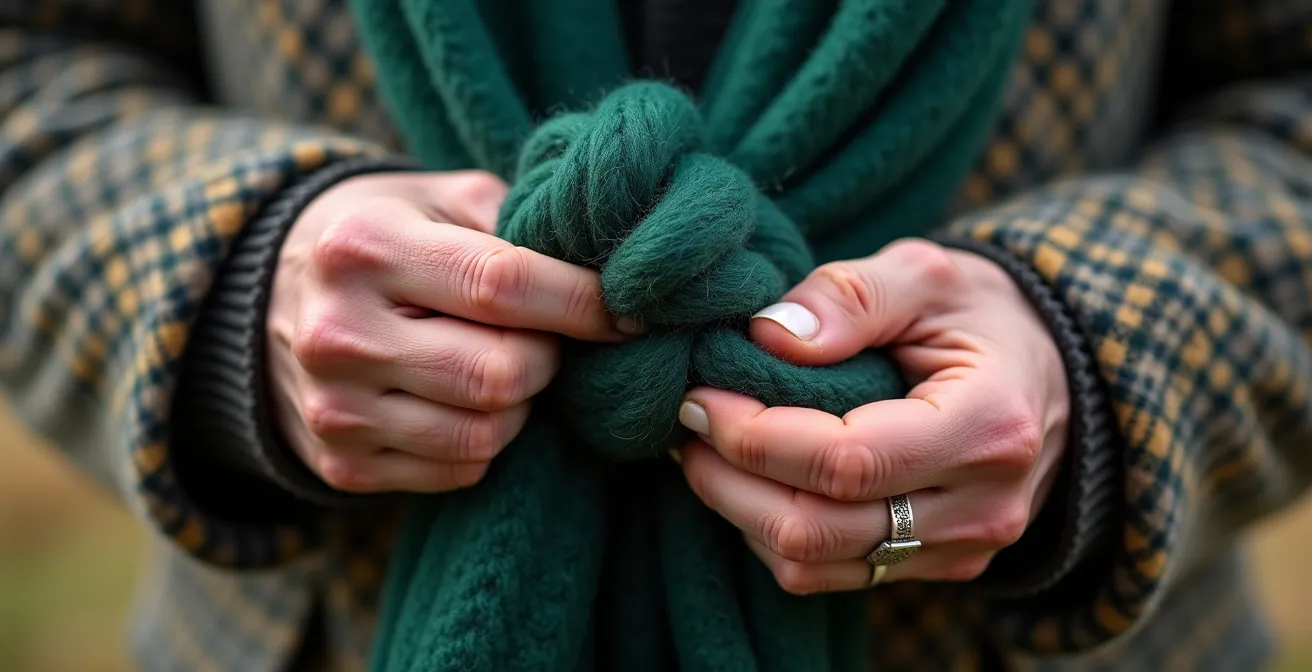
As you can see, the final adjustment is crucial. By tucking the knot and ensuring the front panel lies flat, you eliminate the air pockets that cause heat loss. This method works best with a scarf that has some body, like lambswool or a thick merino, as the fabric will hold its shape and provide a more substantial barrier. It’s the perfect knot for a blustery walk along the coast or waiting on an exposed train platform.
Silk twill or worsted wool: which accessory for the transitional season?
The transitional seasons of autumn and spring present a unique challenge in the UK: the “four seasons in one day” phenomenon. One moment you’re basking in sunshine, the next you’re shielding yourself from a cool breeze or a sudden shower. A heavy winter scarf is too much, but going without is a gamble. This is where the choice of material becomes a strategic art. Worsted wool, with its smooth, tightly-spun fibres, is an excellent choice for outdoor-centric days, like an autumn walk around a National Trust estate. It offers warmth without the fluff and bulk of its winter counterparts.
For days involving indoor-outdoor transitions—think a September wedding in Surrey or a day of shopping that moves from cool streets to warm stores—a silk twill scarf is unparalleled. It provides a surprising amount of warmth for its weight by trapping a thin layer of air against the skin, yet it’s breathable and won’t cause you to overheat indoors. However, the most versatile solution often lies in modern blends. As sustainable fashion expert Catherine Green of Smol UK notes:
For the unpredictable UK transitional season, a Tencel/wool or modal/cashmere blend offers breathability, drape, and light warmth – the perfect problem-solver
– Catherine Green, Sustainable Fashion Expert, Smol UK
These engineered blends are the true workhorses of a transitional wardrobe. They combine the best properties of different fibres—the softness of cashmere, the breathability of Tencel, the structure of wool—to create a fabric that can adapt to fluctuating temperatures. It’s no surprise that a House of Colour UK client survey found that 73% of British women preferred these versatile blend scarves to navigate the unpredictable weather. They offer the perfect balance of style and practicality, folding away neatly when the sun comes out and providing instant comfort when the clouds roll in.
L’erreur de laver son écharpe en laine à la machine, même à froid
It’s a dirty little secret of British winter life. Despite being worn daily, pressed against our skin, and exposed to the elements, our winter woollens are often neglected. In fact, some shocking research reveals that 31% of Brits have never washed their winter scarves. When we do decide to clean them, the temptation is to toss them in the machine on a ‘cold’ or ‘wool’ cycle. This is a catastrophic mistake. The damage isn’t caused by temperature alone, but by the combination of water, agitation, and friction.
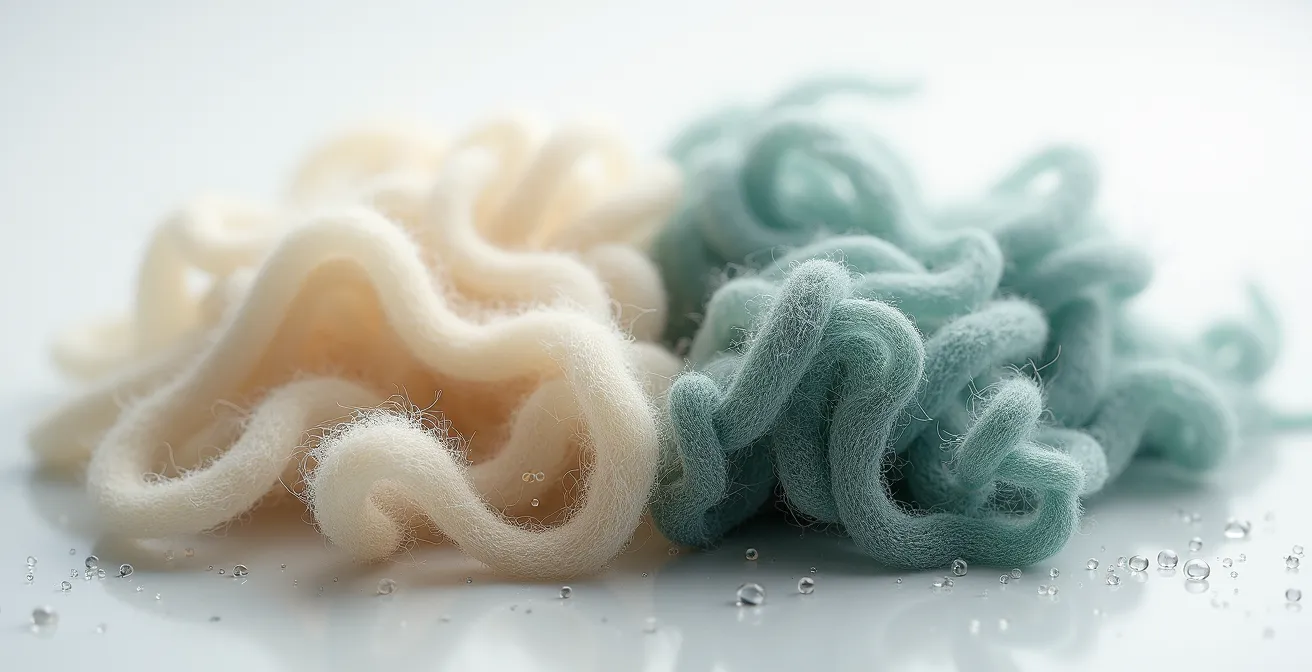
Wool fibres are covered in microscopic scales. When subjected to the tumbling motion of a washing machine, these scales lock together like Velcro, causing the fibres to mat and shrink. This process is called felting, and it is irreversible. It destroys the fabric’s softness, drape, and, most importantly, the tiny air pockets between fibres that provide insulation. A felted scarf is not only smaller and stiffer but also significantly less warm. The image below shows healthy fibres on the left, full of air-trapping crimp, compared to the dense, matted structure of felted fibres on the right.
Hand-washing in cool water with a dedicated wool detergent (like the UK brand Ecover Wool & Silk, available at Waitrose) is the only truly safe method. But what if the damage is already done? Don’t despair; sometimes a felted item can be partially salvaged.
Your Action Plan: Rescuing a Machine-Washed Wool Scarf
- Soak and Soften: Submerge the scarf in a basin of cold water mixed with a generous amount of hair conditioner. Let it soak for at least 30 minutes to help relax the fibres. Do not rinse.
- Gently Stretch: Lay the scarf flat on a thick towel. Gently begin to stretch the fabric back into shape, working section by section. Be patient and avoid aggressive pulling which can break the weakened fibres.
- Tease the Fibres: While it’s still damp, use a soft boar-bristle brush (a classic Kent Brush is perfect for this) to gently tease the matted fibres apart. Brush in one direction to restore some of the surface texture.
- Reshape and Dry: Lay the scarf on a fresh, dry towel, carefully reshaping it to its original dimensions. Roll the towel up to squeeze out excess water, then lay it flat to air dry, away from direct heat or sunlight.
- Future-Proof Care: For all future washes, stick to hand-washing. Using a conditioner rinse even on healthy wool can help keep fibres smooth and reduce the itchiness some people experience.
Problème d’encombrement : 3 écharpes essentielles pour couvrir toute l’année britannique
A drawer overflowing with scarves of every shape and size is a common sight, yet most of us still feel we have “nothing to wear” for the day’s specific weather. The solution isn’t more scarves, but a strategically curated ‘scarf wardrobe’. A core collection of just three high-performing scarves can cover every eventuality the British year throws at you, from a drizzly commute to a formal event. This minimalist approach focuses on function first, ensuring you are always comfortable and prepared.
This capsule wardrobe consists of three key archetypes: the Drizzle-Proof Commuter, the Cosy Country Companion, and the Smart Transitional Layer. The ‘Commuter’ needs to be hardworking, preferably in a dark, forgiving colour, made from a material like merino wool that can handle a shower and won’t cause the dreaded ‘Tube sweat’. The ‘Country’ scarf is all about maximum warmth for colder, often drier, outdoor activities like a bonfire night or a winter pub lunch. This is where a luxurious, thick lambswool or a Scottish cashmere piece truly shines. Finally, the ‘Transitional’ scarf needs to be lightweight and elegant, made from a silk, modal, or Tencel blend, perfect for layering over office wear or adding a touch of warmth on a cool spring evening.
The table below offers a practical guide to building this essential trio, with options for different budgets featuring well-known British retailers.
| Scarf Type | Best Use | Budget Option | Premium Option |
|---|---|---|---|
| Drizzle-Proof Commuter | Daily London Tube/rain | M&S Merino (£35) | Johnstons of Elgin (£125) |
| Country Pub/Bonfire Night | Weekend countryside | Edinburgh Woollen Mill (£45) | Brora Scottish Cashmere (£195) |
| Office Layer/Transition | Indoor-outdoor shifts | COS Modal Blend (£29) | N.Peal Silk-Cashmere (£175) |
Managing this collection is also key. A study of London commuters by Who What Wear UK found that those who used a specific folding technique—rolling the scarf into a tight cylinder, then folding it in half—kept their accessories wrinkle-free 85% more effectively than those who just stuffed them into a bag. This ‘tube roll’ method is particularly brilliant for navigating the hot train to cold platform transition.
Pourquoi le Tencel et le Lyocell nécessitent un repassage à basse température ?
Tencel and Lyocell are modern marvels in the world of textiles. As semi-synthetic fibres derived from wood pulp cellulose, they are celebrated for their sustainability, silky-smooth feel, and beautiful drape. They are fantastic choices for transitional scarves, offering lightweight warmth and excellent breathability. However, they have one particular sensitivity: high heat. Applying a hot iron directly to a Tencel or Lyocell scarf can scorch or melt the delicate fibres, leaving a shiny, permanent mark and ruining the fabric’s fluid texture.
The reason for this sensitivity lies in their fibre structure, which is designed to be exceptionally smooth. This smoothness, while luxurious, makes them less resilient to direct, high heat than robust natural fibres like cotton or linen. This issue is compounded by the British climate. A key finding from The Wool Company’s research indicates that UK homes average 65% humidity in winter, which can make these fabrics feel cool and slightly damp to the touch even when they are fully dry. This can tempt one to use a hotter iron to “dry it out,” a move that often proves fatal for the garment.
So how do you remove wrinkles safely? Steaming is the ideal method. But for a quick fix, there’s a brilliant, low-risk tip from a beloved British source of practical wisdom. As “Clean and Green” author and Great British Bake Off winner Nancy Birtwhistle advises:
In a damp British home, Tencel fabrics can feel cool to the touch even when dry. Instead of risking an iron, use a quick blast from a hairdryer on medium setting to release wrinkles
– Nancy Birtwhistle, Clean and Green author
This gentle approach uses warm air rather than direct, intense heat, relaxing the fibres just enough to let the creases fall out without any risk of damage. It’s a perfect example of using a little domestic science to care for modern, delicate fabrics properly.
Comment repérer le polyester qui fait transpirer dans les rayons des grandes chaînes ?
We’ve all been there. You spot a beautifully patterned, seemingly soft scarf in a high-street chain like Primark or H&M for under £20. The label might even say “wool blend,” but after wearing it on your commute, you feel uncomfortably clammy. This is the work of cheap, non-breathable polyester, a plastic-based fibre that traps moisture against your skin. A Cosmopolitan UK study on the ‘Tube sweat’ phenomenon found that scarves from fast-fashion chains trapped four times more moisture than those from technical outdoor brands, despite both containing polyester. The difference lies in the quality and engineering of the fibre.
Technical polyester (used by brands like Rab or Berghaus) is often engineered with hollow fibres or specific weaves to allow moisture to escape. The polyester used in fast fashion, however, is typically a solid, non-porous filament designed for low cost, not performance. It creates a plastic-bag effect, which is the last thing you want around your neck. Since labels can be misleading, learning to identify low-quality polyester by touch and sight is a crucial skill for any savvy shopper. You can become your own quality control expert right there in the shop aisle.
Here are a few simple, tactile tests you can perform before you buy:
- The Shine Test: Hold the fabric up to the harsh, bright lights of the store. Cheap polyester will often have an unnatural, plastic-like sheen, whereas natural fibres or high-quality blends tend to absorb light and look more matte.
- The Crinkle Test: Ball up a corner of the scarf tightly in your fist and hold it for 10 seconds. When you release it, low-grade polyester will hold onto sharp, stubborn wrinkles. Good quality wool or a superior blend will spring back with far fewer creases.
- The Static Test: Briskly rub a section of the fabric against itself. Cheap polyester is notorious for building up static electricity; you might even feel a slight crackle. Natural fibres do not have this issue.
- The Breathability Check: While it might feel a bit odd, holding the fabric over your mouth and trying to breathe through it is the ultimate test. If you feel significant resistance and the air doesn’t pass through, you’re holding a sweat-trap.
Key takeaways
- Merino wool beats cashmere in the damp British climate for durability and water-resistance.
- A functional ‘wind-seal’ knot is more important for warmth than scarf thickness alone.
- A curated three-scarf wardrobe (drizzle-proof, country-warm, transitional) can effectively cover all UK seasons.
Beyond the Wash: How Airing and Brushing Maintains Your Scarf Wardrobe
In our quest to keep our clothes clean, we often over-wash them, especially hardworking items like scarves. This not only shortens their lifespan but is also unnecessary for natural fibres like wool. Wool is naturally anti-bacterial and odour-resistant. With the right care between washes, you can keep your scarves fresh and performing at their best all season long. According to experts at Persil and Cleanipedia UK, wool scarves may only need washing 3-5 times per season if they are aired properly between wears. The two key practices for this are airing and brushing.
Airing allows the moisture absorbed during the day—from your breath, your skin, and the damp British air—to evaporate completely. This prevents odours from setting in and allows the fibres to rest and regain their natural, lofty structure. Brushing is equally important; it removes surface dirt, dust, and lint that can dull the fabric’s appearance and get ground into the fibres over time. It also helps to lift the pile on fabrics like cashmere and lambswool, restoring their softness and preventing pilling.
However, these simple tasks must be done correctly, especially in the UK climate. Here is a guide to effective scarf maintenance:
- Airing Indoors: Never air wool scarves outside in a damp UK winter. You’ll simply be adding more moisture. Instead, drape them overnight indoors in a well-ventilated room. Hanging them over a traditional ‘Sheila Maid’ ceiling airer or near a dehumidifier is ideal.
- Implement a Rotation: The golden rule is to never wear the same wool scarf two days in a row. Give it at least a 24-hour rest period to fully dry and air out.
- Choose the Right Brush: Use a soft, natural bristle brush. A classic Kent Brushes boar-bristle model is perfect for delicate cashmere, while a slightly stiffer brush can be used for more robust weaves like Harris Tweed.
- Brush with the Grain: Lay the scarf flat and brush it gently in one direction only, following the grain or weave of the fabric. This smooths the fibres without causing stress or pulling.
By integrating these simple habits into your routine, you treat your scarves less like disposable fashion and more like the long-term, functional investments they are. This mindful approach is not only more sustainable but ensures your chosen accessories look and feel their best for years to come.
Start today by assessing your current collection against these principles. By investing in the right materials and caring for them correctly, you can build a small but mighty scarf wardrobe that will keep you stylish, warm, and dry through every unpredictable British season.