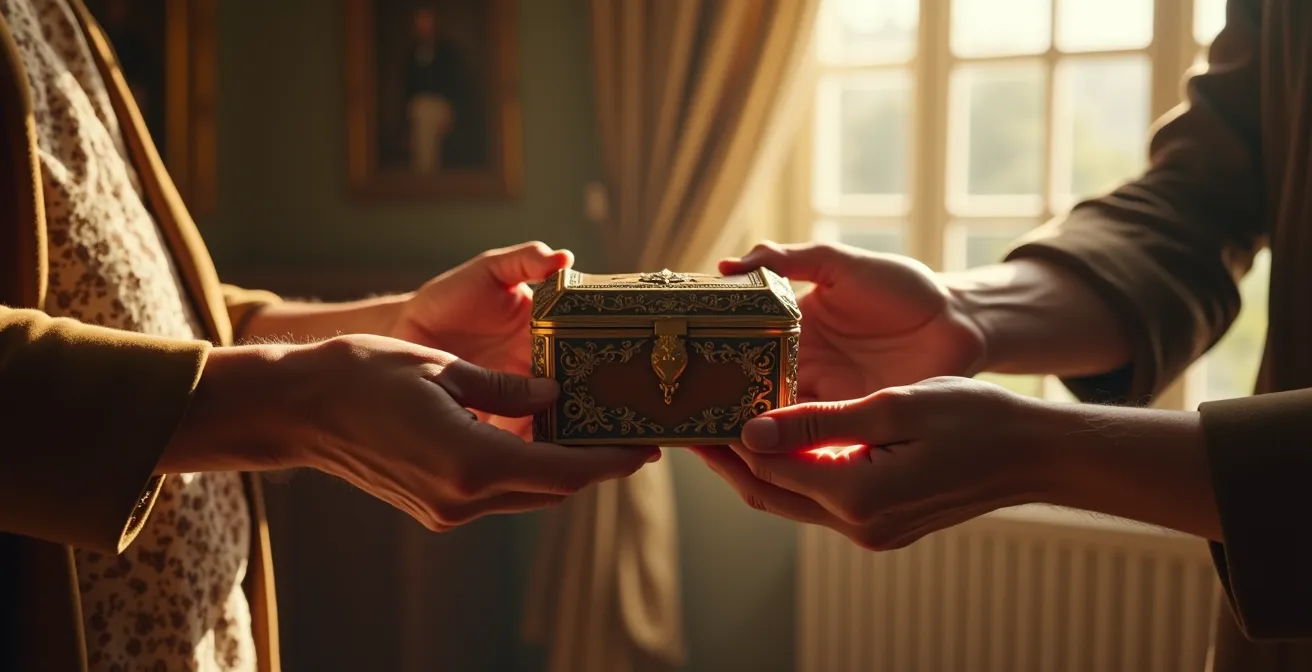
Passing on family jewellery without a significant portion going to HMRC requires more than just surviving seven years; it demands precise strategy.
- The key is gifting during your lifetime using specific exemptions and robust documentation, such as a formal Deed of Gift, to establish a clear timeline.
- Declaring the correct ‘probate value’—not the higher ‘insurance value’—is the single most critical step to prevent overpaying Inheritance Tax.
Recommendation: To secure your legacy effectively, begin by creating a detailed inventory with professional probate valuations for all significant items.
The desire to pass on treasured family heirlooms—a grandparent’s watch, a mother’s engagement ring—is a deeply personal one. These pieces are not just assets; they are capsules of memory and family history. However, in the UK, this sentimental act is fraught with fiscal complexity. The shadow of Inheritance Tax (IHT) looms large, threatening to diminish the value of your legacy before it even reaches the next generation. Many families believe the “seven-year rule” for gifts is a simple panacea, a straightforward countdown to tax exemption.
While the seven-year clock is a fundamental part of IHT planning, relying on it alone is a perilous strategy. The common advice often overlooks the nuanced, and potentially costly, pitfalls set by His Majesty’s Revenue and Customs (HMRC). The true challenge lies not in the act of giving, but in the meticulous process of documenting the gift, valuing it correctly, and navigating the intricate rules that distinguish a tax-free transfer from a taxable one. A simple mistake, such as using an insurance valuation for probate purposes, can lead to a significant and entirely avoidable tax bill for your heirs.
This is where strategic planning transcends simple generosity. The difference between a successful transfer and a financial burden for your beneficiaries lies in understanding the mechanics behind the rules. It’s about shifting from a passive hope of outliving a deadline to an active strategy of compliance and optimisation. This involves creating an unassailable paper trail, understanding the critical concept of “probate value,” and making informed decisions about the future of each piece, whether it’s preserved, sold, or even transformed.
This guide moves beyond the basics. We will dissect the strategic framework required to navigate HMRC’s requirements effectively. We will explore the critical steps for gifting jewellery in your lifetime, the common valuation errors that inflate tax liability, and the methods for distributing items in a way that preserves not only their financial value but also family harmony. By adopting the mindset of a strategic planner, you can ensure your legacy is passed on intact and as intended.
To navigate this complex but crucial topic, this article provides a structured path. Below is a summary of the key strategic areas we will explore, designed to equip you with the knowledge to protect your family’s heirlooms from unnecessary taxation.
Summary: A Strategic Guide to Passing Down Jewellery
- Why gifting your jewellery in your lifetime is more tax-efficient?
- How to create an emotional and financial inventory for your heirs?
- Selling to share the cash vs. a lottery: which method preserves family harmony?
- The mistake of declaring insurance value (replacement) instead of market value to HMRC
- When to transform an outdated brooch into pendants for the granddaughters?
- When to resell your jewellery to optimise Capital Gains Tax (CGT)?
- The mistake of not re-evaluating your jewellery in gold every 3 years
- Why Standard Home Insurance Won’t Cover Your Luxury Jewellery Collection?
Why gifting your jewellery in your lifetime is more tax-efficient?
Gifting jewellery during your lifetime, known as making a Potentially Exempt Transfer (PET), is the cornerstone of effective Inheritance Tax (IHT) planning. The primary mechanism is the seven-year rule: if you survive for seven years after making the gift, its value is entirely removed from your estate for IHT purposes. However, the strategy is far more nuanced than simply handing over a necklace and starting a stopwatch. The real efficiency comes from understanding the rules that govern these gifts and how they interact with other allowances.
A crucial pitfall to avoid is the ‘Gift with Reservation of Benefit’ (GROB) trap. If you gift a piece of jewellery but continue to wear it or keep it in your personal safe without a formal arrangement, HMRC will rule that you have reserved a benefit. Consequently, the item will be treated as if it were still part of your estate upon your death, nullifying the seven-year rule entirely. The transfer must be absolute. Furthermore, you can leverage annual exemptions to make smaller gifts tax-free immediately. Every individual in the UK has a £3,000 annual exemption, which can be used to gift assets, including jewellery, without any IHT implications. If you did not use the previous year’s allowance, you can carry it forward for one year, allowing for a gift of up to £6,000.
For gifts that exceed the available exemptions and fall within the seven-year window, taper relief can reduce the IHT liability. This relief only applies if you survive for at least three years after making the gift and reduces the tax payable on a sliding scale. It does not reduce the value of the gift itself, but rather the tax due on it. The table below illustrates how significantly the tax liability can decrease over time.
| Years Between Gift and Death | Taper Relief Rate | Effective IHT Rate | Tax on £50,000 Watch |
|---|---|---|---|
| 0-3 years | 0% | 40% | £20,000 |
| 3-4 years | 20% | 32% | £16,000 |
| 4-5 years | 40% | 24% | £12,000 |
| 5-6 years | 60% | 16% | £8,000 |
| 6-7 years | 80% | 8% | £4,000 |
| 7+ years | 100% | 0% | £0 |
Your Action Plan: The 7-Step Guide to Lifetime Jewellery Gifting
- Document the gift: Immediately create a Deed of Gift, signed and witnessed. This document establishes the exact date of transfer, which is crucial for starting the seven-year IHT clock.
- Combine annual exemptions: Strategically use your £3,000 annual exemption. Remember to add any unused amount from the previous tax year for a potential total of £6,000.
- Leverage wedding gifts: For gifts made in consideration of marriage, parents can give up to £5,000 IHT-free. This can be combined with the annual exemption for an even larger tax-free gift.
- Ensure a complete transfer: Physically hand over the jewellery and, crucially, stop wearing it. This avoids the Gift with Reservation of Benefit (GROB) trap, which would negate the tax advantages.
- Obtain a professional valuation: For any item valued over £1,500, get a formal probate valuation from a member of the National Association of Jewellers (NAJ) or the Institute of Registered Valuers (IRV) to establish the gift’s market value for HMRC.
- Update insurance policies: The insurance policy must be updated to reflect the new owner. If the item remains in your safe for security, a formal ‘Deed of Bailment’ is essential to prove the recipient is the legal owner.
- Keep comprehensive records: Your executor will need a complete file including photos, the professional valuation, and the signed Deed of Gift to satisfy any HMRC compliance checks.
Ultimately, lifetime gifting is a proactive measure that gives you control over the distribution of your assets, providing certainty for your heirs and significantly mitigating the impact of IHT.
How to create an emotional and financial inventory for your heirs?
An inventory of heirlooms is more than a simple list; it is a vital bridge between generations and a critical document for your estate’s executor. This “heirloom passport” should capture both the financial data required by HMRC and the emotional significance that gives each piece its true value. Neglecting this step creates ambiguity, which can lead to family disputes and, crucially, tax compliance issues. In fact, valuations are the biggest single area of risk, forming a large part of HMRC’s compliance checks on estates. A poorly documented collection is a red flag for tax authorities.
The financial component must be precise. For each significant piece, you should record a detailed description, any identifying marks, its provenance (how and when it was acquired), and, most importantly, a formal probate valuation. This is not the time for guesswork or using an old insurance figure. The emotional component is equally important for preserving family harmony. Alongside the financial data, include a short note on the piece’s history: who owned it, on what occasions it was worn, and what it symbolises. This context can help heirs understand your intentions and appreciate the non-monetary value of their inheritance, which can be invaluable during distribution.

This organised approach provides your executor with a clear, defensible record. As the image above suggests, combining the physical items with professional certificates and personal notes creates a comprehensive and authoritative archive. It transforms a box of jewellery into a well-managed portfolio of assets, ready for a smooth probate process. Without it, your executor is left with the difficult and expensive task of valuing items posthumously, often under pressure and without the benefit of your personal knowledge.
Case Study: The Importance of Professional Probate Valuation
An estate solicitor was faced with a challenge: a diamond ring was specifically mentioned in a will, but the only documentation was a high insurance valuation. Unsure how to assign a fair probate figure, the solicitor recommended a professional in-person assessment. An expert valuer with over 20 years of experience examined the ring, identifying it as a 1.60-carat brilliant-cut diamond. The resulting probate valuation provided a defensible, market-based figure for HMRC, which was significantly different from the insurance value, preventing the estate from overpaying IHT and ensuring the executor fulfilled their legal duty.
This document serves as the single source of truth for your family and HMRC, preventing misunderstandings and ensuring your wishes are carried out precisely and tax-efficiently.
Selling to share the cash vs. a lottery: which method preserves family harmony?
Distributing a collection of jewellery amongst several heirs is one of the most emotionally charged aspects of estate administration. When items vary greatly in financial and sentimental value, simply “dividing things up” is a recipe for discord. The choice of distribution method can either honour your memory by fostering unity or sow seeds of resentment that can last for decades. There is no one-size-fits-all solution; the best approach depends on your family’s dynamics and the nature of the collection itself.
One common method is the “family round robin” or lottery, where heirs take turns choosing items. The picking order is often determined by drawing lots to ensure perceived fairness. This method works well when the sentimental value is high and heirs have different tastes, as it gives everyone agency in their choices. Another approach, the sealed bid family auction, can be effective for quantifying sentimental value. Each heir is given a notional budget of ‘estate credits’ and can privately bid on the items they desire most. This allows those who feel a stronger connection to a piece to ‘pay’ for it with their share of the estate, while others can prioritise different items.
However, for certain high-value, indivisible items—like a signature diamond necklace or a rare vintage watch—these methods can fail. If multiple heirs desire the same piece, or if no one particularly wants it but its value is too high to ignore, conflict is almost inevitable. In these situations, the most pragmatic and harmonious solution is often to sell the item and distribute the cash proceeds. Engaging a specialist UK auction house like Fellows or Bonhams ensures the piece achieves its true market value and removes the emotional burden from the family. This transforms a single, contentious asset into a liquid and easily divisible one, ensuring absolute equality in financial terms.
Despite careful planning, disagreements may still arise. Siblings might contest a will, challenge the validity of a gift, or question equitable distribution. In the UK, contesting a will is a legal possibility if someone believes they’ve been unfairly left out or if they question the mental capacity of the person who drafted the will. This makes pre-planning and transparency all the more crucial.
– My Will and Probate Legal Experts, Guide to Passing Family Heirlooms
Ultimately, the goal is to preserve relationships. Openly discussing your intentions with your heirs while you are still able to can preempt many future conflicts. Documenting your wishes clearly in your will, perhaps even specifying the desired method of distribution, provides your executor with the authority to act decisively and fairly.
The mistake of declaring insurance value (replacement) instead of market value to HMRC
This is arguably the most common and costly mistake made in estate administration. Executors, often acting in good faith, will find an insurance valuation for a piece of jewellery and use that figure when completing IHT forms for HMRC. This is a critical error because the two valuations serve entirely different purposes and represent vastly different sums. Using the wrong one can lead to a massively inflated IHT bill.
An insurance valuation represents the full retail cost to replace an item with a brand-new equivalent. It is intentionally high to cover the cost of materials, craftsmanship, design, and retailer profit. In contrast, the probate value required by HMRC is the “open market value” at the date of death. This is the realistic price the item would likely fetch if sold in a second-hand market, such as at auction. This figure is almost always significantly lower than the insurance value. As a simple example, a watch might be worth £500 at auction (probate value) but cost £2,000 to replace new (insurance value). Declaring the £2,000 figure would mean paying IHT on an extra £1,500 of phantom value.
HMRC is acutely aware of this discrepancy. Submitting an insurance valuation is a major compliance red flag that will almost certainly trigger further investigation and queries, delaying the probate process. It is the executor’s legal responsibility to ascertain the correct probate value for all estate assets. Failing to do so is a breach of their duty.
The table below clearly outlines the distinctions between the main types of valuation an executor might encounter. It is essential to understand which one is required for tax purposes to ensure compliance and avoid overpayment.
| Valuation Type | Definition | When Used | Typical Value Range |
|---|---|---|---|
| Probate Value | Open market value at date of death | HMRC inheritance tax | Lowest (second-hand market) |
| Insurance Replacement | Cost to replace with new equivalent | Insurance coverage | Highest (retail prices) |
| Fair Market Value | Price between willing buyer/seller | Private sales | Middle (negotiated price) |
Therefore, obtaining a professional probate valuation from a qualified expert is not an optional expense; it is an essential investment in ensuring the accuracy of your IHT return and protecting the estate from unnecessary tax leakage.
When to transform an outdated brooch into pendants for the granddaughters?
Heirloom jewellery often carries immense sentimental value but may not align with modern tastes. An ornate Victorian brooch or a heavy gold chain might be cherished for its history but destined to remain unworn in a safety deposit box. In such cases, redesigning the piece can be a powerful way to breathe new life into a family legacy, making it relevant and wearable for the next generation. The key is to approach this transformation with both sensitivity and strategic foresight.
The decision to redesign should begin with a family conversation. The piece may hold a specific meaning for one heir in its current form, and altering it without consensus can cause unintended hurt. However, if the consensus is that the piece is more valuable for its components (the gold, the gemstones) and its history rather than its specific design, a transformation can be a wonderful solution. A single, large, multi-stone brooch could be deconstructed to create several elegant pendants, one for each granddaughter. This not only makes the heirloom wearable but also cleverly solves a distribution problem, turning one indivisible item into several smaller, more personal gifts.
From a tax perspective, it’s vital to document the process. You should obtain a professional appraisal of the item’s value before the transformation. This establishes a baseline for IHT or Capital Gains Tax purposes. Keep all receipts from the artisans who perform the work, as these costs may be relevant. After the redesign, if the piece’s value has increased significantly, a new valuation is prudent to maintain clear records for HMRC. Specialist consultations for such projects are readily available across the UK.
Case Study: The Birmingham Jewellery Quarter Transformation Project
In Birmingham’s historic Jewellery Quarter, expert designers and goldsmiths offer specialized services for heirloom redesign. A client can bring in an inherited piece, consult on its potential, and choose between simple alterations or a complete redesign of the metal and gemstones. This process ensures the transformed jewellery honours family history—often by incorporating key original elements—while creating a piece that suits modern tastes and can be enjoyed for generations to come, rather than being locked away.
By thoughtfully redesigning a piece, you are not erasing its history; you are ensuring its story continues, woven into the lives of your descendants in a form they can truly embrace.
When to resell your jewellery to optimise Capital Gains Tax (CGT)?
While much of the focus is on Inheritance Tax, Capital Gains Tax (CGT) is another critical consideration, particularly for heirs who may decide to sell an inherited piece. CGT is a tax on the profit made when you ‘dispose’ of an asset that has increased in value. For inherited jewellery, the “profit” is calculated as the difference between the sale price and its value at the time of inheritance, which is established by the probate valuation. This makes the initial probate valuation doubly important: a low, accurate probate value is good for IHT, but it also sets a low-cost basis for CGT if the item is later sold.
The timing of a sale can have significant tax implications, especially given recent government changes. The annual CGT allowance—the amount of profit you can make in a tax year before any tax is due—has been drastically cut. A recent analysis shows that the capital gains tax allowance in 2025-26 is just £3,000, a sharp drop from £12,300 only a few years prior. This means even modest gains from selling jewellery are now more likely to trigger a tax liability.
Strategic planning can help mitigate this. For example, if an heir inherits several valuable pieces they intend to sell, they could consider staggering the sales across different tax years to utilise multiple annual CGT allowances. Furthermore, under UK law, personal possessions, known as ‘chattels’, sold for £6,000 or less are exempt from CGT. If a piece is sold for more than £6,000, there are special rules that may limit the amount of chargeable gain. It’s a complex area where professional advice is essential. The probate valuation becomes the crucial starting point for any future CGT calculation, as it establishes the heir’s acquisition cost.
For example, if a beneficiary inherits a ring with a probate value of £5,000 and sells it five years later for £12,000, they have made a capital gain of £7,000. With the current £3,000 allowance, they would be liable for CGT on the remaining £4,000. Understanding this calculation is key for any heir considering selling a piece.
Failing to account for CGT can result in an unexpected tax bill, eroding the financial benefit of the inheritance. Proper documentation and strategic timing are the best defences.
The mistake of not re-evaluating your jewellery in gold every 3 years
Owning valuable jewellery, particularly pieces made of gold or set with significant gemstones, is not a static state. The value of these assets can fluctuate dramatically with market trends, precious metal prices, and inflation. A valuation conducted five or ten years ago may bear little resemblance to an item’s current worth. Failing to re-evaluate your collection regularly—ideally every two to three years—is a common oversight with serious financial consequences for both insurance and estate planning.
From an insurance perspective, an out-of-date valuation means you are likely underinsured. If a piece is lost, stolen, or damaged, your insurer will only pay out up to the value stated on the policy. If the price of gold has doubled since your last valuation, your compensation will fall far short of the replacement cost, leaving you with a significant financial loss. Most specialist UK jewellery insurers, in fact, mandate in their policy terms that valuations for specified items must be updated every two or three years to remain valid.
From an IHT planning perspective, regular re-evaluation provides a clear and current picture of your estate’s value. This is crucial when making decisions about lifetime gifts. Knowing the current market value of a piece allows you to make full, strategic use of your annual £3,000 exemption without accidentally exceeding it. For example, a gold bracelet valued at £2,500 four years ago could easily be worth over £3,000 today. Gifting it without a new valuation could inadvertently create a small Potentially Exempt Transfer, adding unnecessary complexity for your executors.
Keeping valuations current demonstrates diligent management of your assets. It provides you with the accurate data needed to make informed decisions about insurance coverage, gifting strategies, and equitable distribution among heirs. It replaces guesswork with certainty and ensures that your planning is based on current financial reality, not historical data.
This simple, recurring task protects you against loss during your lifetime and provides clarity for your estate, ensuring your financial planning remains accurate and effective.
Key takeaways
- Gifting is a strategy, not a single act: Using lifetime gifts, supported by a formal Deed of Gift, is the most effective way to reduce your estate’s IHT liability, but it requires meticulous documentation to be valid.
- Valuation is non-negotiable: Always use a professional ‘probate value’ (open market value) for HMRC. Using a higher ‘insurance value’ is a costly error that will inflate the tax bill.
- Documentation prevents disputes: A detailed inventory with valuations and personal histories provides clarity for your executor, satisfies HMRC, and helps preserve family harmony during distribution.
Why Standard Home Insurance Won’t Cover Your Luxury Jewellery Collection?
A final, critical area that is often overlooked in estate planning is insurance. Many people assume that their valuable jewellery is adequately covered by their standard home and contents insurance policy. This is a dangerous assumption that can lead to devastating financial loss. Standard policies are simply not designed to cover high-value, portable assets like luxury jewellery and almost always contain restrictive single-item limits.
Typically, a home insurance policy will have a “single article limit” of around £1,500 to £2,500. This means that for any individual item, the insurer will not pay out more than this amount, regardless of its true value. If your £10,000 engagement ring is stolen, you may only receive £1,500 in compensation. Furthermore, these policies often have limited cover for items taken outside the home and may not cover risks like accidental damage. For a collection of any significant value, standard home insurance offers a false sense of security.
The correct approach is to secure a specialist jewellery insurance policy or a high-value home policy with a specific ‘all-risks’ extension for your collection. Specialist UK insurers like TH March or Hiscox provide policies tailored to the unique risks associated with jewellery. A key requirement of these policies is that you must list any item above a certain threshold (often £1,500) as a ‘Specified Item’, supported by a recent professional valuation. It is also crucial to check the policy’s requirements for storage; many will mandate that items not being worn must be kept in a safe of a specific grade, such as a Eurograde 1 minimum.
This becomes particularly important during the seven-year gifting period. If you have gifted an item but it remains in your safe for security, a legal document called a ‘Deed of Bailment’ is essential. This document clarifies that you are holding the item on behalf of the new owner, which is crucial for both insurance and IHT purposes to avoid the ‘Gift with Reservation of Benefit’ trap. This ensures the item is properly insured under the new owner’s policy while being stored securely by you.
To ensure your heirlooms are protected from loss during your lifetime and that your estate planning is not undermined, the next logical step is to conduct a thorough review of your current insurance policies and begin the professional valuation process for all significant pieces.