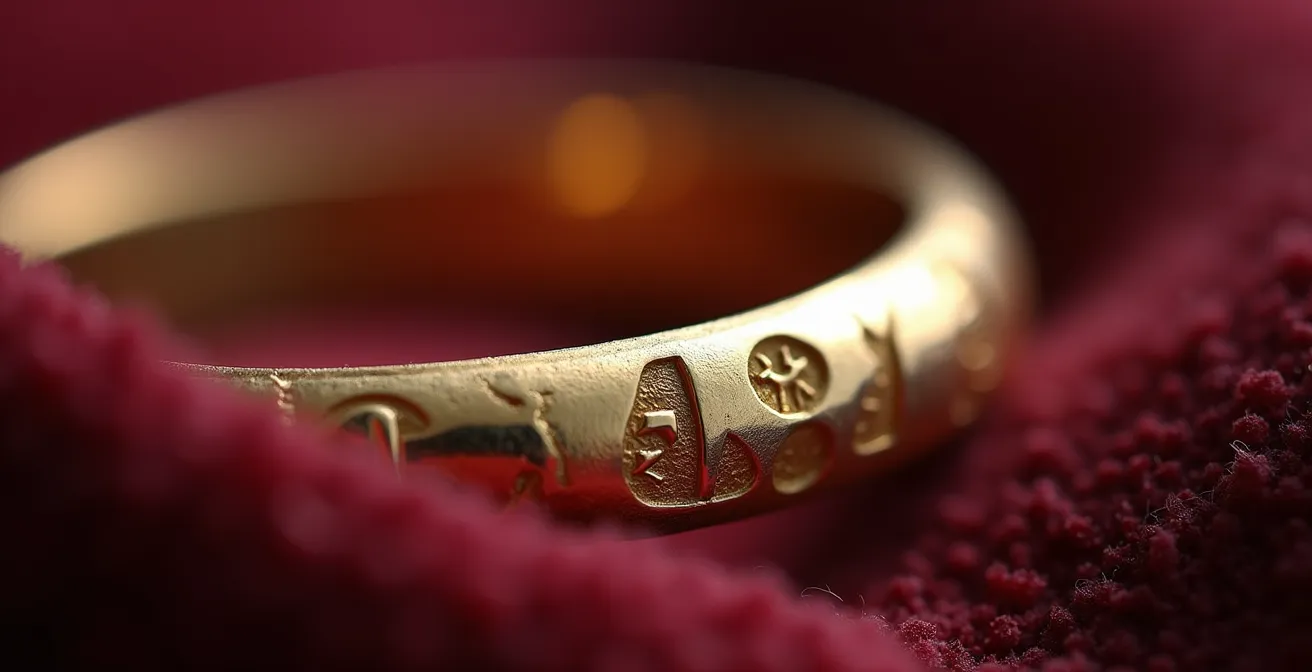
A UK hallmark is the hidden ‘passport’ to your jewellery’s true age and value, but only if you can decipher its language.
- Understanding the interplay between the Assay Office mark, date letter, and maker’s mark separates authentic antiques from costly fakes.
- The UK’s independent testing provides a legal guarantee of metal purity and origin that most simple European stamps do not.
Recommendation: Treat every hallmark as a complete story to be investigated, not just a stamp to be glanced at. This is your primary tool for smart collecting.
For any collector trawling a car boot sale or an online marketplace, the moment of discovery is thrilling. You’ve found a piece of gold jewellery that whispers of a bygone era. But is it a genuine Victorian treasure or a clever 1970s revival piece? The answer is often hidden in plain sight, struck into the metal in a series of tiny, cryptic symbols: the UK hallmark. Many guides simply tell you to match a letter to a chart, but this barely scratches the surface. True authentication isn’t just about identification; it’s about forensic interpretation.
This system, one of the oldest forms of consumer protection in the world, is far more than a simple guarantee of quality. It’s a passport, detailing an item’s journey from its maker, through a specific city’s Assay Office, in a particular year. Understanding this narrative is the single most powerful skill an amateur collector in the UK can possess. It transforms you from a hopeful buyer into a knowledgeable authenticator, capable of distinguishing genuine value from deceptive appearances. A simple ‘750’ stamp tells you the gold content; a full UK hallmark tells you the item’s biography.
This guide moves beyond the basic charts. We will deconstruct the hallmark’s story, exploring how the location of its ‘stamping’ can influence value and how to use subtle clues in letter and shield shapes to pinpoint an exact year. By learning to read this passport correctly, you will gain the confidence to assess authenticity, question online listings, and truly understand the intrinsic and historical worth of your jewellery finds.
To help you master this essential skill, this article breaks down the complex world of UK hallmarking into clear, manageable sections. Below is a summary of the key areas we will explore to turn you into a more discerning and confident collector.
Summary: Reading UK Hallmarks: A Collector’s Guide to Authentication
- Why the anchor (Birmingham) and the leopard’s head (London) change the value?
- How to use date letter charts to know if your ring is from 1974 or 1999?
- UK hallmark vs “750” European: which is the stricter guarantee?
- The mistake of trusting a blurry or misaligned hallmark
- Weight issue: why do some lightweight jewellery pieces lack a legal hallmark?
- The online buying error that costs amateur collectors £3,000
- COSC or METAS: which certification guarantees the best everyday accuracy?
- Lab-Grown vs. Mined Diamonds: Which Holds Value Better in the UK Market?
Why the anchor (Birmingham) and the leopard’s head (London) change the value?
The Assay Office mark does more than just state where an item was tested; it tells a story of provenance and production that directly impacts its market value. The leopard’s head of the London Assay Office, often associated with the luxury jewellers of Hatton Garden, carries a significant prestige. For certain periods, especially for bespoke or high-end designer pieces, a London mark can command a premium at auction. It suggests a connection to the heart of the UK’s luxury jewellery trade.
In contrast, the anchor of the Birmingham Assay Office represents the city’s heritage as the ‘workshop of the world’. Historically, Birmingham was the centre of mass-market jewellery production. While this means the quality of the metal is equally guaranteed, the mark can sometimes imply a more commercial origin rather than high-end craftsmanship. However, this is not a universal rule. The context of the era and the specific maker are crucial. For example, certain Victorian silver lockets or Arts and Crafts pieces from Birmingham are highly sought after by collectors for their specific style and history.
Case Study: The Impact of Origin on Valuation
The historical reputation of an Assay Office can create tangible price differences. Auction records consistently show that for comparable items from certain eras, the origin story matters. For instance, an Art Deco piece marked in London might fetch a 20% higher price than a similar piece from the same year marked in Birmingham. This premium is not for the metal’s quality but for the perceived prestige and association with London’s luxury craftsmanship during that period. This highlights that a hallmark is not just a technical certificate but also a brand of origin.
Therefore, when you identify the Assay Office, you are adding a critical layer to the item’s value narrative. It’s the first clue to understanding its place in the UK’s rich jewellery history, moving your assessment from a simple material check to a nuanced historical valuation.
How to use date letter charts to know if your ring is from 1974 or 1999?
The date letter is the most direct tool for dating a piece, but it requires more than just matching a letter. The context of the font, case, and the shape of the surrounding shield (or cartouche) are crucial for distinguishing between cycles. For instance, a lowercase ‘z’ in a shield might appear in both 1974 and 1999. Without observing the other clues, you could be 25 years off in your valuation.
The key is to understand that the entire design of the date mark changes with each new alphabetical cycle. According to reforms following the UK Hallmarking Act, since 1975, all UK Assay offices use the same date letter, which changes annually in January. Before this, offices had slightly different cycles. The primary differentiators between modern cycles are the font (e.g., Gothic vs. sans-serif) and the shape of the cartouche.
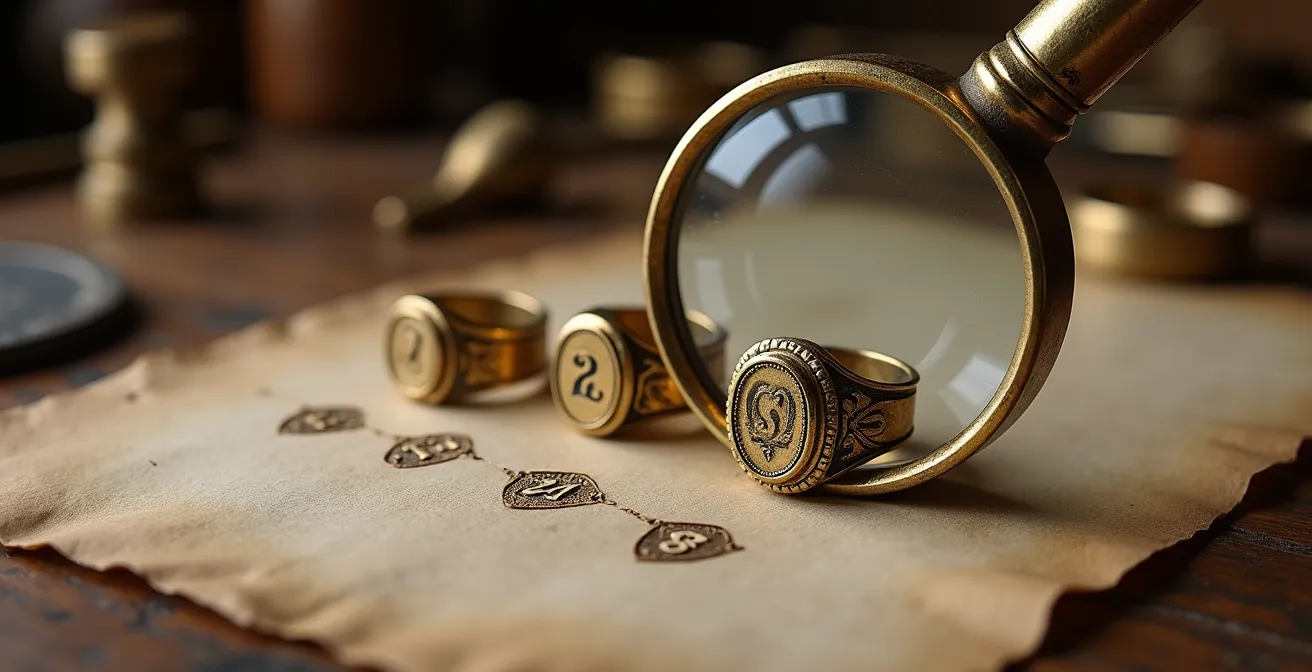
This image demonstrates how the cartouche shape is a vital piece of the puzzle. An oval, a square with cut corners, or a shield shape can immediately place a letter within a specific 25-year period. A collector must use all three elements—the letter, its font, and its shield—to make a definitive identification.
This table illustrates how subtle changes can distinguish between two very similar marks. Relying on the letter alone is a common novice mistake.
| Period | Birmingham Shield Shape | London Shield Shape | Letter Style |
|---|---|---|---|
| 1974-1975 | Square with cut corners | Shield shape | Gothic lowercase |
| 1999-2000 | Square with cut corners | Square | Sans-serif lowercase |
| Key Difference | Font style and case are often more reliable indicators than shield shape alone, as shown by the official Assay Office records. | ||
Mastering this trifecta of letter, font, and shield is what separates a quick guess from an accurate, evidence-based dating of your jewellery.
UK hallmark vs “750” European: which is the stricter guarantee?
This is a critical distinction for any buyer in the UK. A full UK hallmark and a simple ‘750’ stamp may both indicate 18-carat gold, but they represent fundamentally different levels of guarantee. The UK system provides a legally binding, third-party assurance, while the ‘750’ mark is often just a manufacturer’s claim. Understanding this difference is key to protecting yourself as a consumer.
The full UK hallmark is a legal certification. Under the Hallmarking Act 1973, it is illegal to sell an item described as gold, silver, platinum, or palladium in the UK over a certain weight unless it has been independently tested and stamped by an official UK Assay Office. This means the fineness (e.g., 18-carat) has been verified by an impartial body with no commercial interest in the sale. It’s a legal guarantee of purity.
In contrast, a ‘750’ stamp found on many pieces from continental Europe often operates under a system of self-certification. The manufacturer simply stamps the item to declare it contains 750 parts per thousand of pure gold. While reputable brands adhere to this standard, the system relies on an ‘honour system’. There is no compulsory independent verification. Post-Brexit, the rules for imports into the UK have been tightened, and most new items sold in the UK now require a full UK hallmark, further cementing its status as the higher standard for consumer protection.
Ultimately, a UK hallmark provides legal certainty. It’s a promise backed by centuries of regulation. A standalone ‘750’ mark is simply a statement, and its reliability is only as good as the reputation of the manufacturer who applied it.
The mistake of trusting a blurry or misaligned hallmark
One of the most dangerous mistakes a collector can make is to dismiss a poorly struck hallmark as simple ‘wear and tear’. While genuine antique pieces will show age, a blurry, soft-edged, or poorly aligned set of marks is a significant red flag for forgery or alteration. Genuine hallmarks are struck with hardened steel punches, creating crisp, sharp impressions. Fakes are often cast or crudely engraved, resulting in softer edges.
When you encounter a suspicious mark, your forensic investigation begins. Look for inconsistencies. Are the marks in the correct order for the period? Is the maker’s mark from a jeweller who was active in the year indicated by the date letter? Counterfeiters often use genuine punches but apply them incorrectly, or they transpose hallmarks from a low-value item (like a spoon) onto a newly made, high-value piece of jewellery.
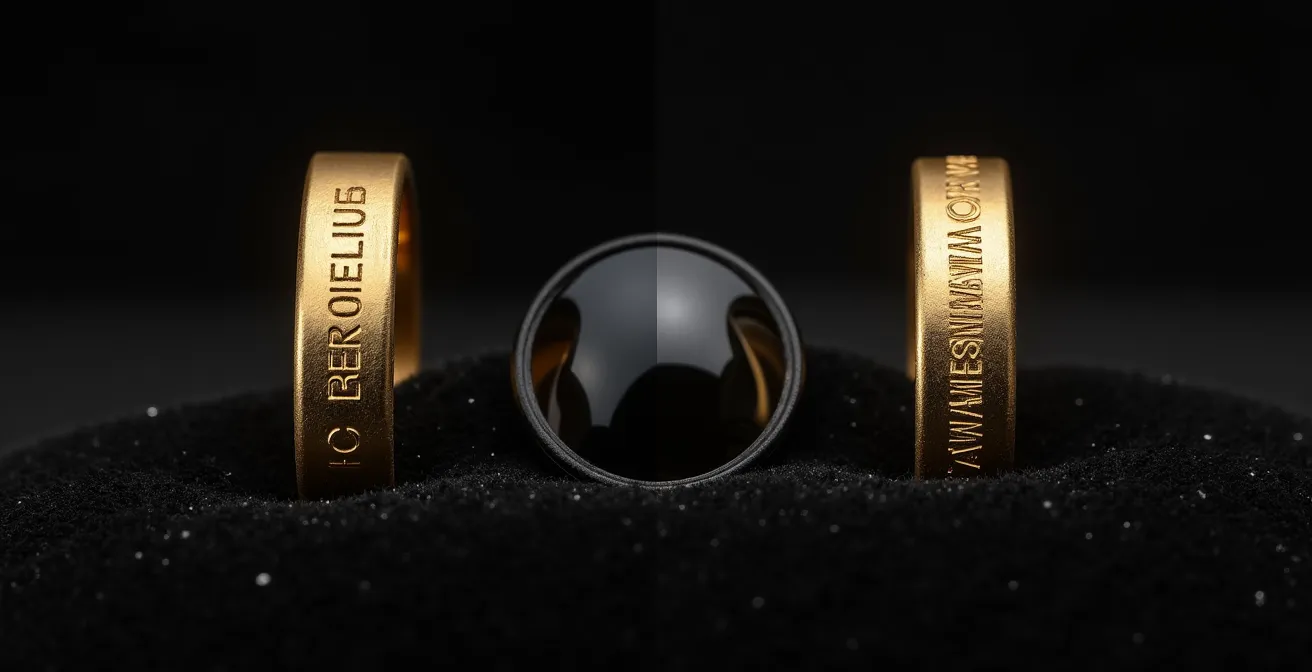
Here are key indicators to help you spot a fake or transposed hallmark:
- Edge Definition: Genuine marks have sharp, well-defined edges. Fakes often look soft or ‘melted’.
- Alignment and Spacing: Official marks are struck with precision. Poorly spaced or misaligned marks are highly suspect.
- Style Consistency: The style of all marks (fineness, office, date) should be consistent with the claimed era.
- Wear Patterns: Natural wear is even and consistent with the item’s use. Artificial distressing can look patchy or forced.
Your 5-Step Hallmark Audit Plan
- Identify Points of Contact: Locate all individual marks on the item. This includes the sponsor’s mark (maker), fineness mark (purity), Assay Office mark, and date letter.
- Collect and Document: Use a 10x loupe to photograph or sketch each mark. Document their order, orientation, and the shape of their cartouches.
- Verify Coherence: Cross-reference the marks. Does the style of the date letter and its cartouche match the official records for the year and Assay Office identified? Was the maker (sponsor’s mark) active in that year?
- Assess Mémorability and Condition: Evaluate the mark’s physical state. Are the edges crisp and the impression deep (a sign of a genuine strike) or are they soft and shallow (a red flag for casting)?
- Formulate an Integration Plan: Based on your findings, decide your next step. If all marks are coherent and crisp, proceed with confidence. If there are inconsistencies or red flags, your plan should be to consult an expert or use a verification service. For definitive authentication of a suspicious item, all 4 UK Assay Offices offer non-destructive XRF testing.
Never assume a mark is legitimate. A blurry hallmark isn’t just hard to read; it’s a loud warning sign that demands closer scrutiny.
Weight issue: why do some lightweight jewellery pieces lack a legal hallmark?
It can be disconcerting to find a piece of jewellery described as gold that bears no hallmark at all. While this is often a sign of a fake, it isn’t always the case. UK law includes specific weight exemptions for mandatory hallmarking, which is crucial knowledge for anyone buying delicate or antique items. Not seeing a hallmark doesn’t automatically mean the item isn’t genuine precious metal.
The Hallmarking Act is designed to protect consumers on significant purchases, and it sets minimum weight thresholds below which hallmarking is not legally required. According to current UK hallmarking regulations, items weighing less than 1.0 gram for gold, 7.78 grams for silver, 0.5 grams for platinum, and 1.0 gram for palladium are exempt. This means that lightweight items like small stud earrings, thin chains, or delicate charms can be legally sold without a hallmark.
This is particularly relevant for antique jewellery. Historically, weight exemptions were different, and many genuine Victorian or Georgian pieces were never hallmarked because they fell below the threshold of their time. This is where a collector’s knowledge of period styles, construction techniques, and materials becomes paramount, as you cannot rely on a hallmark for authentication.
However, many reputable modern jewellers choose to apply for a voluntary hallmark even on exempt items. As retailers like F.Hinds have demonstrated, getting a voluntary mark adds provenance, increases consumer confidence, and enhances the insurability of the piece. For the buyer, a hallmark on a lightweight item is a sign of a transparent and quality-conscious maker, providing the same legal certainty as it would on a heavier, non-exempt piece.
The online buying error that costs amateur collectors £3,000
The online marketplace is a treasure trove for collectors, but it’s also a minefield. The single biggest and most costly error is buying a high-value “antique” based on low-resolution photos and a seller’s description alone, without demanding and verifying clear hallmark evidence. This mistake can lead to paying antique prices for modern reproduction pieces, a lesson that can cost thousands.
The digital distance makes it easy for sellers—intentionally or not—to misrepresent an item. A piece described as “Georgian style” can easily be misread as “Georgian period.” Without a clear, magnified image of the full hallmark, you are buying a story, not an authenticated object. Your only defence is to become a proactive, inquisitive buyer and treat the transaction as an investigation.
The Cautionary Tale of the Georgian Revival Ring
A collector purchased a “Georgian Mourning Ring” online for £3,000, swayed by its classic style and the seller’s convincing narrative. The seller noted that many Georgian pieces were un-hallmarked due to weight exemptions. Upon receiving the item, the buyer took it for valuation, where a tiny, partially obscured hallmark was discovered. It was a 1978 Birmingham mark, revealing the piece to be a 20th-century revival ring with an actual value of around £200. The £2,800 difference was the price paid for not verifying the hallmark before purchase.
To avoid this fate, you must insist on evidence. Before you even consider bidding or buying, ask the seller these five crucial questions:
- Can you provide a clear, magnified photo of the full, complete hallmark, including all individual marks?
- What are all the specific marks you can identify (assay office, date letter, maker’s mark)?
- Is the maker’s mark identifiable and registered with a UK Assay Office?
- Does the date letter you’ve identified match the claimed historical period of the piece?
- Can you confirm if the piece has been independently verified by a member of the National Association of Jewellers (NAJ) or an Assay Office?
A reputable seller will welcome these questions. A hesitant or evasive seller is providing you with your first and most important red flag.
COSC or METAS: which certification guarantees the best everyday accuracy?
When buying a high-end second-hand watch in the UK, you might encounter two different types of quality marks: a movement certification like COSC or METAS, and a UK hallmark on the precious metal case. It is a common and costly mistake to confuse the two. The former certifies the watch’s timekeeping performance, while the latter is a legal guarantee of the metal’s authenticity—and in the UK market, it’s the hallmark that provides the most concrete and protected value.
COSC (Contrôle Officiel Suisse des Chronomètres) and METAS (Federal Institute of Metrology) are Swiss certifications that guarantee a watch movement’s precision and accuracy under various conditions. They are a mark of high-quality horological engineering. However, they have no legal standing in the UK regarding the material of the watch itself. A vintage Swiss watch could have a COSC-certified movement inside a case that is gold-plated, not solid gold.
This is where the UK hallmark becomes indispensable. Since 1907, foreign-made watch cases imported for sale in the UK have been required to be tested and hallmarked at a UK Assay Office. These ‘import marks’ are the only way to be certain that the gold or platinum case is what it claims to be. It protects the buyer from a common issue in the second-hand market: a valuable, certified movement being put into a cheaper, non-original case.
The following table clarifies the distinct roles of these two types of certification for a UK buyer.
| Certification Type | What It Guarantees | UK Relevance |
|---|---|---|
| COSC / METAS | Movement precision and timekeeping | No UK legal requirement; mark of quality |
| UK Hallmark on Case | Precious metal purity and authenticity | Legally required for gold cases over 1g |
| UK Import Marks | Foreign cases tested to UK standards | Special symbols used to denote import |
In essence, while COSC/METAS tells you how well the watch works, the UK hallmark on the case tells you what it’s truly made of. For a collector or investor, the hallmark provides the verifiable, intrinsic value.
Key takeaways
- A full UK hallmark is a legal guarantee of metal purity, not just a maker’s claim like many European marks.
- The combination of Assay Office, date letter, and maker’s mark tells a value story of origin and prestige.
- Blurry, soft, or misaligned marks are major red flags for forgeries and must be investigated, not ignored.
Lab-Grown vs. Mined Diamonds: Which Holds Value Better in the UK Market?
The debate between lab-grown and mined diamonds is a major topic in the jewellery world, with significant implications for long-term value. While the market for both is still evolving, for a UK buyer, the hallmark on the setting provides a foundational, guaranteed element of value that exists completely independently of the stone’s origin. This is a crucial “safety net” for any purchase.
The value of both lab-grown and mined diamonds can fluctuate based on market trends, consumer perception, and changes in supply. However, the precious metal of the setting—be it gold or platinum—has an intrinsic, commodity-based value that is legally certified by the hallmark. For example, a 950 platinum hallmark guarantees that the item is 95% pure platinum, regardless of whether the diamond it holds is natural or man-made. This provides a baseline of tangible, recoverable worth that is recognised by any jeweller, pawnbroker, or insurer in the UK.
This is particularly important from an insurance perspective. UK jewellery insurers assess a hallmarked setting as having a guaranteed intrinsic value. While they will also assess the stones, the hallmark provides one incontrovertible element of the piece’s total worth. It future-proofs the purchase to an extent, ensuring that even if perceptions of diamond value shift dramatically, a core component of the item’s value remains legally documented and secure.
Therefore, when considering a piece with any type of diamond, the first step should always be to verify the hallmark on the setting. It establishes the non-negotiable, material foundation of your investment, giving you a solid platform from which to then assess the more subjective value of the featured gemstones.
By mastering the language of hallmarks, you are no longer just a buyer; you are an archivist and an authenticator. You carry the tools to uncover the true story and value locked within each piece of jewellery. To begin putting these skills into practice, the next logical step is to start building your own reference library of trusted resources and expert contacts.