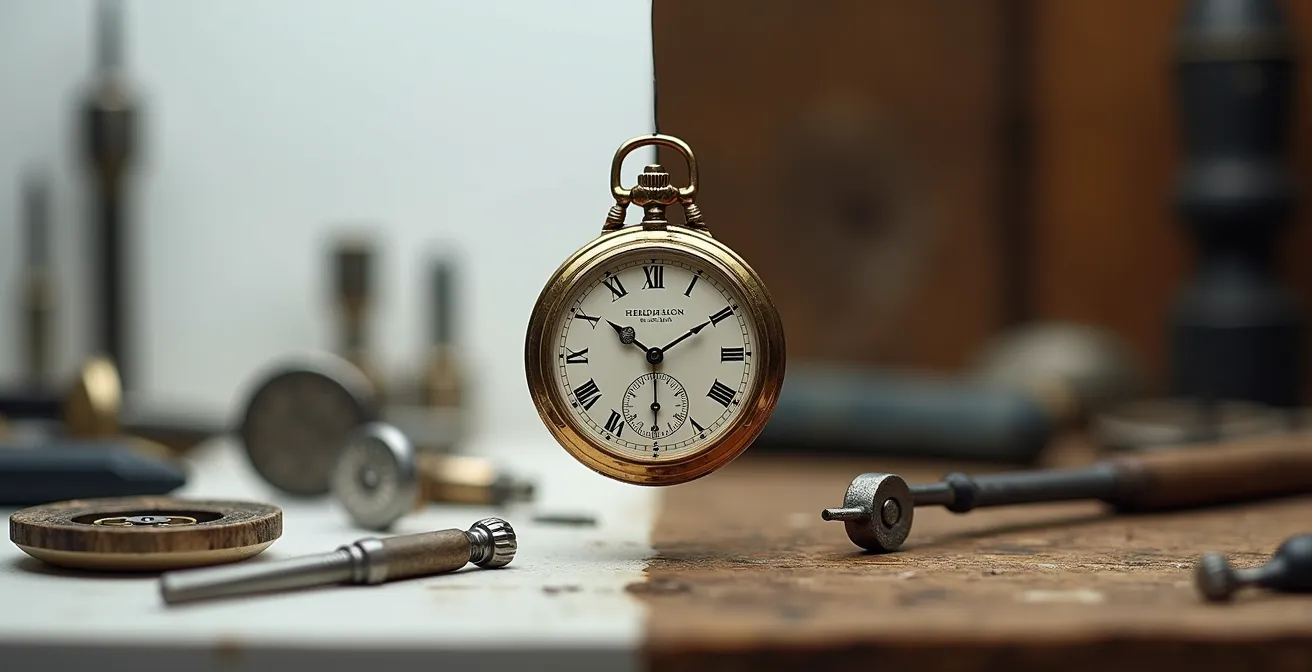
The battle for horological supremacy is not a simple contest of past glory versus future potential; it is a fundamental clash of philosophies, pitting Swiss industrial scale against the resurgent British artisanal soul.
- The ubiquitous “Swiss Made” label is a compromise, requiring only 60% of value to be Swiss, a stark contrast to the radical transparency championed by many new British makers.
- British watchmaking’s revival offers collectors a powerful narrative of reclaimed heritage and direct, local access to the artisan, an increasingly valuable asset in a post-Brexit world.
Recommendation: For the discerning UK collector, the most rewarding investment lies not in mass-produced prestige, but in the verifiable authenticity, compelling story, and tangible craftsmanship of Britain’s independent horologists.
For over a century, the question of horological supremacy had a single, resolute answer: Switzerland. The Alpine nation became synonymous with luxury, precision, and an almost mythical watchmaking tradition. To own a Swiss watch was to own the best. It’s a narrative so powerful, so deeply ingrained, that it has overshadowed a vital piece of history: for a glorious period, the world’s horological heart beat not in Geneva, but in London. Britain was the undisputed master of time, pioneering the innovations that would define the modern watch.
The subsequent decline of our national industry is a story of industrial might, missed opportunities, and the quiet fading of a craft. Today, however, the silence is broken. A powerful revival is underway, not in towering factories, but in small workshops from the Isle of Man to the heart of Norfolk. This isn’t merely a “comeback”; it’s a conscious ideological response to the very system that once eclipsed it. The modern British watchmaker isn’t trying to out-Swiss the Swiss. Instead, they are forging a new identity built on the very principles the mass-market abandoned: uncompromising craftsmanship, radical transparency, and a direct connection to a proud, reclaimed heritage.
This article does not seek to declare a simple winner. It aims to tell the story of this rivalry from a British perspective. We will explore the historical ghost of our industrial past, witness the artisanal purity of its modern rebirth, and deconstruct the myths that prop up old hierarchies. We will ask a crucial question for any British enthusiast or collector: in a world of globalised luxury, where does true value lie? Is it in the established prestige of Swiss ancestral expertise, or in the vibrant, defiant spirit of the British watchmaking revival?
This guide delves into the core of the rivalry, examining the historical context, the current leaders of the British charge, and the practical considerations for anyone looking to invest in our nation’s horological future. The following sections will provide a clear map of this fascinating landscape.
Summary: A Collector’s Guide to the Anglo-Swiss Watchmaking Rivalry
- Why did England lose its watchmaking dominance in the 19th century?
- How does Roger Smith carry on the George Daniels’ legacy on the Isle of Man?
- Swiss mass production or English boutique workshop: which model to support?
- The error of believing that “Swiss Made” means 100% Swiss
- When to invest in independent British watchmakers?
- Made-to-Measure en ligne ou High Street retouché : quelle est la meilleure valeur ?
- Why do the anchor (Birmingham) and the leopard’s head (London) change the value?
- Beyond the Big Three: Underrated Renowned Houses for UK Collectors
Why did England lose its watchmaking dominance in the 19th century?
To understand the pride and passion fuelling Britain’s modern watchmaking revival, one must first confront the scale of our historical loss. In the 18th and early 19th centuries, Britain was not just a player in horology; it was the epicentre. London, particularly Clerkenwell, was the Silicon Valley of its day, home to master craftsmen who invented key technologies like the lever escapement. Yet, by the dawn of the 20th century, our dominance had evaporated. The reason was not a lack of skill, but a rigid adherence to a production model that was brilliant, yet ultimately fragile.
The British system was built on a network of individual, hyper-specialised artisans. One master would make only springs, another only dials, all working in close proximity. This method produced timepieces of unparalleled quality but was slow and fiercely resistant to mechanisation. In contrast, the Swiss were perfecting a system known as établissage. This decentralised model broke down watchmaking into simpler, repeatable tasks that could be performed by less-skilled workers, often in their own homes in the Jura mountains. This approach was perfectly suited for the nascent Industrial Revolution.
The numbers tell a stark story of this industrial divergence. Historical production data reveals that in 1850, Switzerland produced more than two million watches while Great Britain produced a mere 200 thousand. The Swiss had embraced scale, while we revered the individual artist. As the world market demanded more affordable and accessible timepieces, our industry, shackled to its glorious but inefficient past, began its long, painful collapse.
This table illustrates the fundamental philosophical and practical differences between the two competing systems that decided the fate of 19th-century watchmaking. The Swiss model’s adaptability to mass production ultimately sealed its victory over the British artisan system, an “industrial ghost” that haunts and inspires the revival today.
| Aspect | Swiss Établissage System | British Artisan System |
|---|---|---|
| Production Method | Decentralized, parts made in different locations | Individual hyper-specialized artisans |
| Location | Swiss Jura villages | Clerkenwell, London |
| Adaptability | Easily mechanized for mass production | Resistant to industrialization |
| Market Result | Dominated with 2/3 of world output by 1870 | Industry collapsed by end of Victorian era |
How does Roger Smith carry on the George Daniels’ legacy on the Isle of Man?
If the ghost of Britain’s industrial past represents a cautionary tale, then the work of Roger W. Smith on the Isle of Man is its spiritual redemption. Smith is not merely a watchmaker; he is the custodian of a sacred horological flame, the direct protégé and designated successor to the legendary Dr. George Daniels. Daniels, a man who almost single-handedly revived the art of handmade watchmaking in the 20th century and invented the revolutionary Co-Axial escapement, chose Smith to carry his life’s work forward. This is not a legacy of branding or marketing, but one of pure, unadulterated craft.
Smith embodies the “Daniels Method,” a philosophy that dictates a watch should be made from raw materials, by hand, under one roof. It is the absolute antithesis of the Swiss établissage system. In his tranquil workshop, Smith is a one-man manufacture. The results of this devotion are staggering: an official case study notes that Smith himself has mastered 32 of the 34 unique skills needed to transform metal bars and sheets into a finished, ticking masterpiece. This “artisanal purity” means that just seventeen watches leave his workshop each year, each one a testament to thousands of hours of labour and the culmination of a multi-year waiting list.
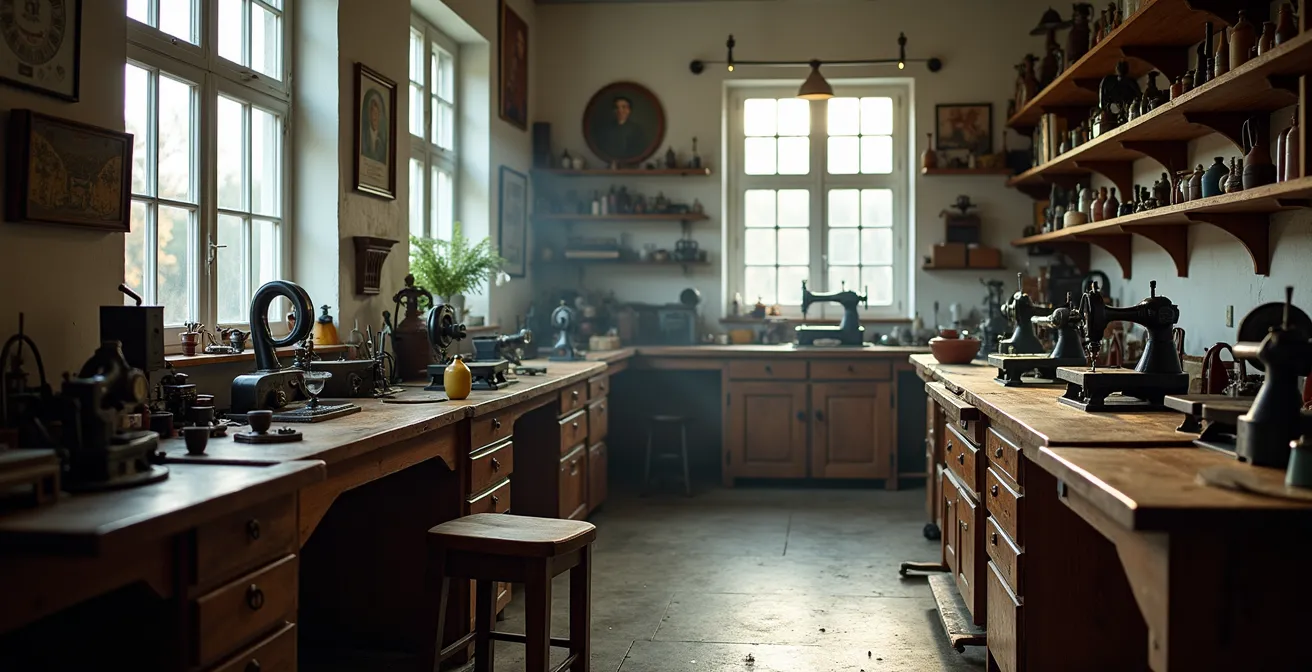
The serene, meticulously organised workshop pictured above is the temple of this philosophy. It is a space where time slows down, and every tool serves the singular purpose of creating horological art. Yet, Smith himself is pragmatic about the role of his ultra-artisanal approach in the broader British revival. In a candid interview, he stated a crucial point of tension:
We cannot rebuild an industry on the back of artisanal watchmaking. It just won’t work.
– Roger W. Smith, Europa Star interview
Smith’s work is the pinnacle, the North Star of the British revival, proving that the highest levels of craft are once again alive on our shores. But he acknowledges it is not a scalable model for an entire industry. His role is to be the standard-bearer, the living proof of what is possible, inspiring a new generation of watchmakers to find their own path between pure art and viable commerce.
Swiss mass production or English boutique workshop: which model to support?
The contrast between Roger Smith’s seventeen-watch-a-year output and the millions produced by Swiss giants frames the central philosophical choice for the modern collector. On one side, you have the Swiss industrial machine, a model honed over 150 years for efficiency, scale, and global brand dominance. On the other, the burgeoning British boutique model, which champions small scale, direct-to-creator relationships, and a narrative of national pride. To ask which model to “support” is to ask what you truly value in a luxury timepiece.
The Swiss model is an undisputed commercial titan. Its power lies in a paradox: while it may produce millions of watches, its grip on the luxury sector is absolute. Astounding market analysis shows that Swiss watches account for fewer than 2% of units sold globally, but more than 50% of the market’s overall value. This demonstrates an unparalleled mastery of brand building, marketing, and perceived prestige. When you buy a Swiss luxury watch, you are buying into a global symbol of success, backed by an industrial powerhouse and a vast distribution network. It is a safe, understood, and universally recognised choice.
The English boutique workshop offers a fundamentally different proposition. It is a vote for provenance and personality. Supporting a brand like Fears or Garrick is not an anonymous transaction; it is often a personal investment in a founder’s vision and a workshop’s specific skills. You are buying a piece of a story—the story of a reclaimed family legacy, the mastery of a specific craft like engine-turning in Norfolk, or the revival of a military design. The value is not just in the object, but in its creation, its rarity, and its direct link to a person and a place here in the UK. This model replaces the allure of global ubiquity with the power of authentic scarcity and a tangible connection to the craft.
Ultimately, supporting the Swiss model reinforces the status quo of industrial luxury. Supporting the British boutique model is an act of patronage. It helps build a new, diverse, and resilient horological ecosystem on home soil. It is a choice between owning a globally recognised symbol and owning a piece of a national industrial renaissance.
The error of believing that “Swiss Made” means 100% Swiss
For decades, the “Swiss Made” label on a watch dial has been the ultimate seal of approval, a shorthand for quality and authenticity that consumers have trusted implicitly. It evokes images of skilled artisans in tranquil Alpine villages, crafting every component with meticulous care. While Switzerland undoubtedly produces magnificent timepieces, the legal definition of “Swiss Made” is far more pragmatic—and far less romantic—than this popular image suggests. Believing it signifies a 100% Swiss product is a common and significant misunderstanding.
The reality is governed by what could be called the “60% Compromise.” To earn the coveted label, the official Swiss Made criteria requires only that a minimum of 60% of the watch’s production value must be generated in Switzerland. The movement must be Swiss, it must be cased up in Switzerland, and the final inspection must happen there. However, this leaves a considerable 40% of the value that can originate from anywhere in the world. This means that cases, dials, hands, and straps can—and often do—come from specialist manufacturers in Asia or elsewhere, without violating the letter of the law.
This is not a deception, but an industrial reality. The Swiss have built an incredibly efficient global supply chain. Yet, it stands in stark contrast to the emerging philosophy of the British revival. Rather than hiding behind a percentage-based rule, many new UK brands are turning radical transparency into a core part of their identity. A case study of the British sector highlights this trend: many of the UK’s most prominent names, including Bremont and Christopher Ward, openly acknowledge their reliance on Swiss movements or components from global partners, even as they increase their UK-based manufacturing capabilities. They are not trying to pretend to be something they’re not. Instead, they are building trust with educated buyers by being honest about their supply chains, celebrating the parts made in Britain while acknowledging the partners who help make their watches possible.
This transparency is a powerful marketing tool. It appeals to a modern consumer who values authenticity over ambiguous labels. While “Swiss Made” remains a powerful mark of quality, the British revival proposes a new standard: “Honestly Made,” where the story of where and how a watch is created becomes as valuable as the flag on the dial.
When to invest in independent British watchmakers?
The question of investment in British horology moves beyond philosophy and into the realm of tangible assets and market timing. For a patriot or a history enthusiast, the answer is always “now,” as each purchase supports the revival. But for the collector considering financial appreciation, the question is more nuanced. The key is to understand that you are not investing in a commodity, but in art, scarcity, and narrative. The time to invest is when you find a maker whose story and craftsmanship resonate on a personal level, backed by growing evidence of market recognition.
The top of the British market provides a compelling case for long-term value. Watches from Roger W. Smith are the ultimate “blue chip” assets of this new era. Their extreme rarity and unimpeachable quality mean they are already achieving spectacular results at auction. For example, recent auction results demonstrate a Series 1 piece achieving £600,000, a figure that was twice its reserve price. This is not just a watch; it’s a piece of horological history whose value is appreciating dramatically due to a supply that can never meet the immense global demand.
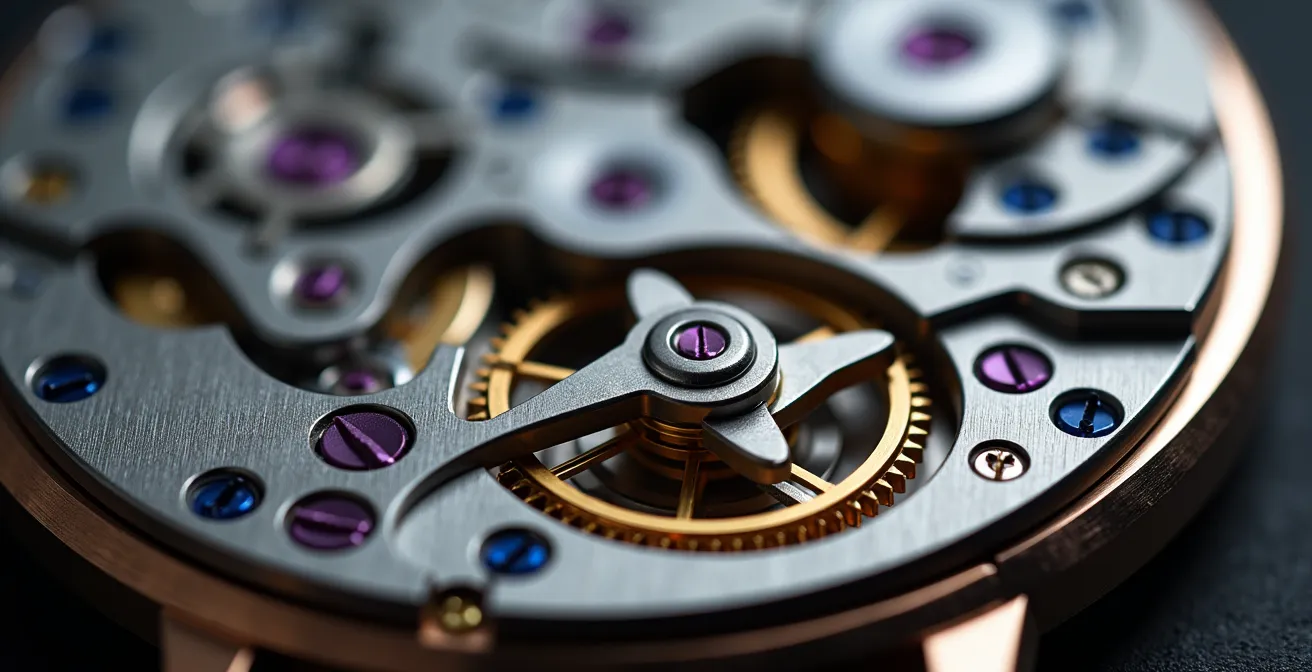
This level of investment is out of reach for most. However, the principle applies across the spectrum of the British revival. The time to invest in a maker like Garrick, Fears, or anOrdain is precisely when their waiting lists begin to grow, and their unique proposition—be it in-house movements, reclaimed heritage, or artisanal dials—starts to gain traction among connoisseurs. You are investing just ahead of the broader market recognition. The intricate, hand-finished movements and dials, like those depicted in the close-up above, are the tangible evidence of the value being created.
The emotional return on these investments is as significant as the financial one. These are not mass-produced objects; they are the life’s work of passionate individuals. As Roger Smith himself eloquently put it when describing his clients’ motivations: “There’s something in my story that [my clients] understand and appreciate, a counter to the otherwise frenetic world we live in maybe, or an appreciation in seeing someone use their hands to produce things.” Investing in an independent British watchmaker is an investment in this very sentiment—a tangible piece of authenticity in a digital world.
Made-to-Measure en ligne ou High Street retouché : quelle est la meilleure valeur ?
Interpreting this question in the context of horology, the core debate is clear: what offers better long-term value for a British collector? A bespoke or highly personalised piece from a UK independent, or an off-the-shelf icon from a Swiss brand, purchased from a high street Authorised Dealer (AD)? The answer is not simply about the initial price tag; it is about the total cost of ownership, the ownership experience, and the potential for appreciation.
The initial outlay for a British bespoke piece can vary enormously, but it often involves a significant waiting period. This is the “cost” of true craftsmanship. In return, the buyer receives an unparalleled level of customisation and a direct relationship with the maker. Servicing is local, personal, and avoids the complexities and costs of international shipping—a significant advantage in a post-Brexit Britain. Conversely, a Swiss icon from an AD may have a lower entry price, but often comes with its own notorious waitlist. Customisation is minimal, and servicing can require sending a cherished timepiece abroad for months, incurring shipping costs, insurance, and potential customs headaches.
The secondary market is where the value proposition becomes even more distinct. While a popular Swiss steel sports watch offers high liquidity, its appreciation can be volatile and subject to market hype. The market for bespoke British watches is less liquid, but pieces from established makers demonstrate exceptionally strong, steady appreciation due to their inherent rarity. You may not be able to sell it overnight, but the right piece is highly likely to increase in value significantly over time.
The following table provides a clear analysis of the value factors, comparing the experience of commissioning a British independent piece against acquiring a Swiss icon from a traditional retailer. The “best value” depends entirely on whether an owner prioritises liquidity and brand recognition or customisation, personal connection, and long-term appreciation potential.
| Factor | Bespoke British Independent | Swiss Icon from AD |
|---|---|---|
| Initial Cost | £10,000-£150,000+ | £5,000-£50,000 |
| Wait Time | 2-5 years | Waitlist varies (0-10 years) |
| Servicing | Direct local UK maker access | International shipping may be required |
| Customization | Full collaborative design process | Limited or no customization |
| Secondary Market | Limited liquidity but strong appreciation | High liquidity, variable appreciation |
Why do the anchor (Birmingham) and the leopard’s head (London) change the value?
For a British watch, the small, almost hidden marks stamped into its case—the anchor of the Birmingham Assay Office or the leopard’s head of London—are far more than simple legal requirements. They are a profound statement of identity and a direct, unbroken link to centuries of British craftsmanship. In the context of the modern revival, these hallmarks have become a critical tool for “reclaiming heritage.” They are a powerful differentiator from globalised luxury, and for the educated collector, they tangibly increase a watch’s value by anchoring it in a uniquely British story.
The British hallmarking system is one of the oldest and most respected forms of consumer protection in the world. For a watch case made of a precious metal, these marks guarantee its purity. But their significance now runs much deeper. For a new brand, choosing to have its cases assayed in London or Birmingham is a conscious act. It is a declaration of intent, a way of physically embedding the watch into the lineage of British goldsmithing and silversmithing that predates watchmaking itself. It’s a stamp of authenticity that no overseas manufacturer can replicate.
Modern brands like Fears, a historic Bristol company refounded in 2016 after decades of dormancy, masterfully leverage this connection. As one analysis notes, Fears demonstrates the challenge of extending a legacy authentically. By choosing to use traditional British hallmarks on their modern timepieces, they are not simply engaging in nostalgia. They are making a marketing and authenticity statement, connecting a 21st-century product directly to a heritage that began in 1846. It tells the consumer that while the watch is new, its soul is rooted in a long and proud national tradition. This act transforms a simple component into a piece of the narrative, adding a layer of historical value that resonates deeply with collectors.
As one industry analysis aptly states, “British watchmaking heritage isn’t about living in the past, it’s about channelling historical excellence into contemporary relevance.” The leopard’s head or the anchor are the physical manifestation of this philosophy. They certify not just the metal’s purity, but the purity of the watch’s intent as a genuinely British object, thereby increasing its cultural and, ultimately, its monetary value.
Key Takeaways
- Britain’s 19th-century watchmaking dominance was lost not to inferior skill, but to a rigid artisanal system unable to compete with Switzerland’s adaptable, industrial-scale établissage model.
- The modern British revival is a philosophical counter-movement, championing hands-on craftsmanship and transparency, as exemplified by Roger W. Smith’s continuation of the Daniels Method.
- Supporting British boutique brands is an act of patronage that fosters a diverse national industry, offering a narrative of authenticity and direct creator access that contrasts with the “60% compromise” of the ‘Swiss Made’ label.
Beyond the Big Three: Underrated Renowned Houses for UK Collectors
While Roger W. Smith represents the aspirational pinnacle of the British revival, the movement’s true strength lies in its growing breadth and diversity. A new generation of brands is creating exceptional timepieces at more accessible price points, each offering a unique reason to invest in British horology. For the UK collector, looking beyond the most famous names reveals a landscape rich with opportunity, innovation, and authentic British character. The community is thriving, as shown by the fact that the growing British watchmaking community includes over 40 member brands in the Alliance of British Watch and Clock Makers alone.
Exploring this ecosystem means discovering specialists who are masters of a particular craft. Brands like anOrdain, for example, have revived the difficult art of grand feu vitreous enamel dials in their Glasgow workshop, creating watches with a depth of colour and artistry that is rare at any price point. In Norfolk, Garrick produces timepieces with intricate, engine-turned dials and in-house movements that rival the finishing of historic Swiss houses. These are not assembly brands; they are centres of excellence in specific, highly-skilled disciplines.
Other brands leverage our nation’s rich history. Vertex, one of the original twelve suppliers of watches to the British military in WWII (the “Dirty Dozen”), has been revived, continuing its legacy of robust, legible, and historically significant tool watches. Meanwhile, a brand like Christopher Ward, a pioneer of the direct-to-consumer model, has consistently proven that Swiss-made quality can be delivered with British design and revolutionary value. They may not be “artisanal” in the same way as Smith, but their contribution to making quality watchmaking accessible is a vital part of the ecosystem. The following checklist provides a starting point for any collector looking to build a “Patriot’s Portfolio.”
Your Action Plan: Identifying Key British Contenders
- Garrick: Investigate their Norfolk workshop’s output, focusing on their in-house movements and engine-turned (guilloché) dials that represent the peak of British decorative craft.
- anOrdain: Research their unique vitreous enamel dial process. Consider them for a collection piece defined by artistry and colour, a skill few in the world possess.
- Vertex: Explore their connection to the original “Dirty Dozen” military watches. Target them if your interest is in authentic British military heritage and robust design.
- Fears: Assess their classical designs and obsessive attention to detail. Note their growing waiting lists as a sign of a brand with rapidly increasing collector demand.
- Christopher Ward: Analyse their direct-to-consumer offerings, particularly their in-house Calibre SH21, as an example of exceptional value and British-driven horological engineering.
The choice is no longer simply “Swiss or nothing.” It is a choice between a legacy of industrial scale and a revival of artisanal soul. For the British collector, the opportunity is not just to own a fine timepiece, but to own a piece of our own industrial history, reclaimed and ticking proudly into the future. To get started, the next logical step is to explore the work of these independent houses and discover which story and style resonates most strongly with you.