
The secret to impeccable style isn’t a high price tag, but a strategic investment in fit and fabric intelligence.
- An expertly altered £150 suit from the high street consistently looks more impressive than an ill-fitting £500 suit off-the-rack.
- Mastering the art of identifying quality fabrics and understanding proportion is more critical for a sharp silhouette than chasing expensive brand names.
Recommendation: Shift your mindset from buying finished clothes to acquiring quality ‘raw materials’ from high street stores, and always budget for professional tailoring to truly unlock their potential.
For any young professional in the UK, the ambition to dress with distinction can feel like a battle against a tight budget. You see colleagues in sharp, well-fitting attire and assume it’s the result of expensive bespoke appointments or designer labels far out of reach. The common advice you’ll hear is to “invest in quality” or “save up for timeless pieces,” which, while true, isn’t particularly helpful when you need to look smart for a meeting next week. The high street, with its endless racks of affordable options from chains like M&S or Next, seems like the only practical solution, but it often feels like a compromise that leaves you with a wardrobe that’s functional but lacks true elegance and personality.
But what if the entire premise is flawed? What if the key to unlocking sartorial style isn’t about the price tag on the suit, but about the intelligence you apply after the purchase? The real secret lies in viewing high street clothing not as a finished product, but as a high-quality starting point. It’s about mastering the art of ‘architectural alteration’—a strategic approach where a small investment in a local tailor can transform an ordinary garment into something that looks and feels custom-made. This isn’t just about hemming trousers; it’s about sculpting a silhouette.
This guide is designed to shift your perspective. We’ll move beyond the generic advice and give you a practical framework for building a sophisticated wardrobe on a realistic budget. We’ll explore how to develop fabric intelligence to avoid poor-quality materials, understand the crucial economics of alterations versus made-to-measure, master the non-negotiable rules of proportion, and identify the foundational pieces that will form the backbone of your new, elevated style. Get ready to turn the high street into your personal outfitter.
Summary: Adopting Sartorial Style on a High Street Budget
- Why a £20 Alteration Is Better Than a Poorly Fitting £500 Suit
- How to Spot Sweaty Polyester on the High Street Racks
- Made-to-Measure Online or High Street Retouched: What Is the Best Value?
- The Mistake of Wearing a Slim Tie With Wide Lapels
- Where to Start: The 3 Foundational Pieces of Sartorial Style
- Why a 44mm Watch Ruins the Elegance of a French Cuff Shirt
- How to Determine the Ideal Trouser Width for a Suit vs. Jeans
- Is Buying Recycled Polyester Actually Good for the Planet?
Why a £20 Alteration Is Better Than a Poorly Fitting £500 Suit
The single biggest misconception in men’s style is that a higher price tag equals a better look. The truth is, a £500 off-the-rack suit that hangs off your shoulders or bunches at the ankles will always look cheaper than a £150 high street suit that has been expertly tailored to your body. Fit is the ultimate status symbol, not the brand label inside the jacket. This is where the power of ‘architectural alteration’ comes into play. By setting aside a portion of your budget for a good local tailor, you are not ‘fixing’ a cheap suit; you are completing its manufacturing process.
The costs are surprisingly modest when compared to the value they unlock. For instance, an analysis of UK tailoring prices shows that shortening jacket sleeves costs £22.66 on average. This single, simple adjustment can completely change the silhouette of a jacket, preventing the dreaded look of ‘borrowed’ clothing. Key alterations like hemming trousers or taking in the jacket waist are similarly affordable and transform a generic garment into one that appears bespoke. The key is to see these costs not as an extra expense, but as an integral part of the purchase price.
Case Study: The £215 M&S Masterpiece
A style-conscious professional purchased a standard £150 wool-blend suit from Marks & Spencer. While the fabric quality was solid, the fit was generic. He then invested a further £65 in professional alterations: shortening the sleeves (£25), hemming the trousers (£15), and suppressing the jacket waist for a sharper V-shape (£25). The final result was a suit that draped perfectly, created a powerful silhouette, and easily rivalled the appearance of made-to-measure suits costing over three times as much. This proves that strategic investment in fit on a quality high street base delivers exceptional, tangible value.
The goal is to reframe your shopping strategy. When you see a £200 suit, don’t just ask if you can afford it. Instead, think of it as a £150 suit with a £50 budget for alterations. This mindset shift is the first and most crucial step toward achieving a truly sartorial look without the associated cost.
How to Spot Sweaty Polyester on the High Street Racks
Walking into a high street store can feel like navigating a minefield of synthetic fabrics. With about 60% of today’s clothing containing polyester, it has become the default choice for fast fashion due to its low cost. However, for anyone aspiring to a sartorial look, cheap polyester is the enemy. It looks shiny and unnatural, it wrinkles poorly, and most importantly, it doesn’t breathe. This is especially critical in the UK’s variable climate, where a non-breathable fabric will leave you feeling clammy and uncomfortable. Developing ‘fabric intelligence’ is your best defence.
You don’t need to be a textile expert to distinguish good from bad. Your hands and ears are the best tools. First, the ‘crinkle test’: grab a handful of the fabric and squeeze. Cheap, low-quality polyester will often make a distinct, slightly plastic-like crinkling sound and feel slippery or slick. Natural fibres like wool or high-quality cotton will feel softer and make minimal noise. Next, observe how the fabric reflects light. A tell-tale sign of cheap synthetics is an unnatural, uniform sheen. Natural fibres have a more complex, matte finish with visible texture.
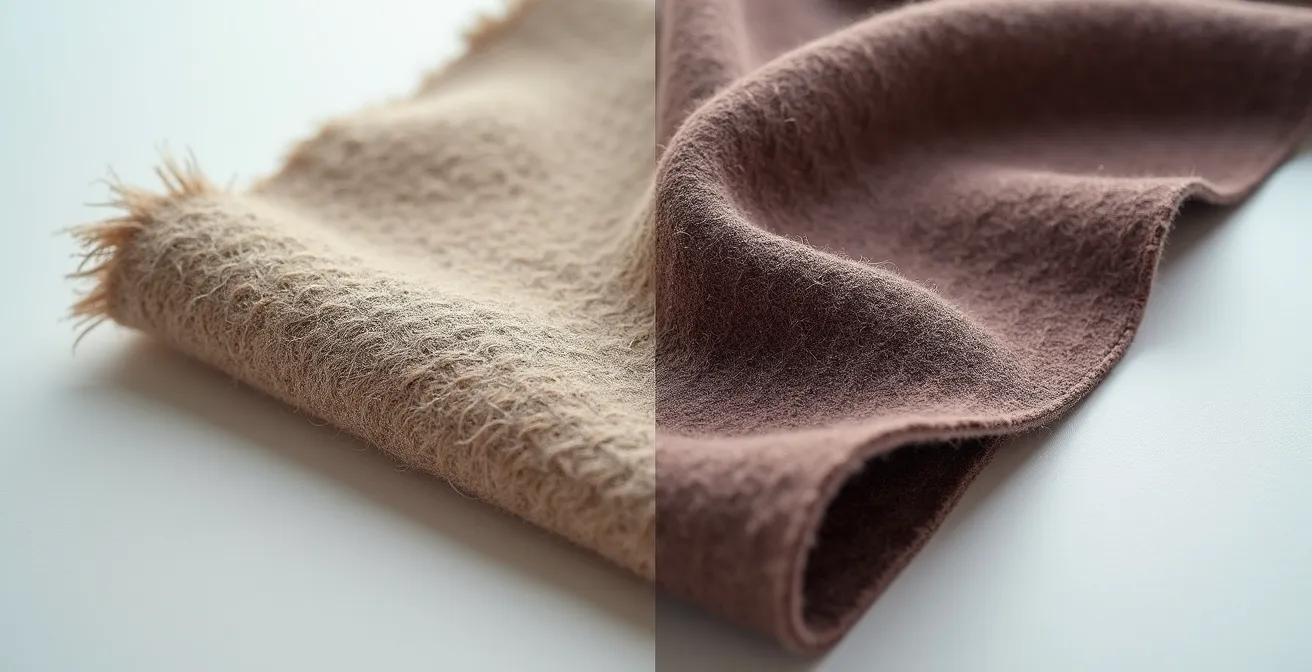
As the image above illustrates, the difference is stark when viewed up close. Wool fibres have depth and variation, while polyester presents a flat, lifeless surface. The reason polyester makes you sweat is simple: it’s essentially plastic. It’s non-absorbent and traps moisture against your skin. Wool, on the other hand, is a natural wonder; it’s a temperature-regulating fibre that can absorb up to 30% of its weight in moisture before feeling wet, wicking it away from your body to keep you dry and comfortable. Prioritising natural fibres or high-quality blends is a non-negotiable part of dressing well.
Made-to-Measure Online or High Street Retouched: What Is the Best Value?
As you begin to appreciate the importance of fit, the world of online made-to-measure (M2M) can seem like the logical next step. Brands promise a custom fit at a fraction of bespoke prices. However, for the budget-savvy professional, the choice between a tailored high street suit and an entry-level online M2M suit is a crucial one, and the answer isn’t always obvious. The key is to analyse the total investment and associated risk, not just the initial sticker price.
A tailored high street suit offers predictability and control. You can try the garment on, assess the base fabric quality in person, and have a direct conversation with a local tailor. The risks are minimal. In contrast, online M2M introduces numerous variables: accurately taking your own measurements is difficult, you can’t feel the fabric beforehand, and if the final product isn’t quite right, dealing with international returns and further adjustments can be costly and time-consuming. The hidden costs of shipping, import duties, and potential correction tailoring can quickly inflate the final price.
| Factor | High Street + Local Tailor | Online Made-to-Measure |
|---|---|---|
| Initial Cost | £150 (Next/M&S suit) | £350 (SuitSupply basic) |
| Alterations/Adjustments | £50-70 | £0 (if perfect) or £30+ for fixes |
| Shipping & Import | £0 | £25-40 + potential VAT |
| Returns Risk | Low – try before buying | High – complex international returns |
| Total Investment | £200-220 | £375-420+ |
| Time to Receive | 1-2 weeks with alterations | 4-8 weeks production + shipping |
As the comparison shows, the tailored high street path often provides a superior value proposition for those starting out. For approximately half the total investment of an online M2M suit, you can achieve a fantastic result with significantly less risk and a much faster turnaround time. While online M2M can be a great option once you have a very clear understanding of your measurements and preferred fit, the high-street-plus-tailor strategy remains the undefeated champion for value and reliability.
The Mistake of Wearing a Slim Tie With Wide Lapels
Achieving a sartorial look goes beyond fit and fabric; it’s about creating visual harmony through proportion. This is where many well-intentioned men stumble. One of the most common and jarring mistakes is mismatching the width of the tie and the jacket lapel. Wearing a skinny tie (a remnant of early 2010s trends) with a classic, wider lapel creates a visual imbalance that instantly undermines the entire outfit. The rule is simple: the widest point of your tie should be roughly the same width as the widest point of your lapel.
This principle of harmony extends to every element of your outfit. It’s a system. The size of your shirt collar points, the scale of your tie knot, the pattern on your pocket square, and even the thickness of your watch all need to work together. A wide, spread collar shirt demands a more substantial tie knot (like a Half-Windsor) and a wider tie to fill the space, while a narrow point collar works better with a slimmer tie and a simple four-in-hand knot. Think of it as composing a picture: every element must be in scale with the others to create a pleasing whole.
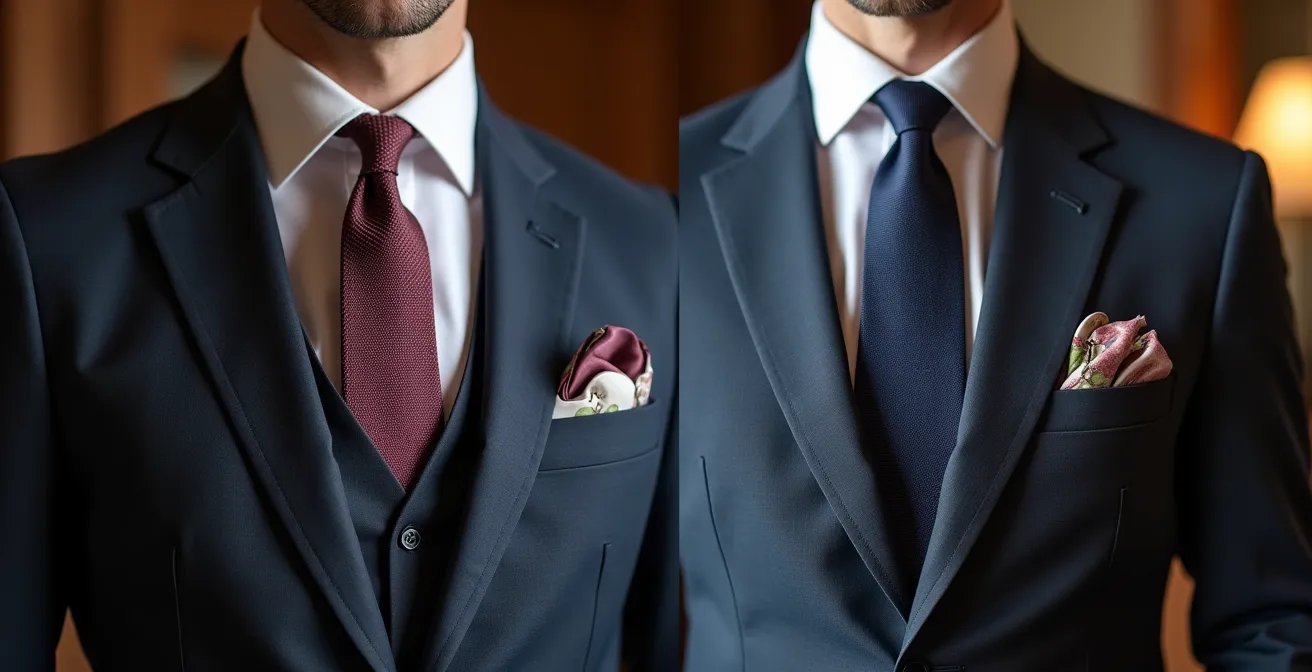
The goal is to create an uninterrupted visual flow that draws attention to your face, not to a distracting mismatch on your chest. Once you start seeing your outfits through the lens of proportion, you’ll notice these details everywhere. This is a skill you can develop with practice, and it costs nothing to implement.
Your 5-Step Proportional Harmony Check
- Mirror Distance: Stand at arm’s length from a full-length mirror wearing your complete outfit to get an objective view.
- Lapel & Tie Match: Check that the widest part of your tie is within 75-100% of the width of your jacket lapel at its widest point. They should look like cousins, not strangers.
- Collar & Lapel Balance: Ensure your shirt collar points extend to, or are just slightly covered by, the edge of the jacket lapels. Too much or too little space looks off.
- Knot & Collar Space: The size of your tie knot should comfortably fill the space between your collar points without spreading them apart or leaving a large gap.
- Accessory Scale: Glance at your watch. The case should not look wider than your wrist. Your pocket square should have just enough presence to add interest, not dominate the pocket.
Where to Start: The 3 Foundational Pieces of Sartorial Style
Building a sartorial wardrobe from scratch can feel overwhelming. The secret is not to buy ‘outfits’, but to invest in a small number of versatile, high-quality foundational pieces that can be combined in dozens of ways. For a young professional on a budget, this ‘Foundation-First’ approach is everything. Instead of buying five cheap, trend-driven items, you focus your resources on three core garments: a well-fitting navy blazer, a pair of versatile grey wool trousers, and a crisp white dress shirt. These three items form the unbeatable starting trinity of menswear.
With just these three pieces, you can create looks for almost any business-casual or smart occasion. The blazer with the grey trousers is a classic ‘separates’ combination. The blazer can be worn with dark jeans or chinos for a more relaxed look. The grey trousers work beautifully with any other jumper or shirt you own. This approach is not only stylish but also incredibly economical. A detailed analysis from sustainable fashion calculations shows that investing in fewer, more versatile pieces significantly lowers your cost-per-wear, proving that quality is a smarter financial decision in the long run.
The Charity Shop Challenge: ‘Broke and Bespoke’
The power of focusing on foundations is perfectly illustrated by Jason Chang, a style enthusiast known as ‘Broke and Bespoke’. He built his entire sophisticated wardrobe by starting in UK charity shops like Oxfam and British Heart Foundation. His strategy was to hunt for foundational pieces from quality heritage brands (like old St Michael from M&S or DAKS) for a pittance. By combining a thrifted blazer (around £20) with quality grey wool trousers (£15) and investing the savings in a well-fitting custom shirt, he was able to create impeccable outfits for under £100, proving that knowledge of fabric and fit trumps a big budget every time.
Your mission is to become a hunter of these foundational pieces. Look for 100% wool in blazers and trousers and 100% cotton in shirts. Ignore flashy patterns and focus on solid, versatile colours. Once you have this base, you can slowly add texture and pattern with ties, pocket squares, and other accessories.
Why a 44mm Watch Ruins the Elegance of a French Cuff Shirt
As you refine your sartorial eye, you’ll discover that elegance is often a game of millimetres. This is particularly true when it comes to accessories, and no accessory causes more blunders than the watch. In recent years, oversized watches (42mm, 44mm, and even larger) have become popular as standalone fashion statements. However, when paired with tailored clothing, especially a formal shirt with French cuffs, they create a clunky, disharmonious look. The core issue is not just diameter, but thickness. As style expert Antonio Centeno notes, “A dress watch should slide easily under a shirt cuff.”
An oversized sports or fashion watch creates a large, unsightly bulge under the cuff, ruining the clean line from shoulder to wrist. It signals a clash of intentions: the shirt says ‘formal refinement,’ while the watch screams ‘casual action.’ For a truly elegant look, the watch should be a discreet companion to the outfit, not the main event. This means opting for a timepiece with a more classic diameter, typically between 38-40mm, and, most importantly, a slim case profile of under 10mm.
A dress watch should slide easily under a shirt cuff. The issue with many oversized fashion watches is their case thickness, not just their diameter.
– Antonio Centeno, Real Men Real Style
The good news is that an elegant dress watch doesn’t have to be expensive. Brands like Seiko (Presage line), Orient (the famous Bambino), and Timex (Marlin series) offer beautifully designed, automatic or mechanical watches with classic proportions for under £250. These offer far more style and horological credibility than an overpriced, oversized designer fashion watch. Even a smartwatch can be adapted; pairing an Apple Watch with a Milanese loop strap and a minimalist analogue face creates a much sleeker profile that can bridge the gap between tech and tradition.
How to Determine the Ideal Trouser Width for a Suit vs. Jeans
The trousers are the anchor of your entire lower-body silhouette, and getting the fit right is paramount. The two most important factors to master are the width through the thigh and the width of the leg opening (or hem). A common mistake is to apply the same logic to all types of trousers, but suit trousers, chinos, and jeans all have different requirements based on their fabric and intended purpose. The universal starting point, however, is the ‘pinch an inch’ test. When standing, you should be able to pinch about one inch (2.5cm) of fabric on either side of your thigh. Any less, and they’re too tight, causing pulling and restricting movement. Any more, and you’re entering baggy territory.
The leg opening is where context becomes key, especially in relation to your footwear. This is a crucial detail for any man building a wardrobe in the UK, home to classic, sturdy footwear. Slim or skinny-fit trousers with a narrow hem (15-17cm) clash horribly with substantial Goodyear-welted English shoes like brogues from Loake or Barker. The slim trouser leg gets ‘stuck’ on the chunky shoe, creating a messy, stacked look. These traditional shoes demand a wider leg opening of at least 18-20cm to allow the trouser to drape cleanly over them with a slight or quarter break. Finally, don’t neglect the ‘rise’—the distance from the crotch to the waistband. Many high street brands favour low-rise cuts, which can visually shorten your legs. A mid or high-rise trouser creates a longer leg line and a more elegant, classic proportion.
| Trouser Type | Ideal Hem Width | Break Style | Best Shoe Pairing |
|---|---|---|---|
| Formal Wool Suit | 18-20cm | Slight break | Oxford shoes |
| Business Chinos | 17-19cm | Quarter break | Derby shoes or loafers |
| Smart Jeans | 16-18cm | Minimal stack | Chelsea boots or brogues |
| Casual Denim | 15-17cm | Natural stack | Sneakers or desert boots |
Use this table as your guide. The goal is to create a harmonious system where your trousers, shoes, and the formality of the occasion all align. Getting your trousers right provides a strong, clean foundation upon which the rest of your outfit is built.
Key Takeaways
- Invest in Alterations: Always budget £50-£70 for a tailor when buying a high street suit. Fit is more important than the initial price tag.
- Develop Fabric Intelligence: Learn to identify natural fibres like wool and cotton. Avoid cheap, non-breathable polyester to ensure comfort and a more premium look.
- Master Proportional Harmony: Ensure your tie width matches your lapel width, and that your accessories (watch, collar) are all in scale with your outfit.
Is Buying Recycled Polyester Actually Good for the Planet?
As a savvy consumer, you’re likely aware of the environmental impact of fashion. In response, many high street brands heavily market clothing made from ‘recycled polyester’ (rPET) as a sustainable choice. It feels like a win-win: you get an affordable garment while helping to clean up plastic waste. However, the reality is far more complex and, unfortunately, a prime example of ‘greenwashing’. While rPET does divert plastic bottles from landfill initially, it creates a new set of environmental problems.
The core issue is that turning a plastic bottle into a t-shirt is a one-way street of downcycling. A bottle can be recycled back into a bottle in a closed-loop system. A polyester garment, however, cannot currently be effectively recycled back into a new garment at scale. Worse still, research shows that recycled polyester can actually shed *more* microfibres than virgin polyester during washing. This is a significant problem, as a report from the Changing Markets Foundation highlights how major brands use this as a marketing tool; for instance, H&M has reported that 94% of its polyester is recycled, while this process simply transforms a recyclable bottle into a microplastic-shedding, unrecyclable textile destined for landfill.
These microplastics are a severe pollutant. Research reveals that UK laundry generates up to 17,847 tonnes of microfibres each year, polluting our waterways and ecosystems. The truth is, from a microplastic perspective, both virgin and recycled polyester are part of the problem. A truly sustainable approach requires a shift in consumer behaviour, prioritising durability and natural fibres over disposable synthetics, regardless of their ‘recycled’ status.
A Smarter Sustainable Clothing Hierarchy
- Wear What You Own: The most sustainable garment is the one already in your wardrobe. Extending its life by just nine months can reduce its environmental impact by 20-30%.
- Shop Second-Hand: Explore UK charity shops (Oxfam, British Heart Foundation) and online platforms like Vinted. This gives existing clothes a new life.
- Buy Durable Natural Fibres: If you must buy new, choose high-quality items made from wool, cotton, or linen from brands with transparent supply chains.
- Wash Synthetics Wisely: When washing any synthetic items you already own, use a Guppyfriend wash bag to capture microfibres and prevent them from entering the water system.
- Avoid New Synthetics: Place new polyester garments, whether virgin or recycled, at the bottom of your purchasing list. Both contribute to microplastic pollution.
Frequently Asked Questions About Sartorial Details
What percentage of today’s clothing contains polyester?
Approximately 60% of modern clothing contains polyester, making it the most dominant fibre in the fast fashion industry, particularly prevalent in budget-friendly high street retail chains.
How can I perform the ‘crinkle test’ in stores?
To perform the crinkle test, simply squeeze the fabric firmly in your hand. Low-quality polyester will often produce a distinctive, plastic-like crinkling sound and feel slippery to the touch, whereas natural fibres like wool or cotton will feel much softer and make very little noise.
What is the ‘pinch an inch’ test for trouser fit?
The ‘pinch an inch’ test is a quick way to check if trousers fit correctly in the thigh. While standing naturally, you should be able to pinch about an inch (or 2.5cm) of loose fabric. This ensures you have enough room for comfortable movement without the trousers looking baggy.
Why is trouser ‘rise’ crucial for elegant proportions?
The rise of a trouser—the distance from the crotch seam to the top of the waistband—is critical because it determines where the trousers sit on your body, which in turn affects the perceived length of your legs and your overall silhouette. Mid to high-rise trousers create a longer, more elegant leg line and allow the fabric to drape properly, while low-rise cuts can make the legs appear shorter and torso longer.