
In summary:
- Effective sustainable garment care in the UK requires specific techniques to combat challenges like hard water and a damp climate.
- Understanding the science of fibres like Tencel and wool is key to preventing damage during washing and ironing.
- Airing, brushing, and spot-treating are more effective for longevity than frequent machine washing.
- Using filtration bags for synthetics and choosing the right bio-detergent are critical for minimising environmental impact.
- Repairing clothes through methods like visible mending and spotting greenwashing are essential skills for a truly sustainable wardrobe.
Investing in a sustainable wardrobe is a commendable first step. You’ve chosen garments made with environmental and ethical considerations, but the journey doesn’t end at the checkout. The real challenge, and where the most significant impact lies, is in the post-purchase care. Many well-intentioned owners of ethical clothing find their garments losing shape, colour, or texture far too quickly. The common reflex is to turn to professional services like dry cleaning, believing it’s a safer option for delicate fabrics. However, this is often a misstep, involving harsh chemicals that contradict the very ethos of sustainable fashion.
The standard advice—wash less, use cold water, air dry—is a good starting point, but it fails to address the practical realities faced by many in the UK. How do you effectively air dry clothes in a damp climate? How do you tackle stains when eco-detergents seem to struggle with the region’s notoriously hard water? The truth is that making clothes last is less about following generic rules and more about mastering a craft. It involves understanding the unique properties of each textile and adapting your methods to your specific environment.
But what if the key wasn’t just gentler washing, but a more profound understanding of your clothes’ needs? This guide moves beyond the platitudes to offer a practical, science-based approach to sustainable garment care, specifically tailored for a UK context. We will explore the fibre-specific science of materials like Tencel, learn techniques for “micro-climate management” to refresh clothes without washing, and understand the chemical dialogue between detergents and hard water. By transforming maintenance from a chore into a skill, you can drastically extend the life of your wardrobe, honouring the resources that went into making it and saving a significant amount of clothing from ending up in landfills.
This article provides a structured path to becoming an expert in garment care. Each section tackles a common mistake or a specific challenge, offering practical solutions and the knowledge to apply them confidently.
Contents: Why Dry Cleaning Is Often a Mistake
- Why Do Tencel and Lyocell Require Low-Temperature Ironing?
- How to Air and Brush Your Garments to Extend Time Between Washes
- Bio-Detergent vs. Soap Nuts: What is Their Real Effectiveness on Stains?
- The Mistake of Washing Recycled Fleece Without a Filtration Bag
- When to Use “Visible Mending” to Save a Damaged Garment
- The Mistake of Machine Washing a Wool Scarf, Even on a Cold Cycle
- The Drying-Out Problem: How to Condition Leather Without Staining Your Trousers
- How to Spot Greenwashing in High Street Ethical Collections?
Why Do Tencel and Lyocell Require Low-Temperature Ironing?
Tencel™ and Lyocell are celebrated materials in sustainable fashion, prized for their silky-smooth feel and closed-loop production process. However, their unique properties also make them susceptible to damage from high heat. The core issue lies in the fibre-specific science of these regenerated cellulose fibres. When wet and exposed to high temperatures or mechanical stress, their fibrils—tiny hairs on the surface of the yarn—can rupture. This process, known as fibrillation, results in a permanently fuzzy, whitened, or pilled appearance on the fabric’s surface, robbing it of its signature lustre.
Unlike robust cotton, Lyocell’s delicate structure demands a gentle approach. The common mistake is treating it like a standard textile and using a hot iron, which can irreversibly “cook” the fibres. The correct method involves a low-temperature setting, ideally below 110°C (230°F), which corresponds to the ‘silk’ or one-dot setting on most UK irons. Using a steamer is an even better alternative as it relaxes wrinkles with moist heat rather than direct, high-pressure heat.
For those living in hard water areas across the UK, there’s an additional consideration. Mineral deposits can build up on the fabric, making it feel stiff and more prone to heat damage. A simple pre-wash soak in distilled water with a dash of white vinegar can help dissolve these minerals. When ironing, it’s best to work while the garment is still slightly damp and use a pressing cloth as a physical barrier. This combination of low heat and moisture management preserves the structural integrity of the fabric, ensuring your Tencel and Lyocell pieces remain beautiful for years.
How to Air and Brush Your Garments to Extend Time Between Washes
One of the most impactful habits in sustainable garment care is simply washing less. Every machine wash cycle consumes water and energy and contributes to the gradual wear and tear of fabric fibres. The alternative isn’t wearing dirty clothes; it’s adopting the art of micro-climate management—proactively refreshing garments between wears. This is especially crucial for robust materials like wool, denim, and heavy knits that rarely require a full wash after a single day’s use.
The primary techniques are airing and brushing. As sustainable wardrobe expert Roberta Lee notes, “If you air your clothes after wearing them, very often 30-minutes hung outside in the fresh air is enough to revive them.” The moving air helps to dissipate odours and moisture. In the often-damp UK climate, outdoor airing isn’t always feasible. An effective indoor alternative is to hang garments in a steamy bathroom after a shower. The moisture helps to relax wrinkles and deodorise the fibres, a method particularly effective for wool. Placing cedar blocks or lavender sachets in the wardrobe also helps to repel moths and impart a fresh scent naturally.
Brushing is the second pillar of this approach. A high-quality clothes brush, with natural bristles of varying stiffness, is an essential tool. Brushing removes surface-level dust, hair, and lint before they can become embedded in the fabric weave. It revitalises the nap of materials like cashmere and tweed, keeping them looking fresh. This simple, two-minute ritual after taking off a jacket or jumper can significantly extend the time until a wash is genuinely necessary, preserving the fabric’s integrity and colour.
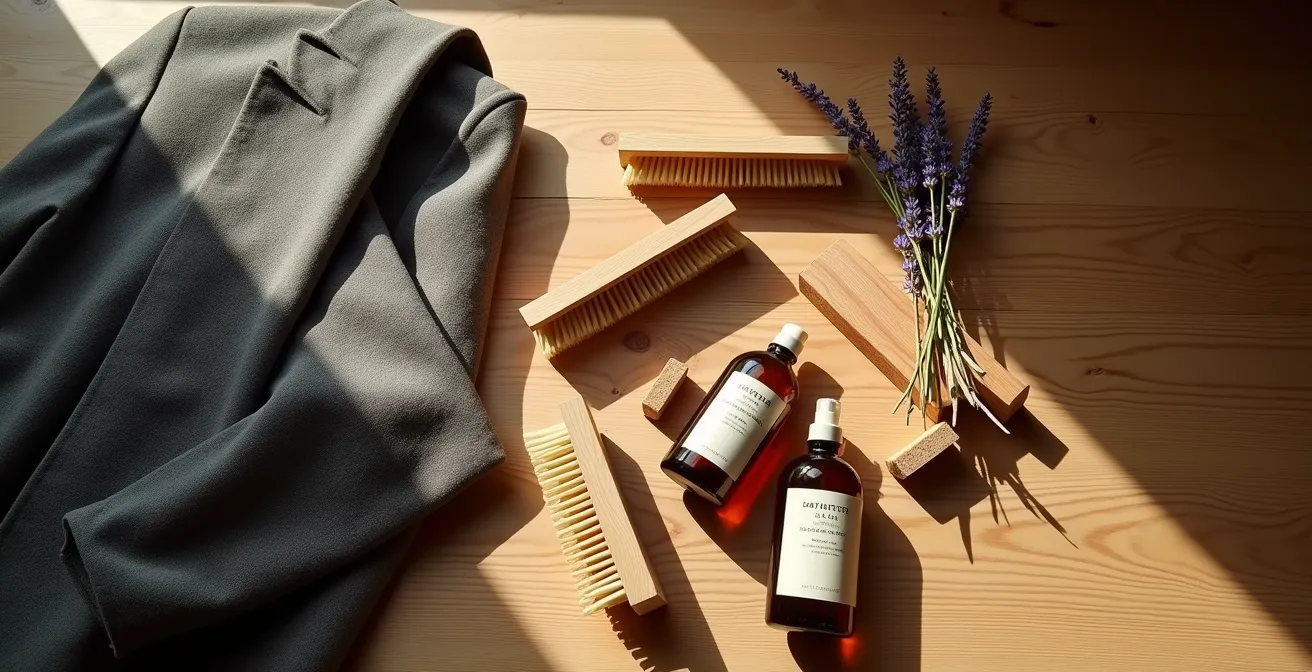
A complete refresh kit, including different brushes for different textiles, is a small investment that pays huge dividends in garment longevity. Combining a gentle brush-down with a period of airing is often all that’s needed to make a garment ready for its next wear, reducing your laundry load and environmental footprint.
Bio-Detergent vs. Soap Nuts: What is Their Real Effectiveness on Stains?
Choosing an eco-friendly laundry detergent is a minefield. The shelves are filled with options promising powerful cleaning with minimal environmental impact, but their performance can vary dramatically, especially when faced with tough stains and the challenges of UK hard water. Understanding the chemical dialogue between your detergent, water, and stains is key to making an effective choice. Two popular contenders are commercial bio-detergents and natural soap nuts, but they operate in very different ways.
Soap nuts are the dried fruit shells of the Sapindus mukorossi tree, which contain natural surfactants called saponins. When agitated in water, they release soap-like suds. While their natural origin is appealing, their effectiveness is limited. In hard water, the minerals (calcium and magnesium) interfere with the saponins, drastically reducing their cleaning power. They are generally only suitable for very lightly soiled items and struggle with protein- or oil-based stains.
Modern concentrated bio-detergents from eco-conscious brands like Ecover or Smol represent a more advanced approach. They use plant-derived surfactants and enzymes specifically designed to break down stains—proteases for protein stains (like blood or egg) and lipases for fats and oils. Crucially, their formulations often include water softeners or are designed to perform better in hard water conditions, making them a more reliable choice for most UK households. While they involve more processing than simple soap nuts, their superior efficiency means cleaner clothes and less need for re-washing, which has its own environmental benefit.
The following table, based on performance in typical UK hard water areas, offers a clear comparison for everyday laundry decisions.
| Detergent Type | Hard Water Performance | Stain Removal | Cost per Load | Best Use Case |
|---|---|---|---|---|
| Soap Nuts | Poor (20-30% efficacy) | Light stains only | £0.08 | Lightly soiled synthetics |
| Ecover Concentrated | Good (75-80% efficacy) | Most common stains | £0.25 | Regular washing |
| Smol Capsules | Excellent (85-90% efficacy) | Heavy soil removal | £0.18 | Heavily soiled items |
| Soda Crystals Pre-treat | Very Good (80% efficacy) | Tea, wine, grass | £0.05 | Spot treatment |
As this comparative analysis for a sustainable wardrobe shows, for reliable stain removal in the UK, a well-formulated eco-detergent is generally superior to soap nuts. For tough, specific stains, pre-treating with natural aids like soda crystals remains a highly effective and low-cost strategy.
The Mistake of Washing Recycled Fleece Without a Filtration Bag
Recycled polyester, often found in warm fleeces and activewear, is a popular sustainable choice as it diverts plastic bottles from landfills. However, it comes with a hidden environmental cost: microplastic pollution. Every time a synthetic garment is washed, it sheds thousands of tiny plastic fibres. These microfibres are too small to be caught by standard wastewater treatment plants and inevitably flow into our rivers and oceans, where they harm aquatic life and enter the food chain.
The common error is to wash these items like any other, unaware that each cycle releases a plume of microscopic pollutants. The solution is to practice waste stream interruption—actively preventing these fibres from entering the water system in the first place. Pioneering UK research, such as that from the University of Plymouth, highlights the scale of this problem and has spurred the development of effective filtration solutions that consumers can adopt at home.
The most accessible method is to use a specially designed filtration bag, such as the Guppyfriend. You place your synthetic garments inside the bag before putting it in the washing machine. The bag’s fine mesh allows water and detergent to pass through but physically traps the microfibres that are shed during the wash. After the cycle, you can collect the captured fibres from the corners of the bag and dispose of them in your household waste bin, preventing them from becoming aquatic pollutants. For those looking for a more permanent solution, washing machine filters that attach directly to the outflow pipe are also available. These methods are essential for anyone who owns and washes synthetic clothing, turning a routine chore into a meaningful act of environmental protection.
When to Use “Visible Mending” to Save a Damaged Garment
In a world of fast fashion, a small hole or a tear often signals the end of a garment’s life. However, a growing movement is reclaiming the lost art of repair, not as a way to hide a flaw, but to celebrate it. This is the essence of “visible mending,” a technique that uses colourful threads and decorative stitches to turn a point of damage into a feature. It’s about preserving the structural integrity of a garment while adding a unique, personal story to it.
This approach is particularly resonant in British culture. As Fashion Revolution UK puts it, “Visible mending represents a modern revival of the wartime ‘Make Do and Mend’ spirit, deeply ingrained in British culture.” It shifts the perception of a damaged item from “broken” to an “opportunity for creativity.” Techniques like Japanese Sashiko stitching, with its beautiful geometric patterns, or simple, colourful darning are used not just on worn-out elbows of jumpers but also to patch up jeans or reinforce thinning fabric.
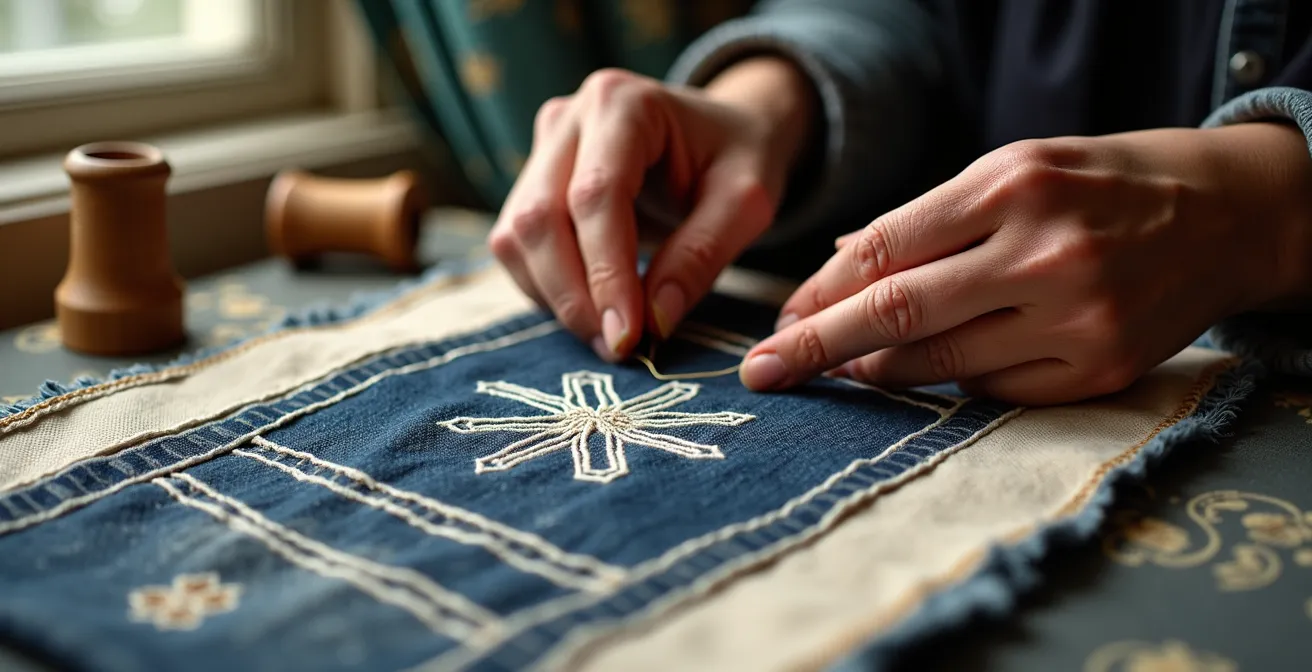
The best time to turn to visible mending is when a garment is structurally sound but has a localized point of failure. It’s perfect for moth holes in a beloved cashmere sweater, a tear in a sturdy denim jacket, or a worn-through patch on a pair of trousers. The key is to see the repair as an embellishment. This mindset is being fostered across the country by community initiatives like the UK’s Repair Cafe network, which has expanded to over 50 locations. These spaces provide the tools, skills, and community support to help people give their clothes a second life, transforming mending from a domestic chore into a shared, creative act.
The Mistake of Machine Washing a Wool Scarf, Even on a Cold Cycle
Wool is a natural wonder: it’s breathable, temperature-regulating, and naturally odour-resistant. However, its microscopic structure is also its Achilles’ heel. Each wool fibre is covered in tiny, overlapping scales. When exposed to a combination of water, heat, and agitation, these scales open up and lock together, causing the fibres to felt and the garment to shrink irreversibly. This is why machine washing a wool item, even on a ‘cold’ or ‘wool’ cycle, is a high-stakes gamble.
The machine’s tumbling action provides the agitation that causes felting, regardless of the water temperature. A delicate wool scarf, jumper, or blanket can emerge from the machine several sizes smaller and with a stiff, matted texture, its soft drape and structural integrity completely destroyed. Given that many high-quality wool garments are investment pieces, this is a costly mistake born from a misunderstanding of the fibre’s science.
The only truly safe method for washing wool is by hand. This allows you to control the two key risk factors: temperature and agitation. The process is simple and gentle, ensuring the scales on the wool fibres remain flat and do not interlock. Following a careful hand-washing protocol is non-negotiable for preserving the life, shape, and softness of your cherished woollens.
- Fill a clean basin with lukewarm water, ensuring it’s no hotter than 30°C.
- Add a small amount of a pH-neutral wool wash; brands like Eucalan or Soak are specifically designed for this purpose and often don’t require rinsing.
- Submerge the garment and gently squeeze the water through the fibres. Never rub, twist, or wring the wool.
- Drain the basin and gently press the excess water out of the garment.
- To dry, lay the item flat on a thick towel, roll it up like a Swiss roll, and press firmly to absorb the majority of the water.
- Finally, unroll the garment, reshape it to its original dimensions, and lay it flat to dry on a mesh rack or clean towel, away from direct sunlight or heat.
The Drying-Out Problem: How to Condition Leather Without Staining Your Trousers
Leather is a durable, long-lasting material, but it is not invincible. As a natural skin, it contains oils that keep it supple and strong. Over time, exposure to heat, dryness, and moisture can strip these oils away, causing the leather to become brittle, stiff, and prone to cracking. The key to preserving its structural integrity is regular conditioning, which replenishes these lost oils. However, the fear of leaving a greasy residue that can stain clothes often prevents people from properly caring for their leather goods.
The mistake is either using the wrong product or applying too much. Heavy waxes are ideal for waterproofing rugged boots but will leave a thick, tacky film on a soft leather jacket or bag. The secret to conditioning without creating a mess is choosing a light cream or natural oil and applying it with the principle of “less is more.” A pea-sized amount of a quality leather balm, worked into the surface in a circular motion with a soft cloth, is usually sufficient for a large panel.
After application, the crucial step is allowing the leather to fully absorb the conditioner. This can take anywhere from 30 minutes for a light spray to 12 hours for a natural oil. Once the surface feels dry to the touch, you must take a clean, dry cloth and buff the entire surface vigorously. This final buffing removes any excess product sitting on the surface and is the non-negotiable step to prevent the conditioner from transferring onto your trousers or other clothing. The following table compares common UK leather care products and their appropriate uses.
A good understanding of what product to use is essential. For instance, a light cream is often the best choice for jackets and bags, and a clear guide can be invaluable.
| Product Type | Best For | UK Brands | Application Method | Drying Time |
|---|---|---|---|---|
| Heavy Wax | Boots, outdoor gear | Barbour, Dr. Martens | Thick layer, heat activation | 24-48 hours |
| Light Cream | Jackets, bags | Smith’s Leather Balm | Pea-sized amount, circular motion | 4-8 hours |
| Natural Oil | Vintage leather | Norfolk Natural Living | Sparingly with cloth | 6-12 hours |
| Spray Conditioner | Quick maintenance | Collonil | Light misting | 30 minutes |
Key takeaways
- True sustainable clothing care extends beyond the purchase and requires mastering practical, fibre-specific techniques.
- Simple, consistent habits like airing, brushing, and proper storage are more effective for garment longevity than frequent, harsh washing.
- Empowering yourself with knowledge about spotting greenwashing and performing simple repairs is as important as the cleaning process itself.
How to Spot Greenwashing in High Street Ethical Collections?
You’ve mastered the art of caring for your clothes, but the sustainability journey begins with a wise purchase. High street brands are increasingly launching “conscious” or “sustainable” collections to appeal to eco-aware consumers. Unfortunately, many of these claims are a form of greenwashing—marketing spin designed to make a product seem more environmentally friendly than it truly is. Learning to see through the hype is the final and most crucial skill for a sustainable wardrobe.
The UK’s Competition and Markets Authority (CMA) has established the Green Claims Code to tackle misleading environmental statements. However, enforcement can be slow, and vague language persists. A report from the Changing Markets Foundation found that 59% of sustainability claims by European and UK fashion brands were unsubstantiated or misleading. Terms like ‘eco-friendly’, ‘green’, or ‘conscious’ are often used without any specific, verifiable meaning. A truly sustainable claim will be precise. For example, instead of “made with sustainable materials,” a transparent brand will state “made with 75% GOTS-certified organic cotton.”
Another common tactic is to highlight one small positive aspect while ignoring a larger negative one. A t-shirt might be lauded for being made of organic cotton, but if it was produced in a factory with poor labour conditions and flown halfway across the world, its overall sustainable credentials are questionable. Always question percentages as well. A garment advertised as being made with “30% recycled polyester” also contains 70% virgin, fossil-fuel-based plastic. To protect yourself, you must become a critical consumer, looking for independent, third-party certifications that verify a brand’s claims.
Your Action Plan: UK Greenwashing Detection Checklist
- Check for third-party certifications: Look for rigorous, independent labels like the OEKO-TEX Standard 100, which tests for harmful substances, often promoted through initiatives like Greenpeace’s Detox My Fashion campaign.
- Verify with the ASA: If a claim seems particularly suspicious, you can report it to the UK’s Advertising Standards Authority (ASA) for investigation.
- Look for the Soil Association logo: For any claim about organic cotton in the UK, the Soil Association logo is a reliable indicator of authenticity.
- Check for the Fairtrade mark: This certification provides assurance of ethical production standards and fair wages for workers.
- Beware vague terms: Be highly sceptical of words like ‘eco-friendly’, ‘sustainable’, or ‘conscious’ if they are not backed up by specific data or certifications.
- Question percentages: Always ask what the *other* part of the fabric is made from when you see a claim like “made with 30% recycled materials.”
By arming yourself with this checklist and a healthy dose of scepticism, you can navigate the high street with confidence, ensuring that your purchasing decisions align with your values and contribute to a genuinely sustainable fashion industry.