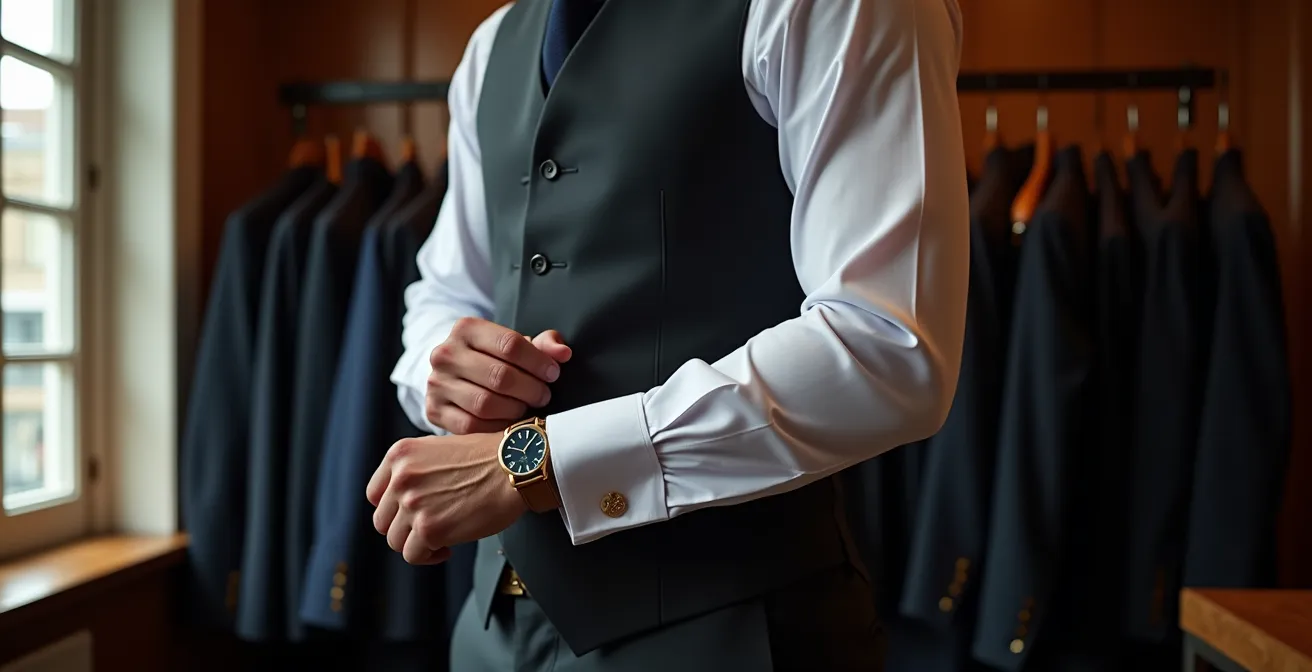
The true art of pairing a watch with a suit is not about matching colours; it’s about respecting the architectural intent of the tailoring.
- A watch’s size and thickness must complement the shirt cuff’s clearance, not compete with it.
- The visual weight of a watch dial, from clean to complex, sends a powerful, non-verbal message in professional and formal settings.
Recommendation: Treat your watch as the final structural element of your outfit. Its purpose is to complete the silhouette your tailor has crafted, not disrupt it.
In the world of a London professional, where every detail of one’s attire is a subtle broadcast of competence and taste, the pairing of a watch with a suit is often misunderstood. The common advice—to simply match the metal of your watch to your belt buckle—is a platitude that barely scratches the surface. It’s the sartorial equivalent of learning a single word and believing you can write poetry. This approach ignores the nuanced interplay of proportion, texture, and context that defines true elegance, especially when set against the benchmark of Savile Row tailoring.
The conversation must be elevated beyond simple colour-coordination. We must consider the structural relationship between the timepiece and the garment. How does a watch interact with the precise cut of a French cuff? What does the complexity of a dial communicate during a high-stakes negotiation? These are not trivial questions; they are central to crafting a persona of effortless authority. Forget the generic rules you have read before. The key is to understand that a gentleman’s watch is not a mere accessory.
This guide abandons those superficial guidelines. Instead, it presents a new philosophy: viewing your watch as a deliberate extension of your suit’s architecture. It’s about achieving a seamless harmony where the watch doesn’t just sit on your wrist but belongs to the overall composition of your look. We will deconstruct the relationship between cuff, case, and dial, exploring why certain combinations project power and others suggest a lack of discernment. Through this lens, you will learn not just to wear a watch, but to wield it as an instrument of personal style, fully integrated with the principles of bespoke British tailoring.
This article provides a structured approach to mastering this art. The following sections will guide you through the critical decisions that separate the novice from the connoisseur, ensuring your timepiece is always an asset to your tailored look.
Contents: A Framework for Sartorial Harmony
- Why a 44mm watch ruins the elegance of a French cuff shirt?
- How to match the metals of your watch with your cufflinks?
- Clean dial or skeleton: which to choose for a job interview?
- The mistake of wearing a dive watch with a tuxedo (Black Tie)
- Style problem: modernizing a classic look with a contemporary watch
- Why a £20 alteration is better than a poorly-fitting £500 suit?
- How to determine the ideal width for a suit vs a jean?
- Defining a Taste for Elegance at UK Black Tie Events
Why a 44mm watch ruins the elegance of a French cuff shirt?
The fundamental error in wearing an oversized watch with formal tailoring lies not in the watch itself, but in its blatant disregard for the suit’s architecture. A French cuff shirt, the cornerstone of formal British attire, is designed with a specific allowance of fabric to fold back gracefully. A tailor meticulously crafts the sleeve to accommodate this, creating a clean, uninterrupted line from shoulder to wrist. Introducing a 44mm watch, often thick and imposing, is an architectural violation. It forces the cuff to bunch and stretch, creating an unsightly bulge that screams “ill-considered”.
This isn’t just a matter of aesthetics; it’s a matter of respect for the craft. In a market where the United Kingdom luxury watch market reached approximately USD 1.35 Billion, making an informed choice is paramount. A large watch doesn’t project power; it projects an inability to appreciate proportion. The goal is for the watch to slide effortlessly under the cuff, revealing itself with the natural movement of the arm. This requires a case diameter typically under 40mm and, more crucially, a thickness of no more than 10-11mm. The elegance is in the discretion, not the declaration. An oversized watch is a blunt instrument in a setting that demands surgical precision.
To ensure this harmony, one must think like a tailor. The relationship between the watch and the cuff is not an afterthought but a primary consideration. The following checklist provides a framework for achieving this perfect integration, moving beyond the simple metric of case diameter to a more holistic understanding of fit.
Action Plan: Achieving Perfect Watch-Cuff Harmony
- Measure your wrist circumference precisely at the bone to establish a baseline.
- Add 0.5cm of clearance for a French cuff when selecting your watch case diameter.
- Ensure the total watch thickness, from caseback to crystal, does not exceed 10mm for proper, smooth cuff closure.
- Test the cuff’s movement with the watch on; it must slide smoothly over the watch without catching or bunching.
- Prioritise the lug-to-lug measurement over case diameter, as this dictates the watch’s true footprint on your wrist.
Ultimately, the right watch doesn’t fight the cuff; it dances with it. This synergy is the first and most critical step in aligning your timepiece with the refined world of bespoke tailoring.
How to match the metals of your watch with your cufflinks?
The rule to “match your metals” is the first piece of advice most men receive, yet it is often applied with a distinct lack of nuance. The true principle is not about rigid uniformity but about creating a coherent metallic palette on the upper body. Your cufflinks, being on the same visual plane as your watch, are the primary point of reference. A mismatched watch and cufflinks create a subtle visual discord, signalling a lack of attention to detail that is antithetical to the ethos of Savile Row.
The choice of metal is also a form of code-switching. Cool-toned metals like steel, white gold, and platinum project a modern, professional, and serious image, making them ideal for the boardroom. Conversely, warm-toned metals like yellow and rose gold convey a sense of occasion, luxury, and social warmth, better suited for evening events, celebrations, or more traditional business environments. The key is to ensure all metallic elements—watch case, cufflinks, tie bar, and even the hardware on your briefcase—belong to the same temperature family for a given context.
Case Study: Anderson & Sheppard’s Heritage of Harmony
The storied Savile Row house of Anderson & Sheppard, which has dressed style icons from King Charles III and Fred Astaire to Daniel Craig and Tom Ford, exemplifies this principle. Their signature ‘English drape cut’ is a masterclass in soft, fluid lines. This philosophy of visual continuity extends to accessories. The house implicitly understands that harmonising metals is essential to maintaining the integrity of their silhouette. For their clients, a watch isn’t just a watch; it’s a component that must align with the quiet confidence their tailoring provides.
For the discerning gentleman, a clear framework is required to navigate different levels of formality. The following guide provides prescriptive advice for key British dress codes, ensuring your choices are always impeccable. This demonstrates how traditional British tailoring houses have long understood the importance of harmonising accessories.
| Dress Code | Watch Metal | Cufflink Metal | Additional Notes |
|---|---|---|---|
| Black Tie | Yellow/White Gold | Onyx/Mother-of-Pearl with gold trim | Avoid steel for maximum elegance |
| Morning Dress | Yellow Gold/Steel | Silver or Gold | Match with waistcoat buttons |
| Business Formal | Steel/White Gold | Silver or Platinum | Cool metals for professional settings |
| Smart Casual | Rose Gold/Steel | Mixed metals acceptable | Contemporary combinations allowed |
By moving from simple matching to considered coordination, you elevate your accessories from a collection of items to a curated statement of personal style.
Clean dial or skeleton: which to choose for a job interview?
In the charged atmosphere of a job interview, your watch speaks before you do. The choice between a clean, minimalist dial and a complex skeleton dial is not merely stylistic; it is a strategic decision. A job interview is a performance of competence, focus, and discretion. Your attire should support this performance, not detract from it. This is precisely why a clean, uncluttered dial is the unequivocal choice for any professional assessment.
A minimalist dial—perhaps with simple baton markers, a date window, and nothing more—conveys a sense of purpose and seriousness. Its visual weight is low. It suggests that its wearer values clarity, efficiency, and is not given to unnecessary flamboyance. It is a tool of quiet confidence. In contrast, a skeleton dial, with its intricate display of moving gears and springs, has a high visual weight. It is designed to attract attention. While a testament to horological craftsmanship, in an interview context, it can be perceived as ostentatious or distracting. It sends a signal—intentionally or not—of a desire to be noticed for one’s possessions rather than one’s abilities. With the consideration for luxury watches on the rise, as a recent survey shows scores rose from 6.0% to 8.2% among young men aged 18-34, making the *right* sartorial choice is more critical than ever.
The visual distinction between these two choices is stark, and its psychological impact on your audience, while subtle, is very real. The image below illustrates the contrast in messaging between these two styles in a professional setting.
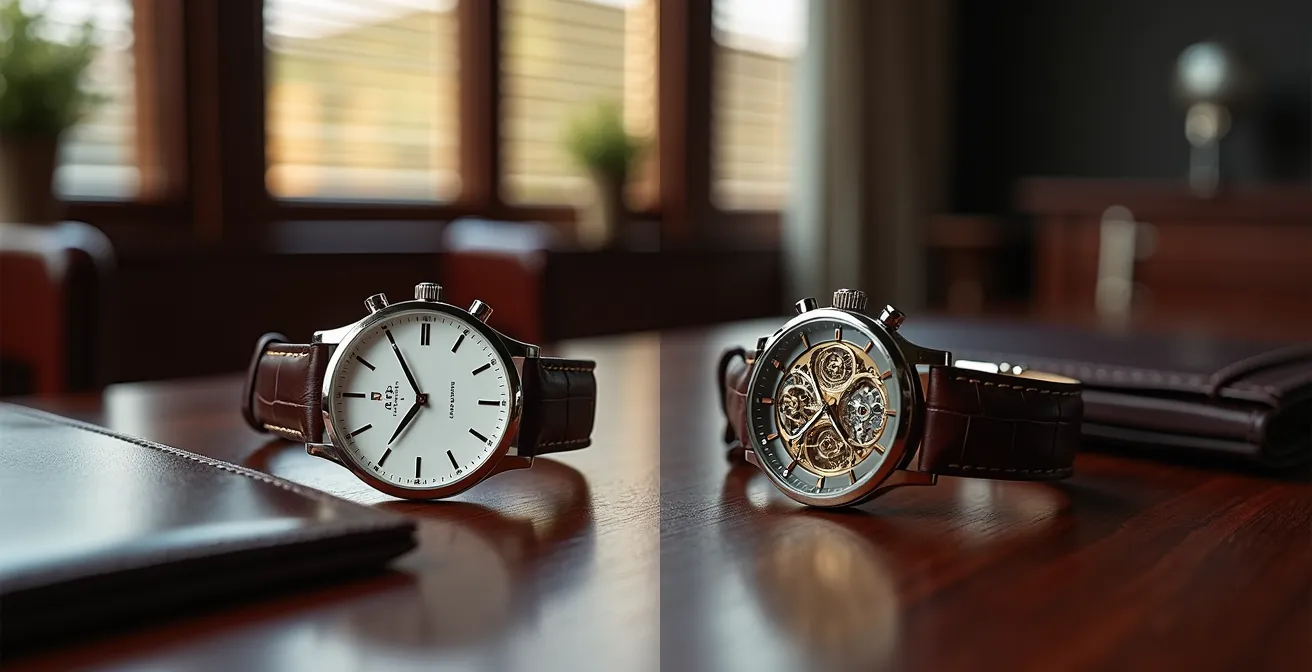
As you can see, the clean dial on the left integrates into the professional environment, while the skeleton watch on the right becomes a focal point. For an interview, you want the focus to be on your words and your qualifications. Your watch should be a supporting actor, not the lead. It should whisper competence, not shout for attention.
Therefore, when your future career is on the line, the choice is clear. Opt for the understated elegance of a classic dress watch. It is a decision that demonstrates not only good taste, but also strategic intelligence.
The mistake of wearing a dive watch with a tuxedo (Black Tie)
Wearing a dive watch with a tuxedo is one of the most common, yet most egregious, sartorial errors a man can make. It is a fundamental misunderstanding of the Black Tie dress code’s purpose. Black Tie is not about personal expression; it is a uniform designed to create an atmosphere of collective elegance, where men become a sophisticated backdrop for the ladies’ gowns. As the experts at Aristocracy London state in A Gentleman’s Guide to Dress Codes, its components are specific and non-negotiable.
A classic black tie outfit consists of a dinner suit, usually black, a white dress shirt, patent or highly polished dress shoes and a bow tie.
– Aristocracy London, A Gentleman’s Guide to Dress Codes
Into this carefully prescribed uniform, a dive watch intrudes with all the subtlety of a foghorn. A dive watch is, by its very nature, a robust tool. Its features—a thick case for water resistance, a rotating bezel for timing, and luminous markers for legibility underwater—are born of function, not form. To pair this utilitarian object with the refined silk lapels of a dinner jacket is to create a jarring contradiction. It’s the sartorial equivalent of parking a Land Rover in a ballroom. Even if the watch features a leather strap, its robust case and functional bezel fundamentally clash with the sleek, refined aesthetic of Black Tie.
Some will point to fictional spies or celebrities on red carpets as a counter-argument. This is a flawed defense. These instances are either a form of deliberate, brand-driven rule-breaking or simply a mistake. In genuine British formal circles, it remains a faux pas. The traditional and most purist view is that one should not wear a watch at all to a Black Tie event, the logic being that a gentleman should not be concerned with the time when he is enjoying an evening’s entertainment. If a watch must be worn, it must be an ultra-thin, time-only dress watch in a precious metal, designed to disappear discreetly under the cuff.
To violate this code is not a sign of rebellious flair, but rather an indication that one has failed to understand the context and the spirit of the occasion. For Black Tie, the choice is simple: a slim dress watch, or nothing at all.
Style problem: modernizing a classic look with a contemporary watch
For the man who appreciates classic tailoring but lives in the modern world, a significant style challenge arises: how to integrate a contemporary timepiece without disrupting the timeless elegance of a bespoke suit. The fear of creating a jarring mismatch often leads to overly conservative choices. However, the solution is not to shun modernity, but to embrace it with intelligence and restraint. This is the art of ‘Considered Disruption’.
The principle is simple: when introducing a modern element, it should be the sole point of contrast. If your suit is a classic two-button from a traditional Savile Row house, a minimalist contemporary watch can provide a compelling update. The key is that the modern watch must still respect the foundational rules of proportion and discretion. A clean dial, a slim profile, and a case size between 38-40mm serve as a bridge between classic and contemporary aesthetics. This approach allows the watch to be a statement, but a sophisticated and intentional one.
This philosophy is already being practiced by a new generation of Savile Row tailors. They understand that tradition must evolve to remain relevant, a principle that applies as much to watches as it does to suits.
Action Plan: Modernising Your Look with Considered Disruption
- Isolate the modern element: let the watch be your single, deliberate statement piece against a classic sartorial backdrop.
- Favour contemporary watches with clean, minimalist designs over those with overly technical or busy appearances.
- Maintain cohesion by matching the watch strap material and colour to your shoe leather.
- Select mid-sized cases (38-40mm) that act as a perfect bridge between classic and contemporary proportions.
- Consider independent British watchmakers like Bremont or anOrdain for a sense of cultural coherence with your Savile Row heritage.
This allows you to signal an appreciation for heritage while demonstrating a clear, forward-looking perspective—the very definition of a modern gentleman.
Why a £20 alteration is better than a poorly-fitting £500 suit?
The single most important element of a suit is not its price tag, its fabric, or its brand; it is the fit. An off-the-peg £500 suit that fits poorly will always look inferior to a modest but perfectly altered garment. This is the fundamental, non-negotiable truth of men’s tailoring. The fit is the architecture of your appearance, and a £20 alteration to sleeve length or waist suppression is the investment that transforms a mere garment into a piece of personal armour. In a world where a true Savile Row commission can start from approximately £5,995 for a bespoke suit, the relative value of a minor alteration becomes strikingly clear.
Nowhere is this more critical than at the cuff—the very junction where your suit meets your watch. A sleeve that is too long obscures both your shirt cuff and your timepiece, creating a sloppy, unrefined line. One that is too short creates an awkward gap. The correct length, allowing for approximately half an inch of shirt cuff to show, creates a deliberate, tiered effect that frames the watch perfectly. This precision is what a simple alteration provides. It respects the ‘cuff clearance’—the space your watch needs to exist in harmony with your shirt and jacket. Even modern Savile Row tailors like Cad & The Dandy, known for their fusion of tradition and contemporary style, emphasise that proper fit, especially around the cuffs for watch wearers, is what elevates the entire look.
The process of tailoring a sleeve is a craft in itself, a small but powerful act that realigns the entire silhouette of the jacket to the wearer’s body and their chosen accessories. It is here that the suit’s true potential is unlocked.
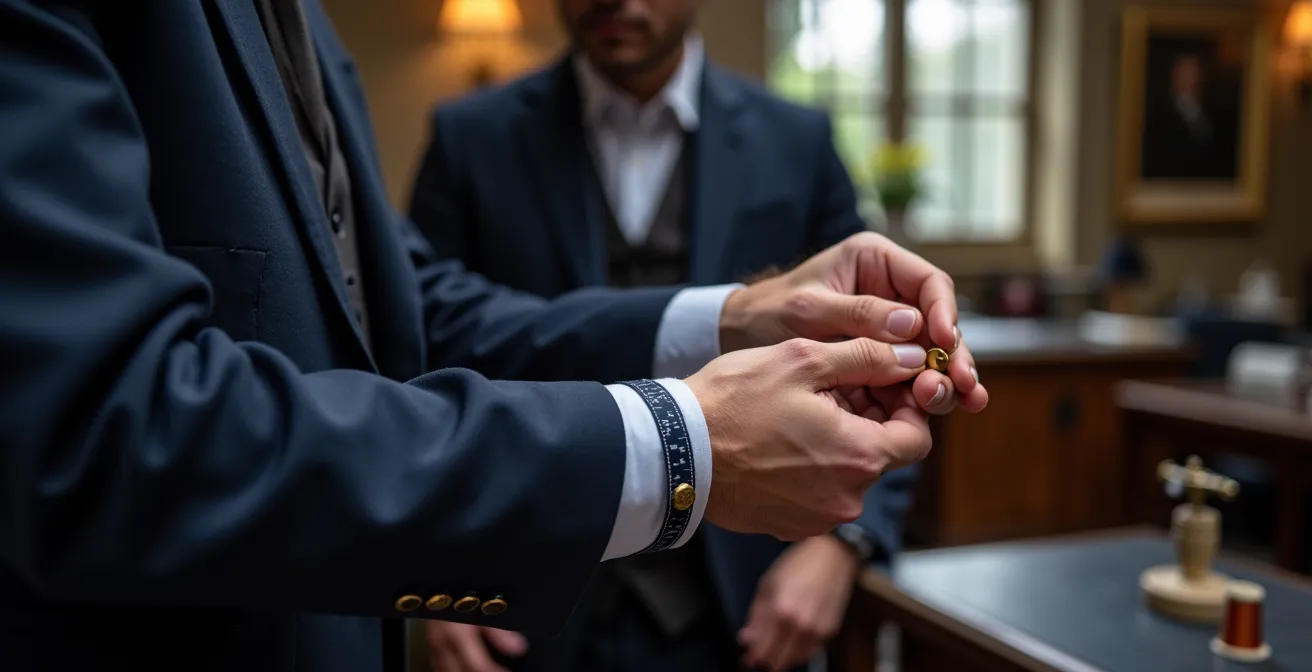
As this image demonstrates, the tailor’s adjustment is not just about length. It’s about creating a clean, deliberate finish that anticipates the presence of a watch. This small investment ensures that your £500 suit—or indeed, any suit—looks like it was made for you and you alone. It is the highest return on investment available in menswear.
Ultimately, a man in a perfectly altered suit, regardless of its original price, projects more confidence and authority than a man drowning in expensive but ill-fitting fabric.
How to determine the ideal width for a suit vs a jean?
The ideal diameter of your watch is not an absolute number but a relative one, dictated by the ‘visual weight’ of the clothes you are wearing. A slim-fit suit and a pair of straight-leg jeans are sartorially worlds apart, and they demand different considerations for your timepiece. The core principle is balance: a heavier, more rugged garment can support a larger, more substantial watch, while a lighter, more refined outfit requires a sleeker, more discreet companion.
With a suit, particularly a modern slim-fit cut, the lines are sharp and the silhouette is lean. The fabric is typically a fine worsted wool. The visual weight is low. Here, a large watch (over 40mm) would overwhelm the look, disrupting the clean lines of the sleeve. The ideal is a dress watch between 34mm and 38mm, with a slim case that slides easily under the cuff. For a more classic-cut suit, you can move up to 40mm, but rarely beyond.
Jeans, by contrast, are made of heavy cotton twill. Their construction is more robust, their lines are softer, and their context is inherently more casual. Their visual weight is high. A delicate 34mm dress watch would look lost and out of place. This context allows for a larger watch, typically between 39mm and 42mm. This is where a more substantial piece, like a classic sports model on a steel bracelet (think a Rolex Datejust or Omega Aqua Terra), feels perfectly at home. As an Esquire UK style guide notes, for bridging the gap into business-casual, steel is often the perfect choice over precious metals for its versatile and understated appeal.
This table provides a clear, prescriptive guide for matching watch proportions to different clothing styles, ensuring you always strike the right balance.
| Clothing Style | Ideal Watch Diameter | Strap Style | Case Thickness |
|---|---|---|---|
| Slim-fit Suit | 34-38mm | Formal leather, tapered | Under 10mm |
| Classic-cut Suit | 38-40mm | Traditional leather | 10-12mm |
| Tapered Jeans | 36-39mm | Suede or fabric | 10-11mm |
| Straight-leg Jeans | 39-42mm | NATO or leather | 11-13mm |
| Business Casual | 37-40mm | Leather or bracelet | 10-12mm |
By understanding this dynamic, you ensure your watch is always in proportion and in context, whether you are in the boardroom or at the bar.
Key Takeaways
- Fit is Paramount: The elegance of any suit, regardless of price, is determined by its fit. A simple alteration is the highest-value investment in your wardrobe.
- Proportion Over Size: The right watch size is relative to the garment. A slim dress watch for a suit, a more substantial one for casual wear, always respecting the cuff’s architecture.
- Context is King: The formality of the event dictates every choice, from the metal of your watch (cool for business, warm for social) to the style of its dial (clean for interviews, none for Black Tie).
Defining a Taste for Elegance at UK Black Tie Events
After deconstructing the rules of proportion, metal, and context, we arrive at the final, most elevated plane: the cultivation of taste. At a formal British Black Tie event, elegance is not demonstrated by adherence to a checklist, but by an innate understanding of restraint and occasion. It is the culmination of all the principles discussed, expressed not as rigid rules but as effortless choices. This is particularly relevant today, where, contrary to assumption, a reported 54% of the Gen Z demographic in the UK own a luxury timepiece, indicating a new generation’s engagement with these traditions.
For Black Tie, the taste for elegance manifests as a move towards radical simplicity. The watch, if worn at all, must be the epitome of discretion. This means an ultra-thin dress watch, typically in a precious metal like yellow or white gold, with a time-only function. Complications like chronographs or moon phases, while technically impressive, are functionally and aesthetically superfluous to the evening’s purpose. They introduce a ‘visual noise’ that detracts from the serene uniformity of the dress code. The strap should be simple black alligator or leather, seamlessly continuing the black-and-white palette of the outfit.
However, the ultimate expression of taste and confidence at a Black Tie event is the ‘no watch’ option. This choice communicates that the wearer is so engrossed in the pleasure of the evening and the company of others that he has no need to consult the time. It is a powerful, purist statement of being truly present. For those who master the rules, this is the final, liberating step: knowing when to leave an accessory off entirely.
Checklist: The Canons of Black Tie Watch Selection
- Choose an ultra-thin dress watch (ideally under 8mm in thickness) crafted from a precious metal.
- Opt for the simplest complication: time-only. Avoid chronographs, divers, or any function-driven designs.
- Select a classic black leather strap; it is the most formal and appropriate choice.
- Ensure the watch slides easily and completely under your dress shirt cuff without any friction.
- Confidently consider the ‘no watch’ option as the ultimate statement of sartorial assurance.
By understanding not just the ‘what’ but the ‘why’ behind each sartorial rule, you graduate from merely following convention to embodying a personal and unassailable sense of style.