
Wearing a smartwatch to a formal British wedding doesn’t have to be a style crime; it’s an exercise in aesthetic integration.
- Success lies in replacing the default silicone band with a strap of fine leather or polished metal that complements your attire.
- The key is to customise your screen with a minimalist, analogue-style watch face that mimics a classic dress watch, removing all digital “clutter.”
Recommendation: Treat your wearable as a piece of modular jewellery, not a piece of technology. Its adaptability is its greatest strength in a formal setting.
The crisp invitation arrives, its elegant script denoting a “Black Tie” or formal dress code for an upcoming British wedding. A familiar modern dilemma immediately surfaces: what to do about the smartwatch that has become a permanent fixture on your wrist? For many, it’s more than a timepiece; it’s a health tracker, a subtle communication tool, and a part of a daily routine. The conventional wisdom, often repeated in traditional etiquette guides, is blunt: leave it at home. This advice, however, ignores the realities of modern life and the genuine utility these devices offer.
But what if the problem isn’t the technology itself, but our approach to it? The prevailing view treats the smartwatch as a monolithic object, an intruder from Silicon Valley in the hallowed halls of sartorial tradition. This perspective is flawed. The true challenge—and opportunity—lies in moving beyond the simple “yes or no” debate. The secret to successfully wearing a wearable to a formal event isn’t hiding it, but consciously and artfully transforming it. It’s about making your device a “digital chameleon,” capable of blending seamlessly into a high-fashion environment.
This isn’t about finding a loophole in etiquette; it’s about applying the principles of good style to a modern accessory. By focusing on three key areas—the strap, the screen, and the overall proportion—you can turn a potential faux pas into a statement of discreet, contemporary elegance. This guide will walk you through the stylistic manoeuvres required to ensure your smartwatch complements, rather than clashes with, your formal wedding attire, respecting the occasion while embracing the tools of today.
To navigate the nuances of formal tech integration, this article is structured to guide you from foundational choices to subtle refinements. The following sections will explore every aspect of styling your wearable for a chic British wedding.
Summary: A Stylist’s Guide to Integrating Wearables in Formal Attire
- Why choosing a jewellery-style strap transforms your tracker into a chic accessory
- How to create a minimalist dial that mimics a classic evening watch
- Hybrid or pure connected watch: which one goes unnoticed at the office?
- The mistake of keeping the sporty silicone strap with a silk dress
- When to swap your connected watch for a classic piece: the dinner rule
- Ultra-slim watch or pocket watch: which option for maximum elegance?
- Why a 44mm watch ruins the elegance of a French cuff shirt
- Defining a Taste for Elegance at UK Black Tie Events
Why choosing a jewellery-style strap transforms your tracker into a chic accessory
The single most significant element that broadcasts “tech gadget” over “elegant timepiece” is the default strap. The standard-issue silicone or rubber band is designed for sports and utility, making it the primary offender in a formal setting. The transformation of your smartwatch begins by severing this link to the gym. The goal is to reframe the device as a piece of jewellery, and the strap is your most powerful tool to achieve this. By selecting a band made from traditional, luxurious materials, you initiate a material dialogue with the rest of your outfit.
Think of the strap not as a holder, but as the setting for the “gem” which is your watch face. A polished Milanese loop in gold or silver, for instance, doesn’t just hold the watch; it reflects light in a way that echoes the shimmer of cufflinks or the sheen of a satin clutch. A fine-grain leather strap in black or dark brown connects to the classic tradition of dress watches and should tonally match your shoes and belt. This deliberate coordination is the essence of sophisticated dressing. The market for these luxury alternatives is growing, with British artisans and global brands offering high-quality options, a trend confirmed by specialist retailers like British luxury strap maker theLISL who have served a significant customer base seeking this very transformation.
The choice of material and finish is paramount. For a black-tie event, a polished or brushed metal strap offers a clean, modern aesthetic. For a country wedding, a textured leather like crocodile-style or a supple full-grain leather adds a layer of classic refinement. The key is to ensure the strap’s texture and colour don’t compete with your outfit but instead form a harmonious part of the whole ensemble. It’s this thoughtful choice that elevates the wearable from a mere gadget to a considered fashion accessory.
How to create a minimalist dial that mimics a classic evening watch
Once you’ve addressed the strap, the second critical element is the screen itself. An animated, data-heavy watch face, with its multicoloured activity rings and notification counters, is the digital equivalent of wearing trainers with a tuxedo. It instantly shatters the formal illusion. As the editorial team at Watch.co.uk wisely notes, “We do however not recommend wearing a smartwatch – especially if it makes noise.” While sound can be disabled, the visual “noise” is just as disruptive. The solution is to leverage your watch’s customisability to become a digital chameleon.
Your mission is to create a watch face that is functionally minimalist and aesthetically classic. Dive into your watch’s settings and select or design a face that emulates a traditional analogue dress watch. This means prioritising simplicity and elegance over information. Opt for a face with a clean, uncluttered background—classic choices are white, cream, black, or a deep navy. The hands should be thin and simple, either stick-like or leaf-shaped (feuille). If numerals are present, choose either subtle, thin Arabic numbers, classic Roman numerals, or, for ultimate minimalism, simple stick indices or no markers at all.
This is a subtractive process. You must ruthlessly remove what are known as “complications”—any on-screen data point beyond the time. This includes the date, weather, battery life, and especially any fitness metrics. The goal is for a casual observer to glance at your wrist and see what appears to be a classic, elegant timepiece, not a miniature computer screen. The beauty of the technology is that this formal “face” can be saved and activated purely for such occasions.

As this image demonstrates, a well-executed minimalist face is virtually indistinguishable from a luxury dress watch from a distance. The focus shifts from data consumption to timeless style. This deliberate act of digital curation shows respect for the formality of the event, proving that you’ve considered not just your clothes, but every accessory you wear.
Hybrid or pure connected watch: which one goes unnoticed at the office?
For those who find the customisation of a pure smartwatch too much of a hassle, or who remain concerned about the “black rectangle” effect when the screen is off, the hybrid watch presents an elegant compromise. A hybrid watch marries a traditional analogue watch mechanism—complete with physical hands and a classic dial—with discreet smart features like step tracking and notification alerts, which are often communicated via subtle vibrations or the movement of a small sub-dial. This makes it an exceptional choice for navigating formal environments, from the boardroom to a wedding reception.
The primary advantage of a hybrid watch is its appearance. To the outside world, it is, for all intents and purposes, a traditional timepiece. It never displays a blank screen, thus avoiding the tell-tale sign of a digital device. This inherent discretion makes it far more suitable for traditional venues and events where a pure smartwatch might be frowned upon. Even the Emily Post Institute, a bastion of American etiquette, finds them more acceptable than their fully digital counterparts. Watch expert Cara Barrett, founder of Parchie, is unequivocal in her assessment of pure smartwatches for the most formal events, stating, ” I don’t think an Apple Watch should ever be worn to a wedding,” a sentiment that highlights the social hurdles a pure smartwatch must overcome.
The choice between a hybrid and a pure smartwatch often comes down to a trade-off between functionality and discretion. A pure smartwatch offers a universe of apps and a rich display, while a hybrid prioritises classic aesthetics. For a formal event like a British wedding, the latter often holds the stylistic advantage.
The following table, based on expert opinions and etiquette guidelines, breaks down the key differences when considering a wearable for a formal UK event. As the data from a comparative analysis in Newsweek suggests, appearance is a critical factor.
| Feature | Hybrid Watch | Pure Smartwatch |
|---|---|---|
| Screen-off Appearance | Always shows time with physical hands | ‘Black rectangle’ when inactive |
| Formal Event Discretion | Excellent – looks like traditional watch | Poor – obviously tech device |
| UK Wedding Suitability | Acceptable at most venues | Problematic at traditional venues |
| Emily Post Institute Rating | Generally acceptable | Not recommended |
| Notification Management | Very subtle | Can be distracting |
The mistake of keeping the sporty silicone strap with a silk dress
The most common and jarring mistake is the failure to change the default silicone strap. Pairing this utilitarian, sporty band with a delicate fabric like silk, fine wool, or lace creates a profound stylistic dissonance. It’s not just a matter of formality; it’s a clash of textures and social signals. A silicone strap signifies activity, casualness, and a focus on function. A silk dress or a bespoke suit signifies celebration, elegance, and a respect for occasion. The two are fundamentally at odds. As one user on a style forum aptly noted, a rubber band at a formal event is simply “tacky.”
This goes beyond aesthetics. In an era of digital mindfulness, wearing a visibly “techy” accessory can signal a divided attention. As Lizzie Post, the great-great-granddaughter of etiquette matriarch Emily Post, explains, ” For any wedding where you are asked to put your phone away… I don’t think that wearable tech is a good idea.” The silicone strap is the most potent visual symbol of that potentially distracting technology. By keeping it, you risk signalling to your hosts and fellow guests that you are not fully present.
Conversely, choosing the right material demonstrates sartorial intelligence. A black leather strap on a man’s watch for a black-tie event creates a seamless line with his tuxedo. A woman matching a rose-gold mesh strap to her other jewellery shows a cohesive and deliberate approach to her accessories. The strap is the bridge between the technology on your wrist and the tradition of your attire. Leaving the silicone strap on is like leaving the price tag on a new jacket—it shows a lack of attention to the final, crucial details.
Action Plan: Selecting the Perfect Formal Strap
- For black-tie events with tuxedos, a black leather strap will often be best for its simplicity and sophistication.
- For business attire and formal day weddings, dark brown or black leather, as well as polished stainless steel, provide a valuable executive style.
- For weddings and cocktail parties, choose a strap that complements and matches the leather of your shoes and belt.
- Consider the most luxurious textures: crocodile or alligator leather is generally the most opulent, while smooth calfskin is delightfully elegant.
- Ensure the metal hardware on the strap (the buckle and connectors) matches the other metals you are wearing, such as cufflinks or jewellery.
When to swap your connected watch for a classic piece: the dinner rule
Even with the most careful styling, there are moments within a formal event where the most elegant move is to perform a strategic swap. This “two-watch strategy” is the ultimate nod to tradition and shows the highest level of sartorial consideration. The principle is simple: wear your styled smartwatch for the less formal parts of the day—perhaps the ceremony and afternoon reception—but switch to a classic, slim dress watch for the formal dinner and evening festivities. This is particularly relevant at very traditional or black-tie weddings, where evening etiquette becomes more stringent.
The rationale behind the “dinner rule” is rooted in classic etiquette. Historically, checking one’s watch at a dinner party was considered rude, implying boredom or a desire to be elsewhere. While this rule has relaxed, a glowing screen at a candlelit dinner table can still be jarring and distracting. As experts at Creative Watch Co UK note on wedding watch protocol, for the most formal parts of a wedding, “it is more traditional to wear a simple yet elegant dress watch.” A classic timepiece with a leather strap is silent, unobtrusive, and purely mechanical—an object of beauty rather than a hub of information.
This transition doesn’t need to be complicated. It can be as simple as leaving a classic watch in your hotel room or a coat pocket to be switched before dinner. It acknowledges that while technology has a place, there are moments that call for timeless, distraction-free elegance. It is the final, and perhaps most sophisticated, step in a successful integration strategy.
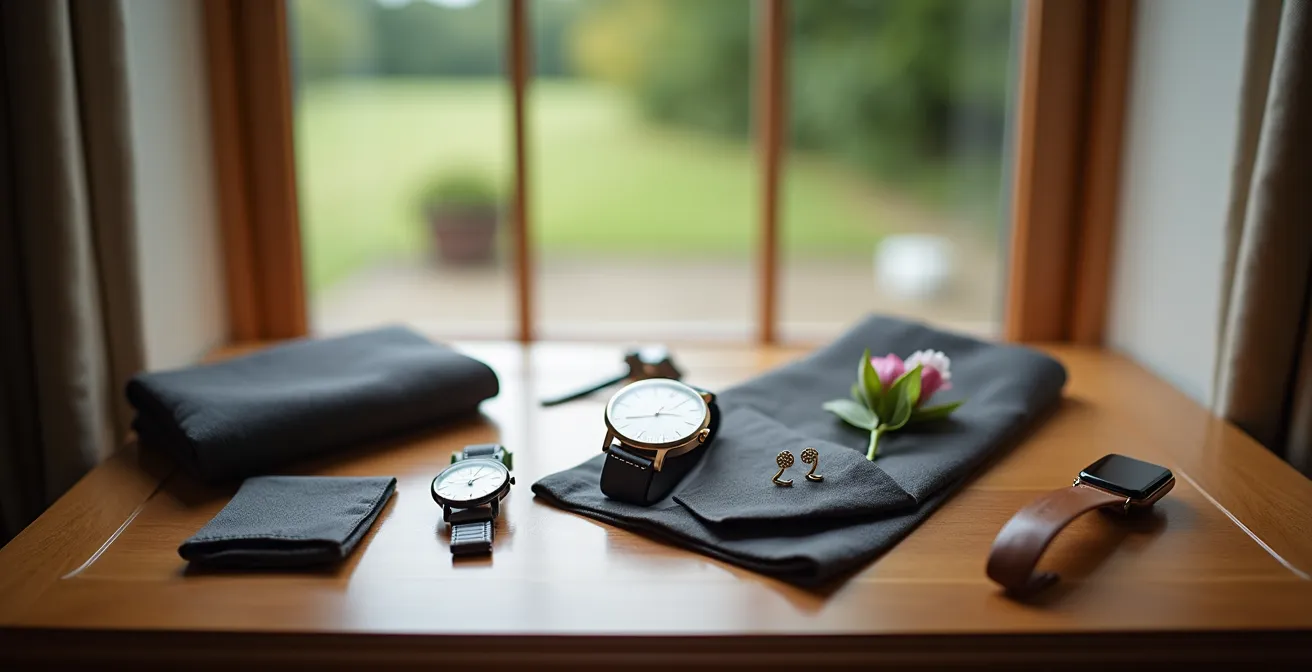
This staged approach allows you to have the best of both worlds: the convenience of your wearable when you need it, and the unimpeachable elegance of a classic watch when the occasion demands it. It is a nuanced solution for a modern problem, showing that you understand and respect the subtle shifts in formality throughout a wedding day.
Ultra-slim watch or pocket watch: which option for maximum elegance?
For the gentleman seeking the pinnacle of formal elegance, the conversation moves beyond smartwatches to the realm of classic horology. The two supreme choices for a black-tie or white-tie event are the ultra-slim dress watch and the traditional pocket watch. Both options prioritise discretion and timeless style over functionality. An ultra-slim watch is the epitome of understated luxury. As noted by horology experts at Watch.co.uk in their Wedding Watch Etiquette Guide, “This type of watch is also generally smaller and thinner and wears nicely under the cuffs of your shirt.” Its slender profile ensures it never snags on or awkwardly bulges under a French cuff, maintaining a clean, unbroken line from shoulder to wrist.
The pocket watch, on the other hand, is a deliberate statement of classicism. Tucked into the waistcoat of a morning suit or evening tailcoat, it is completely hidden from view, adhering to the oldest rule of formal etiquette: that a gentleman should not be concerned with time in good company. It is an accessory revealed only by choice, adding a touch of nostalgic charm and impeccable polish.
However, the modern world offers a third, surprisingly effective path for those who still want to track their metrics: the smart ring. This option provides the ultimate in discreet modernity, a concept perfectly exemplified by a prominent member of the British royal family.
Case Study: Prince Harry’s Oura Ring and Modern Formal Wear
Prince Harry has frequently been photographed wearing an Oura smart ring, even with formal morning suits and black-tie attire. This represents a masterful interpretation of modern etiquette. The ring is almost invisible, lacks a distracting screen, and provides no notifications. It allows him to maintain his health monitoring discreetly, without compromising the traditional aesthetic of his outfit. It is the 21st-century equivalent of a pocket watch: a personal tool, kept out of sight, that perfectly respects the formality of the occasion while embracing contemporary technology.
The choice between an ultra-slim watch, a pocket watch, or even a smart ring depends on the level of formality and personal style. Each offers a path to maximum elegance by prioritising discretion above all else. They are not just accessories, but affirmations of an understanding of deep-rooted sartorial codes.
Why a 44mm watch ruins the elegance of a French cuff shirt
Proportion is a foundational pillar of classic style, and nowhere is this more critical than in the relationship between a watch and a shirt cuff. A large, bulky watch, particularly one with a case diameter of 44mm or more, fundamentally disrupts the elegant silhouette of a formal outfit. The issue is most pronounced with French cuffs (also known as double cuffs), which are the standard for black-tie and formal business shirts. These cuffs are designed to be fastened with cufflinks and sit snugly around the wrist. An oversized watch forces the cuff to bunch up, ride up the forearm, or sit awkwardly on top of the watch, creating a visible and unsightly bulge. This instantly signals a lack of attention to detail.
This isn’t merely a matter of opinion; it’s a principle of good tailoring. As the formal wear guide from Real Men Real Style explains, “Watches should be proportionate to your body.” A watch should be an extension of its wearer, not an anchor. The ideal dress watch, whether smart or traditional, should be slim enough to slide effortlessly under the shirt cuff when your arm is relaxed. It should reveal itself naturally when you bend your arm or check the time, then disappear again. This subtle interplay is known as the “cuff rule.”
For most people, this means choosing a watch with a case diameter under 40mm and a thickness of less than 12mm for formal occasions. If you are a person with a particularly large build, you can handle a slightly larger watch, but the cuff rule still applies: the watch must fit comfortably *under* the cuff, not fight against it. A watch that cannot pass this simple test is, by definition, too large for the formal attire you are wearing, regardless of its price or brand.
To ensure your watch respects the integrity of your tailoring, follow these key checks:
- The Slide Test: Your watch must slide easily under your shirt cuff without catching or bunching the fabric.
- The Size Guideline: For formal shirts with tight cuffs, a watch case under 40mm is almost always the correct choice.
- The Jacket Check: With your suit jacket on and arms at your sides, the watch should be completely hidden beneath the cuff.
- The Bulge Ban: There should be no visible lump or distortion of the cuff fabric caused by the watch.
Key takeaways
- The single most effective change is to swap the default silicone strap for one made of fine leather or polished metal.
- Customise your device with a minimalist, analogue-style watch face, removing all data-heavy “complications” for a clean look.
- Adhere to the “cuff rule”: ensure your watch is slim enough to slide effortlessly under your shirt cuff to maintain a sharp silhouette.
Defining a Taste for Elegance at UK Black Tie Events
Ultimately, navigating the world of formal wear is not about memorising a rigid set of rules, but about cultivating a taste for elegance. This taste is defined by an understanding of proportion, an appreciation for quality materials, and a commitment to discretion. Whether you choose a classic Patek Philippe, a modern Apple Watch, or no watch at all, these principles remain the same. For the most formal UK events, such as a black-tie wedding or a white-tie ball, simplicity is the reigning virtue. The goal is not to draw attention to your accessories, but for them to contribute quietly to a harmonious whole.
The iconic style of James Bond often serves as a modern reference. He wears a functional tool watch (typically an Omega Seamaster) with an impeccably tailored tuxedo. It works because the watch is perfectly proportioned, classically styled, and worn with an air of unstated confidence. It serves as a benchmark for how any functional item, including a smartwatch, should be integrated into a formal context: with subtlety and purpose. The watch should never be the loudest voice in the conversation your outfit is having.
This philosophy of understatement is perfectly captured by the experts at Real Men Real Style, who provide a clear directive for the most stringent dress codes:
Black tie / White Tie – For formal events, simplicity is critical. A simple dress watch in a classic style and black leather band will mute any objections from conservative observers.
– Real Men Real Style, How To Match A Watch With Your Outfit
This advice is the bedrock of formal style. By applying this lens of “critical simplicity” to your smartwatch—by choosing a simple strap, a minimalist face, and a discreet size—you are not breaking the rules. You are translating them for a modern age. You are demonstrating a true taste for elegance, one that understands that style is not about the objects you wear, but the consideration with which you wear them.
Now, armed with these principles, you can confidently integrate your favourite tech into any formal occasion, proving that modern functionality and timeless style can coexist beautifully when guided by taste and discretion.
Frequently Asked Questions About Styling Wearables Without Ruining a Formal Wedding Guest Outfit
Should I wear a smartwatch to a black-tie wedding?
For the most formal weddings, like black-tie events, a classic, slim dress watch is always the safest and most elegant choice. Avoid wearing oversized or flashy watches, as they can distract from the solemnity and celebration of the event. If you must wear a smartwatch, it should be impeccably styled with a leather or metal strap and a minimalist analogue face.
How should I manage smartwatch notifications at weddings?
If you choose to wear a smartwatch, it is imperative to manage your notifications with extreme care. Switch your watch to a silent or “theatre” mode that disables the screen from lighting up with wrist movement. Better still, turn off all non-essential notifications completely for the duration of the event. A vibrating or glowing wrist during the vows or speeches is a significant breach of etiquette.
What’s the traditional rule about watches at formal events?
The most traditional and strictest rule of etiquette suggests that one should not wear a watch at all to very formal evening events. The logic is that guests should be fully present and engaged in the celebration, not concerned with the passage of time. While this rule has relaxed considerably, its spirit endures: any timepiece worn should be discreet and secondary to the occasion itself.