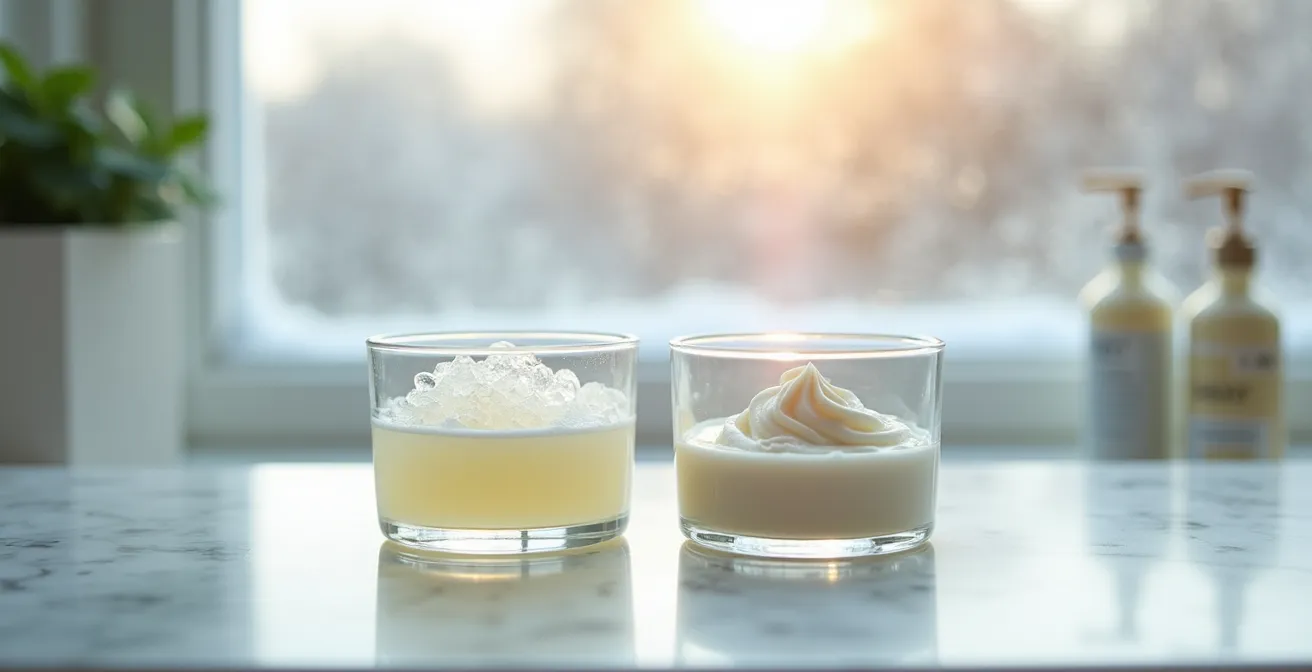
The key to winter hydration isn’t choosing between hyaluronic acid and glycerin; it’s mastering how to use them against the UK’s unique “humidity paradox”.
- Hyaluronic acid can paradoxically dehydrate your skin in the dry air created by central heating.
- Glycerin is often a more stable and reliable humectant in low-humidity environments.
- Occlusive ingredients are non-negotiable to lock in moisture and prevent water loss overnight.
Recommendation: Build an ‘Environmental Hydration Strategy’ by layering products based on your indoor and outdoor environment, not just your fixed skin type.
The annual debate over hyaluronic acid versus glycerin intensifies every time the British winter sets in. One is lauded as a premium moisture magnet, the other as a dependable, old-guard hydrator. Many people experiencing the tell-tale tightness and flakiness from cold winds and relentless central heating believe switching from one to the other is the solution. They wonder if they can be used together, or if one is definitively superior. But this focus on a simple ingredient duel misses the fundamental point.
As a cosmetic formulator, I can tell you the most effective ingredient is not the one with the best marketing, but the one that works in synergy with its environment. The real challenge for British skin isn’t just the cold; it’s the dramatic swing between damp, chilly air outside and the desert-like dryness inside our homes and offices. This is the “Humidity Paradox,” and it dictates how your skincare actually performs.
Instead of picking a side, this guide will equip you with an “Environmental Hydration Strategy.” You’ll learn to think like a formulator, understanding the mechanisms of these ingredients not in isolation, but in the context of your daily life. We’ll deconstruct why your favourite hydrator might be failing you, how to correctly layer products to create a resilient barrier, and how to adapt your routine dynamically for a comfortable, hydrated complexion all winter long.
This article provides a complete framework for understanding and managing your skin’s hydration needs during the uniquely challenging British winter. Below is a summary of the key strategies we will explore.
Summary: A Formulator’s Guide to Hydration in a British Winter
- Why Can Hyaluronic Acid Dry Out Skin if the Air Is Too Dry?
- How to Use Occlusives to Prevent Water from Evaporating at Night?
- Gel-Cream or Rich Balm: Which to Choose for Combination Skin in Winter?
- The Mistake of Applying Moisturiser to a Completely Dry Face
- Tightness Problem: Adding a Few Drops of Oil to Your Cream to Boost It
- When to Run in London: Sequencing Your Outings According to Pollution Alerts
- Why Does Coconut Oil Penetrate While Others Stay on the Surface?
- Why Exfoliating Too Often Destroys Your Epidermis and Causes Breakouts?
Why Can Hyaluronic Acid Dry Out Skin if the Air Is Too Dry?
Hyaluronic acid (HA) is a powerful humectant, meaning it draws moisture from its surroundings. In a humid environment, it pulls water from the air, plumping up your skin. However, the British winter creates a critical challenge known as the “Humidity Paradox.” While it may be damp outside, the moment you step indoors and the central heating kicks in, the air becomes extremely dry. Research confirms this, showing that up to 94% of UK indoor measurements in winter are below 40% humidity, which is the level where skin starts to lose significant moisture.
In this low-humidity indoor environment, HA cannot pull sufficient moisture from the air. Instead, to satisfy its thirst, it can begin to draw water from the deeper layers of your own skin, pulling it towards the surface where it then evaporates. This process, known as transepidermal water loss (TEWL), can leave your skin even drier and tighter than before you applied the product. This is why a serum that feels wonderful on a damp autumn day can seem to betray you in the depths of a centrally heated winter. Glycerin, being a smaller molecule and less aggressively hygroscopic, tends to be a more stable choice when indoor humidity plummets, as it’s better at holding onto the moisture it already has.
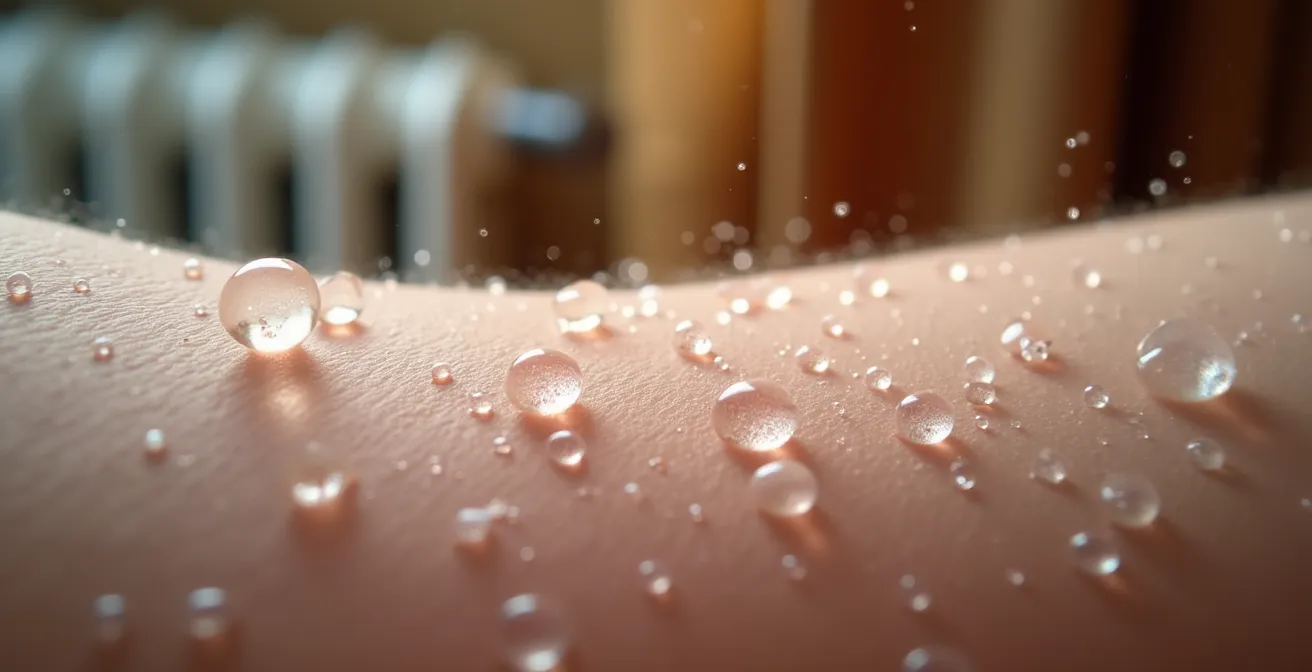
This doesn’t mean you must discard your HA products. It means you must become strategic. You need to assess your environment and provide the HA with the moisture it needs, or seal it in so it cannot escape. Understanding your immediate environment is the first step in an effective hydration strategy.
Action Plan: Assess Your Environment for Humectant Effectiveness
- Gauge Indoor Humidity: Use a simple digital hygrometer to monitor your indoor humidity. The ideal range for skin health is between 40% and 60%. If it’s consistently below 30-40%, your HA needs help.
- Observe Environmental Clues: Look for condensation on the inside of your windows on a cold morning. This is a sign of higher indoor humidity, creating a better environment for HA to work effectively. Crisp, cold air often signifies low humidity.
- Provide a Water Source: Always apply your HA serum to damp skin. After cleansing, mist your face with water (or a thermal water spray) before application. This gives the HA an immediate source of water to draw from, rather than pulling from your dermis.
- Evaluate Skin Feel: Pay attention to how your skin feels 30 minutes after your routine. If it feels tight or parched despite using a hydrating serum, it’s a strong indicator that the environment is too dry and you need an occlusive layer on top.
- Consider a Humidifier: If your indoor air is persistently dry, running a humidifier in your bedroom or office is one of the most effective ways to support your skin’s moisture barrier and boost the performance of all your hydrating products.
How to Use Occlusives to Prevent Water from Evaporating at Night?
If humectants like hyaluronic acid and glycerin are the agents that draw water *in*, occlusives are the security guards that lock it down. An occlusive forms a physical barrier on the skin’s surface, drastically reducing transepidermal water loss (TEWL). At night, when your skin’s repair processes are most active and it’s most prone to moisture loss, applying an occlusive as the final step in your routine can be transformative. This is the principle behind the “slugging” trend.
However, a one-size-fits-all approach isn’t optimal, especially in the UK. As dermatologists featured in Harper’s Bazaar UK note, factors like the notoriously hard water in London and South East England can make heavy, traditional occlusives like pure petrolatum feel too heavy or potentially lead to congestion for some. Instead, they recommend adapting the technique with more elegant formulations that provide an occlusive seal without the greasy feel. This involves looking for products containing ingredients like squalane, ceramides, or dimethicone, which are widely available in UK high street stores like Boots and Superdrug.
This table compares common occlusive ingredients to help you choose the right one for your skin type and needs, with examples of brands easily found in the UK.
| Ingredient | Texture | Best For | UK Availability |
|---|---|---|---|
| Petrolatum | Heavy, greasy | Very dry, compromised skin | Vaseline at all chemists |
| Squalane | Lightweight oil | All skin types, including oily | The Inkey List at Boots |
| Dimethicone | Silky, non-greasy | Combination/oily skin | CeraVe at Superdrug |
| Ceramides | Creamy | Barrier repair, sensitive skin | La Roche-Posay at pharmacies |
The key is to apply a thin layer of your chosen occlusive over your hydrating serums and moisturiser just before bed. This creates a micro-environment where your skin can retain the hydration you’ve just applied, allowing you to wake up with a visibly plumper, more comfortable complexion.
Gel-Cream or Rich Balm: Which to Choose for Combination Skin in Winter?
For those with combination skin, winter presents a particularly confusing challenge. The oily T-zone still feels greasy, yet the cheeks become tight and dry. The conventional wisdom to simply “switch to a thicker cream” can feel wrong, risking breakouts and congestion. This is where the Environmental Hydration Strategy, and the concept of dynamic layering, becomes essential. The choice isn’t necessarily about gel *or* balm; it’s about knowing when and where to use each.
A gel-cream, often rich in humectants like glycerin, provides water-based hydration without heavy lipids, making it ideal for the oilier parts of your face or for daytime use when you don’t want a heavy feel. A rich balm, on the other hand, is higher in emollients and occlusives (like shea butter or ceramides), making it perfect for targeting dry patches on the cheeks or for use as an all-over protective layer at night. You can use both within the same routine: a gel-cream on your T-zone and a richer cream or balm on your cheeks.
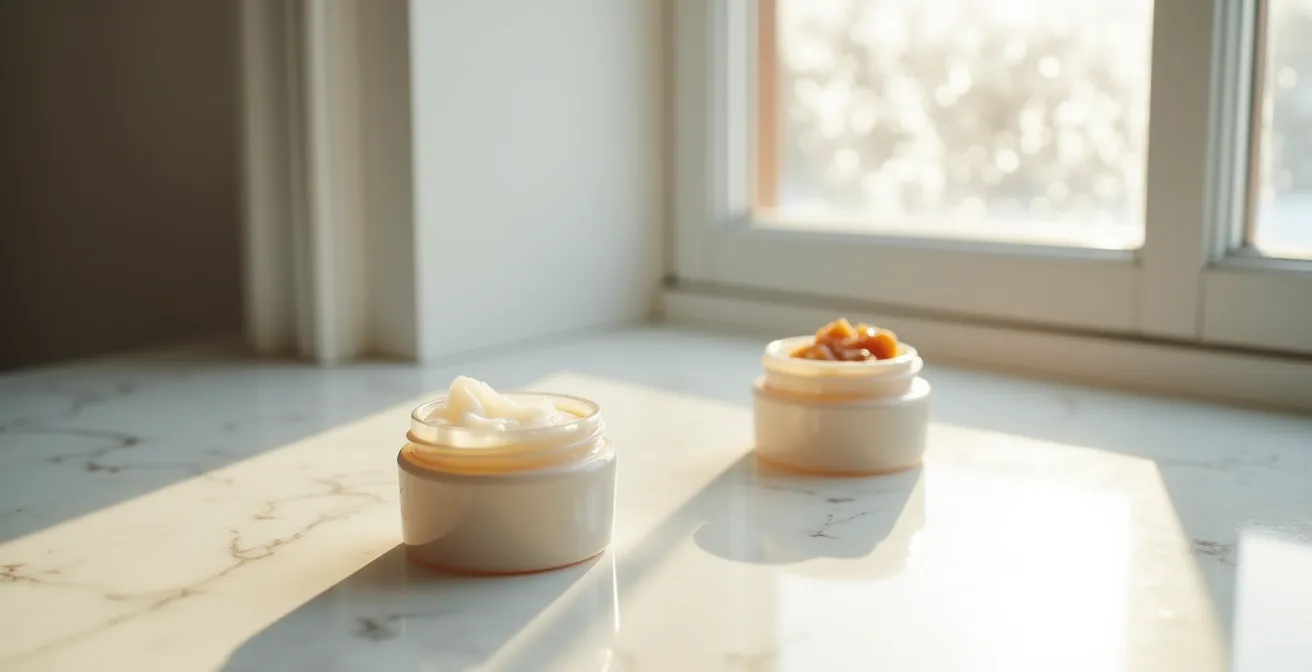
This approach requires you to become more intuitive and responsive to your skin’s daily needs, a sentiment echoed by leading experts. As London-based dermatologist Dr Beibei Du-Harpur advises in the Harper’s Bazaar UK Winter Skincare Guide:
I would not recommend a complete overhaul of all products due to a change in seasons – I think that the most important thing is to develop an awareness and understanding of your own skin.
– Dr Beibei Du-Harpur, Harper’s Bazaar UK
Instead of rigidly sticking to one product, assess your skin daily. Does it feel tight all over? Perhaps it’s a night for a balm. Is it just your cheeks feeling dry? Target them specifically. This flexible approach allows you to provide precisely what your skin needs, where it needs it, preventing both dehydration and congestion.
The Mistake of Applying Moisturiser to a Completely Dry Face
One of the most common yet detrimental mistakes in any skincare routine is applying hydrating products to a bone-dry face. As we’ve established, humectants like hyaluronic acid and glycerin need water to function. When you apply them to dry skin, especially in a low-humidity room, you force them to pull moisture from the deeper layers of your skin, which is counterproductive. Applying your products to a damp surface provides an external water source for them to grab onto and pull into your epidermis.
This is the principle behind the “60-second rule”: the window of time after cleansing when your skin is still damp and most receptive to product absorption. After patting your face gently with a towel, it should not be dripping wet, but should feel cool and have a light film of moisture. This is the optimal canvas. Applying your humectant serum followed by your moisturiser within this minute locks in that surface water, dramatically boosting the efficacy of your entire routine.
For those living in hard water areas like much of London and the South East, there’s an additional consideration. The mineral residue left by tap water can interfere with product absorption and even contribute to barrier irritation. UK dermatologists often recommend a simple extra step: after cleansing and patting your skin, spritz it with a thermal water spray from a brand like Avène or La Roche-Posay, both widely available in British pharmacies. This creates a “clean” film of mineral-balanced water on the skin, providing a purer source of moisture for your serums to bind with before you seal everything in with your moisturiser.
This simple technique shift—from applying products to dry skin to applying them to damp skin—requires no new purchases but can fundamentally change how your skin feels and functions throughout the winter. It ensures your products are working for you, not against you.
Tightness Problem: Adding a Few Drops of Oil to Your Cream to Boost It
Even with the best humectants and moisturisers, there are days when the combination of biting winds and high central heating leaves skin feeling persistently tight. On these days, your moisturiser may need a boost. This is where facial oils come in, not as a replacement for your cream, but as a customisable supplement. Adding a few drops of a suitable oil to your moisturiser enriches its emollient and occlusive properties, creating a more robust barrier against the harsh environment.
This “cocktailing” approach allows you to transform your regular moisturiser into a richer winter cream on an as-needed basis, embodying the principles of a flexible, dynamic routine. As dermatologist Dr Emma Craythorne explains, you can even vary the technique: mixing oil *into* your cream creates a more uniform emollient barrier, while patting a few drops of oil *on top* of your moisturiser acts as a final, powerful occlusive seal. The choice depends on how much protection your skin is signalling it needs.
The key is to choose the right oil. Not all oils are created equal; some are more nourishing, while others are lighter and more occlusive. Critically, you should opt for non-comedogenic oils that won’t clog pores. The following table highlights some of the best facial oils for winter, all readily available from UK retailers, and suggests what type of product they mix best with.
| Oil Type | Benefits | UK Brand Example | Best Mixed With |
|---|---|---|---|
| Rosehip | Repair & antioxidants | Pai Skincare | Glycerin-based creams |
| Squalane | Lightweight occlusion | The Inkey List | Hyaluronic acid serums |
| Marula | Deep nourishment | The Ordinary | Gel-creams |
By keeping a suitable facial oil on hand, you empower yourself to adjust the richness of your hydration on a daily basis, ensuring your skin barrier remains supple and resilient no matter what a British winter day throws at it. This data, drawn from an analysis of moisturisers for dry skin, provides a practical starting point.
When to Run in London: Sequencing Your Outings According to Pollution Alerts
For runners in London, winter skincare is a battle fought on two fronts: against the cold, dry air and against environmental pollution. Particulate matter (PM2.5) from traffic and industry is a significant source of oxidative stress, which accelerates skin ageing and weakens the skin barrier. This damage makes the skin even more vulnerable to dehydration and sensitivity from the winter elements. Therefore, an effective skincare strategy must account for this environmental aggressor.
The first line of defence is strategic timing. Check air quality apps or the London Air Quality Network before you head out. On days with high pollution alerts, consider an indoor workout or run at a time of day when traffic is lower, such as early morning. If you must run in polluted conditions, your post-run skincare routine is not just about cleansing; it’s about damage control and barrier repair. This is where glycerin can be a particularly valuable ally. As a reliable humectant, it helps to replenish the moisture lost during your run, but its primary benefit here is in supporting the skin barrier that pollution has just assaulted.
Your post-run routine should be immediate and focused. First, cleanse your face as soon as you get in to remove the pollutant particles from your skin’s surface. Next, apply a serum heavy in antioxidants like Vitamin C to help neutralise the free radical damage caused by the pollution. Follow this with a glycerin-heavy, ceramide-rich moisturiser. The glycerin will pull in moisture, while the ceramides will act like mortar, filling in the gaps in your compromised skin barrier. This two-pronged approach not only rehydrates but actively repairs, building your skin’s resilience for your next run.
This isn’t just theory; it’s a practice supported by dermatological science. An analysis from skincare experts confirms that ingredients like glycerin help to lock in moisture and repair the skin barrier, making it an essential component for any urban athlete’s winter toolkit. By timing your runs and implementing a targeted repair routine, you can continue to enjoy your sport without sacrificing your skin’s health.
Why Does Coconut Oil Penetrate While Others Stay on the Surface?
The world of facial oils is filled with conflicting advice, and nowhere is this more true than with coconut oil. Praised as a natural wonder for body care, it’s often a source of confusion for facial use. The reason for its unique behaviour—and its potential pitfalls—lies in its molecular structure. Coconut oil is predominantly composed of smaller fatty acid molecules, particularly lauric acid. This smaller molecular size allows it to penetrate the skin’s surface more readily than oils with larger fatty acid chains, like olive or almond oil.
This deeper penetration is what can give it a less “greasy” feel initially. However, this same property is what makes it highly comedogenic (pore-clogging) for many people, especially on the face. Once inside the pore, these fatty acids can mix with dead skin cells and sebum, creating a plug that leads to breakouts. In winter, when the skin is already stressed and cell turnover can be sluggish, introducing a highly comedogenic oil can be a recipe for congestion and inflammation.
Research confirms that while its molecular structure allows for penetration, this doesn’t automatically make it a superior facial moisturiser. In fact, for facial skin, skincare experts in the UK widely recommend non-comedogenic alternatives that provide excellent emollient and occlusive benefits without the risk of clogging pores. Oils like squalane, rosehip, or jojoba oil have molecular structures that are more compatible with facial skin. They effectively form a protective, breathable barrier on the surface, preventing water loss without burrowing into pores. Coconut oil’s place in a winter routine is best reserved for the body, where the skin is less prone to comedonal acne.
Understanding this “why” behind an ingredient’s behaviour empowers you to make informed choices. Just because an oil penetrates does not mean it is beneficial; for facial skin in winter, an oil that provides a protective surface seal is often the more strategic and safer choice.
Key Takeaways
- The British winter creates a “Humidity Paradox”: damp air outside, but desert-dry air inside due to central heating.
- Hyaluronic acid can dry out skin in low-humidity indoor environments; glycerin is often a more stable humectant choice.
- A flexible “Environmental Hydration Strategy”—adapting your routine to your immediate surroundings—is more effective than a rigid one.
Why Exfoliating Too Often Destroys Your Epidermis and Causes Breakouts?
When winter skin becomes dull and flaky, the instinctive reaction is often to exfoliate more aggressively to scrub away the dead cells. However, this is one of the most damaging things you can do. Flakiness in winter is rarely a sign that you need more exfoliation; it’s a cry for help from a compromised, dehydrated skin barrier. The epidermis, your skin’s outermost layer, is being stripped of its natural lipids by cold winds and dry air, and it can no longer hold onto moisture effectively.
Aggressive exfoliation, particularly with harsh physical scrubs or over-used acid toners, physically removes what little is left of this protective barrier. It strips away the very cells and lipids that are trying to defend your skin, leaving it raw and exposed. This not only accelerates water loss, leading to a vicious cycle of dehydration and flakiness, but it also opens the door to irritation and inflammation. Your skin, in a state of panic, may even overproduce oil to compensate for the dryness, leading to the frustrating combination of tight, flaky skin that is also breaking out.
The formulator’s approach in winter is not to attack the flakes, but to repair the barrier that is causing them. This means reducing the frequency of exfoliation significantly. For most people, exfoliating once or twice a week with a gentle acid is more than enough. Consider switching from stronger alpha-hydroxy acids (AHAs) like glycolic acid to milder, larger-molecule options like lactic acid or polyhydroxy acids (PHAs), which exfoliate the surface without penetrating as deeply and causing irritation.
Crucially, always follow exfoliation with a dedicated barrier-repair routine. Immediately apply your humectant serums (to damp skin) and seal them in with a moisturiser rich in ceramides, cholesterol, and fatty acids—the building blocks of your skin barrier. On days when your skin feels particularly sensitive or tight, skip exfoliation entirely. Listening to your skin’s signals and prioritising repair over stripping is the true key to achieving a smooth, glowing complexion in winter.
Frequently Asked Questions About Winter Skincare Ingredients
Why is coconut oil not recommended for the face in winter?
Its high comedogenic rating can clog pores, which is especially problematic when skin is already stressed from winter conditions and central heating. This can lead to breakouts and congestion on the delicate facial skin.
What makes coconut oil different from other oils?
Its chemical structure is dominated by smaller fatty acid molecules, primarily lauric acid. This allows it to penetrate deeper into the skin, but this same property can also disrupt the skin barrier and clog pores if overused on the face.
When is coconut oil appropriate in winter skincare?
It is best reserved for use on the body. Applying it to arms and legs after a shower can be an effective way to combat the dryness caused by hard water and central heating, as the skin on the body is thicker and less prone to breakouts.