
Contrary to popular belief, an in-house movement is not an automatic guarantee of better value; the true worth is a trade-off between prestige and the practical economics of ownership.
- In-house movements offer exclusivity and superior specifications like longer power reserves, but come with significantly higher, brand-locked servicing costs.
- ETA-based movements provide proven reliability and lower, more flexible maintenance costs, with certain discontinued models becoming highly sought-after collector’s items.
Recommendation: Evaluate a watch’s value based on your personal ownership horizon. For long-term, practical ownership, factor in the “serviceability matrix”; for investment, look for unique “collector’s anomalies” which can exist in either category.
For any discerning watch enthusiast, the “in-house versus ETA” debate is a familiar crossroads. On one side stands the allure of the manufacture calibre—a symbol of a brand’s technical prowess, exclusivity, and horological soul. On the other, the robust, reliable, and ubiquitous ETA movement, often dismissed as a generic “workhorse” but trusted by countless prestigious brands for decades. The common wisdom dictates that in-house is unequivocally superior and a better store of value. This perspective, however, often overlooks the most critical aspect of ownership: the long-term economic and practical reality of living with the watch on your wrist.
The discussion is rarely about which is “better” in a vacuum, but about which represents a smarter investment for you. Value isn’t just about brand prestige or the initial purchase price. It’s a complex equation that includes maintenance costs, daily usability, tangible quality you can see under a loupe, and even the quirks of the secondary market. A watch is not a static asset; it’s a functioning machine that requires care and whose value proposition evolves over time. Understanding the hidden costs and benefits is paramount.
But what if the key to determining value wasn’t about choosing a side, but about understanding the trade-offs? This guide moves beyond the surface-level debate. We will dissect the tangible differences that impact your wallet and your weekend, from the startling cost of servicing a manufacture movement to the real-world benefit of a 70-hour power reserve. We will explore the macro details that define true craftsmanship, analyse why certain ETA-powered watches are appreciating assets, and even look beyond the movement to the case itself. Ultimately, you’ll gain a framework for assessing value based not on marketing, but on informed, practical ownership economics.
This article provides a structured analysis to help you make an informed decision. The following sections break down the key factors that define the true value of a watch movement, empowering you to see beyond the brand name on the dial.
Summary: In-House vs. ETA: A Value Analysis for the Discerning Collector
- Why does an in-house calibre cost 3 times more to service?
- How does a 70-hour power reserve change your weekend?
- Hand vs. Industrial Anglage: What’s the visible difference under a loupe?
- The mistake of changing the date between 10 PM and 2 AM
- Why do some references gain 20% in value per year?
- Lost-wax casting or hand-forging: which technique for your design?
- Drift problem: how to regulate your watch without opening the case?
- Spotting Premier Finishing: Macro Details That Fakes Cannot Replicate
Why does an in-house calibre cost 3 times more to service?
The single most significant factor in the long-term cost of ownership is servicing. While an in-house movement is a mark of a brand’s watchmaking independence, it creates a closed ecosystem for maintenance. This is the core of the cost difference. With an in-house calibre, you are tethered to the brand’s authorised service centres. They have a monopoly on the proprietary parts, specialised tools, and the specific knowledge required to correctly disassemble and reassemble the movement. This lack of competition naturally leads to premium pricing.
In contrast, an ETA movement, such as the ubiquitous 2824-2 or the slimmer 2892-A2, is an open-source platform. For decades, these movements have powered watches from a vast array of brands, meaning that any qualified independent watchmaker in the UK will have the experience, the standard tools, and, crucially, access to a ready supply of spare parts to service it. This creates a competitive marketplace for servicing, driving costs down significantly. The value proposition here is not just lower cost, but also flexibility and convenience. You are not forced to ship your watch to a single service centre and wait months for its return.
This table breaks down the fundamental differences in what can be called the “serviceability matrix”—a key component of a movement’s real-world value.
| Aspect | In-House Movement | ETA Movement |
|---|---|---|
| Service Provider Options | Brand-authorized only | Any qualified watchmaker |
| Parts Availability | Restricted to brand | Widely available |
| Special Tools Required | Proprietary tools needed | Standard tools sufficient |
| Typical Service Cost | Premium pricing | Competitive pricing |
Therefore, when you buy a watch with an in-house movement, you are also buying into a long-term, exclusive, and expensive service plan. This is a critical piece of the ownership economics that is often overlooked at the point of purchase but becomes a significant financial consideration over the life of the watch.
How does a 70-hour power reserve change your weekend?
One of the most heavily marketed advantages of modern in-house movements is an extended power reserve, often hitting the 70 or 80-hour mark. This isn’t just a technical specification; it has a tangible impact on the user experience. A standard ETA movement typically offers a power reserve of around 38 to 42 hours. This means if you take your watch off on Friday evening, it will have stopped by Monday morning. You will need to wind it and reset the time—and potentially the date.
A watch with a 70-hour power reserve completely solves this problem. You can put it down on Friday and pick it up on Monday, and it will still be running perfectly. It’s a small convenience, but one that enhances the pleasure of ownership, especially for those who rotate watches in their collection. This “weekend-proof” capability is a direct result of advancements in mainspring technology and barrel design, areas where brands invest heavily to differentiate their in-house calibres.
However, it’s important to contextualise this benefit. While convenient, it doesn’t diminish the core quality of a top-grade ETA movement. As noted by experts, the ETA caliber 2892-A2, for example, is a movement that has been used by major luxury brands like Omega and IWC for years. It has a long-standing track record as a reliable and robust workhorse, proving that a shorter power reserve does not equate to inferior timekeeping or durability. The choice becomes one of practical convenience versus proven, cost-effective reliability. For a daily wearer, the 38-hour reserve may be perfectly sufficient, while for a collector, the extended reserve might be a defining feature.
Hand vs. Industrial Anglage: What’s the visible difference under a loupe?
Finishing is where the philosophical difference between in-house and ETA-based movements becomes truly visible—if you know where to look. High-end manufacture calibres often showcase exquisite hand-finishing techniques, with anglage, or the bevelling of the movement’s bridges and plates, being a prime example. Hand-finished anglage creates highly polished, curved bevels with sharp, perfect inward and outward corners. This is an artisanal skill that machines cannot replicate, designed to catch and play with light in a way that is aesthetically breathtaking.
Industrial finishing, typical of standard ETA movements, is done by machine. While precise and clean, the edges are often uniform and lack the sharp, inward angles that are the hallmark of hand-craftsmanship. A loupe reveals the difference: hand-finishing has a liquid-like brilliance and subtle, human variations, while machine-finishing is consistent but comparatively flat. This visual distinction is a significant component of the “soul” that collectors attribute to in-house movements.
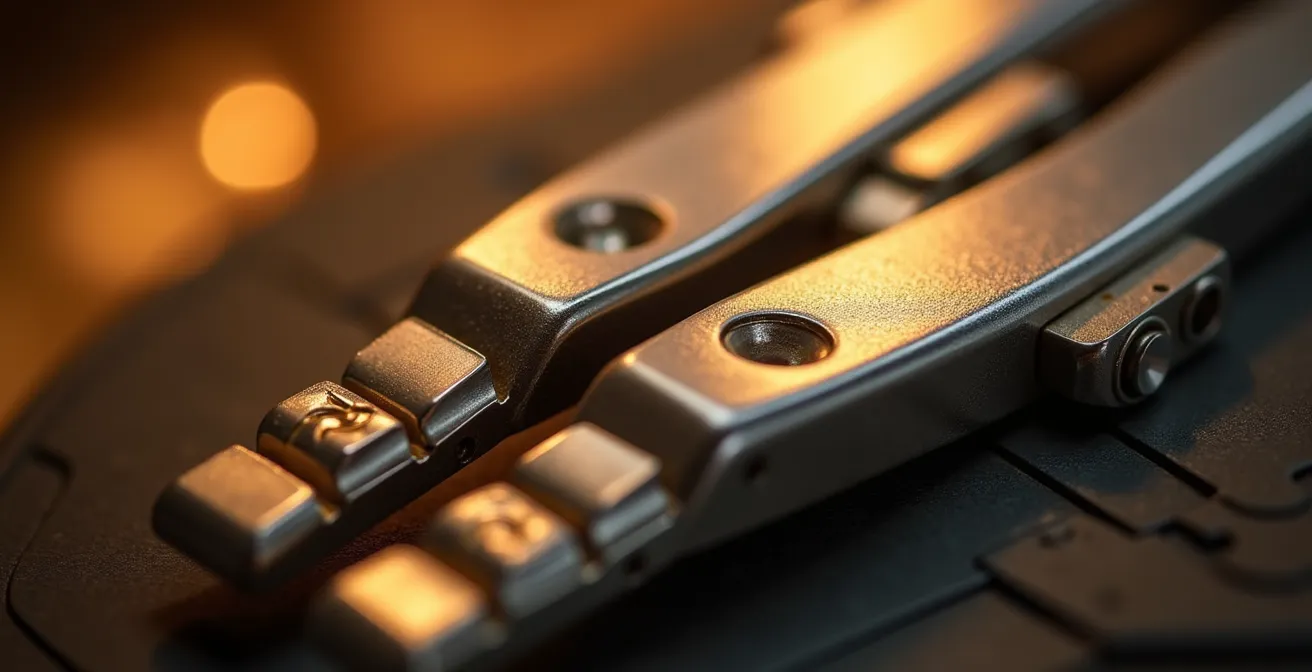
As the image shows, the way light reflects off a hand-polished edge is fundamentally different. It’s not about function; it’s about a commitment to artistry and a tangible indicator of the hours of skilled labour invested in the movement. This is a form of tangible value that, for many collectors, justifies the premium. To assess this yourself, you need a methodical approach.
Your 5-Point Quality Inspection Checklist: Spotting High-End Finishing
- Examine inner corners: True hand-finishing creates sharp, inward-pointing angles on the bridges that are impossible for a machine’s rotating tool to achieve.
- Check edge consistency: Look for the soul in the machine. Hand-applied work shows microscopic, non-uniform variations, whereas machine work is perfectly, almost sterilely, consistent.
- Inspect light reflection: A hand-polished bevel (or ‘anglage’) will have a distinctive, almost liquid-like brilliance that machine polishing cannot match.
- Look for perlage overlap: On the mainplate, hand-applied circular graining (perlage) often shows a deliberate, artistic pattern of overlap, unlike the rigid uniformity of automated application.
- Assess overall harmony: A hand-finished movement presents a cohesive artistic vision, where the decoration on one component flows into the next.
The mistake of changing the date between 10 PM and 2 AM
One of the most common and costly mistakes a watch owner can make applies to many movements, both ETA and in-house, that lack a protective mechanism. This is the act of manually adjusting the date within the “danger zone”—typically between 10 PM and 2 AM. During this window, the movement’s date-changing mechanism is physically engaged with the date wheel, slowly building tension to flip the date at midnight. Forcing a manual change while these gears are interlocked can strip the delicate teeth of the date wheel or damage the date-change finger.
The result is a costly repair. The symptoms are unmistakable: the date may get stuck between numbers, change at noon instead of midnight, or feel “sticky” when you try to adjust it. This isn’t a simple fix. A watchmaker must perform a partial or full disassembly of the movement to access and replace the damaged components. In the UK, with specialist labour rates to consider, this simple mistake can easily turn into a multi-hundred-pound repair bill. For instance, independent watchmaker pricing can run upwards of £60 per hour before parts, making this a painful lesson in mechanical sympathy.
It’s a testament to the fact that a watch, regardless of its price tag, is a delicate piece of micro-engineering. Newer, more advanced in-house calibres from brands like Rolex or Omega often incorporate protective features or instant-jump date mechanisms that disengage the manual setting during the changeover, mitigating this risk. This is a genuine technical improvement and a valid point of differentiation. However, for the vast number of watches in circulation, this danger remains very real. The best practice is simple: always advance the time past 3 AM before attempting to set the date, then wind the time forward to the correct time.
Why do some references gain 20% in value per year?
The conventional wisdom that in-house movements guarantee better value retention is not an absolute rule. The secondary market is driven by scarcity, provenance, and collector sentiment, which can sometimes create a “collector’s anomaly” where an ETA-powered model becomes more valuable than its in-house successor. The perfect example is the original Tudor Black Bay “Smiley” (Ref. 79220), which used an ETA 2824-2 movement.
When Tudor transitioned the Black Bay line to its in-house manufacture calibre, it also changed the dial, replacing the vintage-inspired “rose” logo and the “smiley” self-winding text with a more modern shield logo and a straighter text block. The case also became slightly thicker to accommodate the new movement. A segment of the collector community quickly decided they preferred the proportions, dial aesthetics, and serviceability of the discontinued ETA version. As a result, these “Smiley” models have become highly sought after, with many now trading above their original retail price on the secondary market.
Whether it’s the simpler ETA 2824-2 movement, the slimmer case, ‘Rose of the Tudor’ motif on the dial, or a combination of all three, there are many, many people saying this is the next watch to go pop.
– Time and Tide Watches
This phenomenon demonstrates that value is not solely a function of technical specifications. It is a complex interplay of scarcity, design preference, and narrative. The “Smiley” is valuable precisely *because* it is no longer made and represents a specific, short-lived chapter in Tudor’s history. It proves that a well-regarded watch with a robust, third-party movement can indeed be a fantastic store of value—and in some cases, a better investment than its supposedly superior in-house counterpart.
Lost-wax casting or hand-forging: which technique for your design?
While the movement is the heart of a watch, the case is its skeleton, and its construction method is a crucial, often overlooked, component of its long-term value and durability. Just as with movements, there are different tiers of quality in case manufacturing. The two primary methods are casting (like lost-wax casting) and forging. Forging, where a block of metal is compressed under immense pressure into a rough shape before being machined, creates a much denser and more uniform metal structure. This results in a case that is more resistant to scratches, dings, and corrosion over time. It also allows for sharper, more defined lines and edges.
A forged case has a superior density and heft that you can feel in your hand. This structural integrity is a hallmark of high-end watchmaking. A well-made case not only protects the movement better but also preserves its aesthetic condition for longer, which is critical for value retention. A watch with a scratched, dented case will always be worth less than one in pristine condition, regardless of the movement inside.
Case Study: Bremont’s Value Proposition
The British brand Bremont serves as an excellent example of this principle. While often using modified, high-grade ETA or Sellita movements, Bremont has built its brand identity and value proposition around its incredibly robust, UK-made case technology. Using proprietary Trip-Tick® case construction and specially hardened steel, their watches are exceptionally tough. This focus on external build quality and durability has allowed Bremont to command a premium price and build a loyal following, proving that perceived value is an aggregate of all components, not just the calibre.
This demonstrates a key strategic point: a brand can create significant value by investing in case technology even when using a third-party movement. For an informed buyer, assessing the quality of the case—its weight, the sharpness of its lines, the feel of the crown action—is just as important as knowing what calibre beats inside. It’s another layer of tangible value that separates a good watch from a great one.
Drift problem: how to regulate your watch without opening the case?
One of the most common issues affecting a mechanical watch’s accuracy is magnetism. In our modern environment, we are surrounded by magnetic fields: from laptops and smartphones to the security gates on the London Tube. When a watch passes through a sufficiently strong magnetic field, its hairspring—the delicate, coiled spring at the heart of the balance wheel—can become magnetised. The coils stick together, effectively shortening the spring’s length and causing the watch to run extremely fast, sometimes gaining several minutes per day.
Many owners assume this “drift problem” requires a trip to the watchmaker for expensive regulation. However, in most cases, the solution is simple, cheap, and can be done at home in under a minute without ever opening the case. The tool required is a watch demagnetizer, a small, inexpensive device readily available online.

The process is straightforward: you activate the device, pass the watch slowly over it, and then pull it away. This disrupts the magnetic field that has built up in the hairspring, returning it to its normal state. This simple action can save a significant amount of time, money, and worry, empowering the owner to solve one of the most frequent accuracy issues themselves.
The £15 DIY Accuracy Fix
As demonstrated by countless watch enthusiasts online, the “drift problem” is often not a problem at all. Using a £15 demagnetizer purchased from online retailers, owners can safely and effectively eliminate magnetism from their watch at home in about 30 seconds. This simple, accessible solution resolves one of the most common causes of inaccuracy without needing any professional intervention, turning a potentially costly service visit into a quick and satisfying DIY task.
Key Takeaways
- Value is a Trade-Off: In-house offers prestige and features like long power reserves, but at the cost of high, brand-locked servicing. ETA offers reliability and affordable, flexible maintenance.
- Look Beyond the Movement: The quality of case construction (forging vs. casting) and the level of finishing (hand vs. machine anglage) are tangible value indicators that are just as important as the calibre.
- Market Rules Are Not Absolute: Collector demand for specific designs and discontinued models can cause ETA-powered watches (like the Tudor ‘Smiley’) to appreciate in value, sometimes more than their in-house successors.
Spotting Premier Finishing: Macro Details That Fakes Cannot Replicate
Ultimately, whether a watch uses an in-house or a high-grade ETA movement, its true value is reflected in the overall quality of its execution. This is where premier finishing comes in, and it’s also the area where counterfeit watches inevitably fail. Replicating a movement’s function is one thing; replicating its soul and artistry is another. For the discerning buyer, knowing what to look for is the ultimate protection.
Fake watches cut corners on the details that require time and skilled labour. The printing on a date wheel might be fuzzy or show ink bleed under a loupe, whereas a genuine watch will have crisp, perfectly defined numerals. The polished surfaces of the hands or case might show microscopic tool marks, while a genuine high-end piece will be flawlessly smooth. Even a brand that uses an ETA movement will often add its own custom rotor or a higher level of decoration, and these brand-specific modifications are details that fakes almost always miss. The feel of the bezel action or the precision of a crown engraving are other tactile indicators of authenticity.
This table highlights the key differences between a genuine high-end product and a common fake. These are the markers of quality you should be looking for, regardless of the movement inside.
This comparative analysis provides a clear guide on what to inspect when evaluating a watch’s authenticity and build quality.
| Component | Genuine High-End | Common Fake |
|---|---|---|
| Date Wheel Print | Sharp, no bleeding | Fuzzy edges, ink bleeding |
| Hand Finishing | Perfect polish, no tool marks | Visible machining marks |
| Crown Engraving | Deep, precise relief | Shallow, soft details |
| Bezel Action | Crisp click, precise alignment | Loose feel, misalignment |
| Movement Decoration | Consistent perlage/striping | Uneven or missing decoration |
Learning to spot these details transforms you from a consumer into a connoisseur. It allows you to appreciate the immense skill that goes into a fine timepiece and gives you the confidence to identify true value, protecting your investment and deepening your appreciation for the craft.
The choice between an in-house and an ETA calibre is not a simple question of good versus bad. It is a nuanced decision based on your personal priorities as an owner. By understanding the trade-offs—servicing costs, practical features, finishing quality, and market dynamics—you can make an investment that aligns with your definition of value. For your next acquisition, arm yourself with this knowledge and choose not just a watch, but a long-term ownership experience that is right for you.
Frequently Asked Questions on Watch Movements and Maintenance
Why is changing the date dangerous between 10 PM and 2 AM?
During these hours, the date change mechanism is already engaged with the date wheel. Forcing a manual change can damage the date finger and gear teeth.
Which movements have protective date mechanisms?
Modern in-house calibres from Omega, Breitling, and Rolex often feature instant-jump technology with protective mechanisms that prevent damage.
How can I tell if the date function is damaged?
Signs include a ‘sticky’ date change, misaligned date in the window, or the date changing at incorrect times during the day.