
The effectiveness of a hair treatment is determined by molecular science, not its price tag or whether it comes from a kitchen or a lab.
- Small-molecule oils (like coconut) can penetrate the hair shaft to reduce protein loss, while large-molecule oils (like jojoba) only coat the surface.
- Over-moisturising by leaving masks on wet hair overnight can cause ‘hygral fatigue’, permanently weakening the hair structure.
Recommendation: Diagnose your hair’s specific need (protein vs. moisture) using the ‘wet stretch test’ before applying any treatment, and use heat to enhance the penetration of appropriate oils for true, cost-effective repair.
The bathroom cabinet is often a battleground. On one side, the humble jar of coconut oil, praised on countless blogs as a natural saviour. On the other, the sleekly packaged salon mask, promising revolutionary repair for a premium price. For anyone in England struggling with dry, brittle, or damaged hair, the choice is confusing and often expensive. You’re told that natural is best, but also that professional formulas contain essential technology. The endless cycle of trial, error, and disappointment can leave both your hair and your bank account feeling depleted.
Most advice focuses on what to use, but rarely explains *why* a product works—or fails. We’re encouraged to slather on oils and leave masks on for hours, assuming that ‘more is more’. This common approach often ignores the fundamental biology of our hair. The real conversation isn’t about “kitchen vs. salon”; it’s about physics and chemistry. It’s about understanding the hair shaft’s structure, the molecular size of different ingredients, and the specific condition of your hair’s cuticle.
But what if the key to unlocking true, deep repair wasn’t in buying more products, but in understanding the science? What if you could make a basic conditioner outperform a luxury mask, simply by knowing which £2 ingredient to add? This is the perspective of a hair biologist. It’s an analytical approach that replaces marketing claims with molecular facts. It empowers you to diagnose your hair’s needs accurately and choose your tools—whether from the kitchen or the chemist—based on evidence, not hype.
This guide will deconstruct the science of hair repair. We will analyse why certain oils penetrate the hair shaft while others merely sit on top, show you how to identify what your brittle hair truly craves, and debunk damaging myths like overnight masking. By understanding these core principles, you can finally move beyond guesswork and start a targeted, cost-effective routine that delivers genuine, lasting results.
To navigate this deep dive into hair science, the following sections will break down each critical concept. You’ll find a clear path from understanding molecular structure to applying that knowledge for maximum effect.
Summary: The Science of Hair Penetration and Repair
- Why does coconut oil penetrate while others stay on the surface?
- How to transform a basic conditioner into an intensive mask?
- Protein or hydrating mask: what do your brittle hair need?
- The mistake of leaving a mask on all night on wet hair
- The heat technique: why wrap your hair in a hot towel?
- Tightness problem: adding a few drops of oil to boost your cream
- Why is jojoba oil ideal for regulating the scalp?
- Argan or Jojoba: Which Oil Stops Frizz Without Greasing Fine Hair?
Why does coconut oil penetrate while others stay on the surface?
The fundamental difference between an oil that deeply nourishes and one that simply adds surface-level shine lies in its molecular structure. The hair’s outer layer, the cuticle, acts as a gatekeeper. For an ingredient to pass through it and reach the inner cortex where structural proteins reside, it must be small enough. This is where coconut oil has a distinct chemical advantage over many other popular plant-based oils.
Coconut oil is predominantly composed of lauric acid, a medium-chain fatty acid (C12). Its short, linear structure and low molecular weight allow it to effectively weave through the cuticle scales and penetrate the hair shaft. In contrast, oils like jojoba or castor oil are made of much longer-chain fatty acids. Their large, complex molecules cannot fit through the cuticle’s defences, so they remain on the surface, acting as occlusives that smooth and add gloss but do not internally reinforce the hair’s structure.
The penetration is not just theoretical; it’s measurable. A 2023 study published in Fashion and Textiles confirmed that medium-chain fatty acids show significantly better penetration than long-chain ones. This explains why research shows hair can absorb around 15% of its weight in coconut oil in just one hour, leading to a measurable reduction in protein loss from washing and styling. The ability of an oil to penetrate also depends on your hair’s condition, specifically its porosity. Hair that is highly porous (often from chemical damage) will absorb oils more readily, but may also lose them just as quickly.
Understanding this principle is the first step toward choosing the right tool for the job. If your goal is to strengthen the hair from within and prevent damage, a penetrating oil is required. If your goal is simply to smooth frizz and add shine, a surface-coating oil is more appropriate.
How to transform a basic conditioner into an intensive mask?
A high-end hair mask often justifies its price with a concentrated blend of conditioning agents, humectants, and proteins. However, the foundational ingredients are frequently the same as those in a basic, affordable conditioner. By understanding the function of key additives, you can “boost” a simple conditioner into a potent, customised treatment for a fraction of the cost. The secret is to add concentrated ingredients that target your specific hair needs: hydration, strength, or shine.
This DIY approach allows you to control the formulation. For instance, if your hair is extremely dry and brittle, adding a powerful humectant like glycerine or honey will draw moisture into the hair shaft. Glycerine is particularly effective as it has a small molecular structure that can penetrate the hair cuticle. If your hair is weak and prone to breakage, adding a source of protein like an egg yolk can help temporarily patch gaps in the cuticle and improve elasticity. For general strengthening and to reduce protein loss, adding a penetrating oil like coconut oil is an excellent choice.
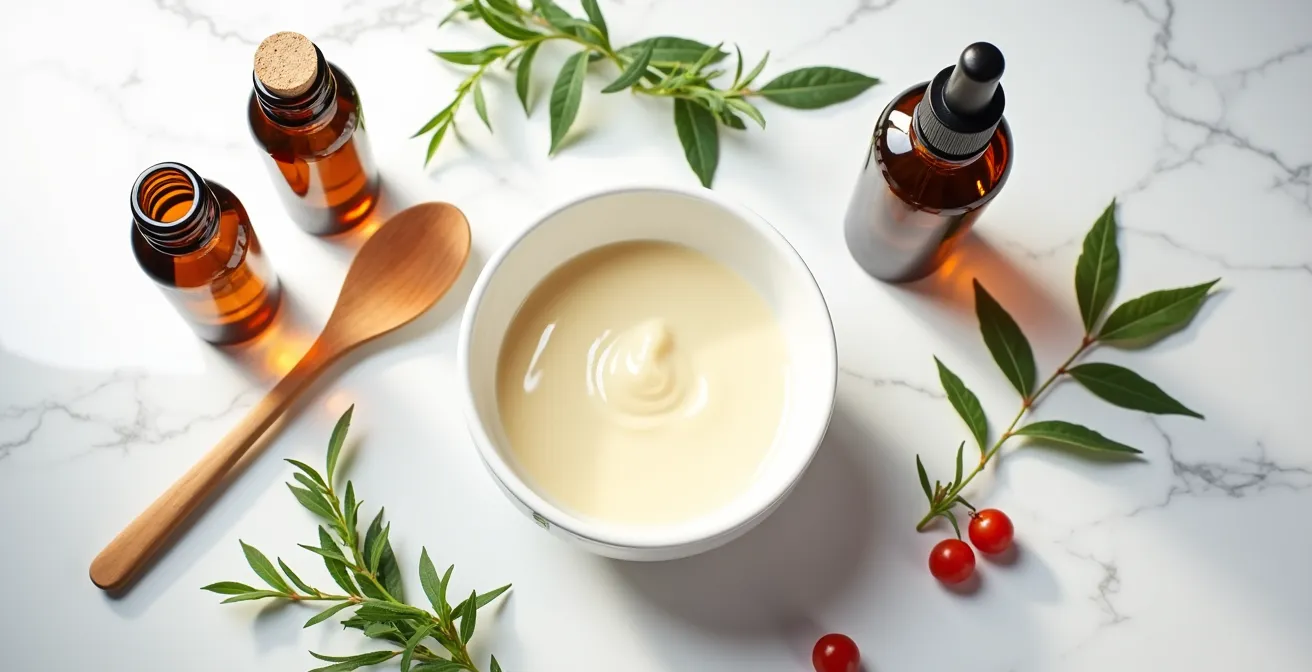
The key is to mix these ingredients into your conditioner immediately before application to ensure their freshness and potency. Start with your usual amount of conditioner in a bowl and thoroughly mix in your chosen booster. This method turns your everyday product into a targeted, intensive treatment that rivals many luxury alternatives. The table below provides a simple guide for customising your conditioner based on your hair’s needs.
| Ingredient | Benefits | Hair Type | Amount per Treatment |
|---|---|---|---|
| Glycerine | Deep hydration, humectant properties | Dry, brittle hair | 1 teaspoon |
| Honey | Natural humectant, adds shine | All hair types | 1 tablespoon |
| Coconut Oil | Penetrates shaft, reduces protein loss | Damaged, coarse hair | 1-2 tablespoons |
| Egg Protein | Strengthens, adds elasticity | Fine, weak hair | 1 egg yolk |
| Olive Oil | Seals moisture, smooths cuticle | Thick, dry hair | 1 tablespoon |
By using your conditioner as a base, you are already starting with a formula designed to adhere to hair and rinse out cleanly. The boosters simply elevate its performance, providing a fresh, potent dose of the specific nourishment your hair requires at that moment.
Protein or hydrating mask: what do your brittle hair need?
The term “brittle hair” is often used as a catch-all, but it can stem from two opposing problems: a lack of protein or a lack of moisture. Applying the wrong type of treatment can be ineffective at best and damaging at worst. For example, adding more protein to hair that is already protein-sensitive can make it even more rigid and prone to snapping. Conversely, adding intense moisture to “mushy,” over-elastic hair will only exacerbate the problem. The ability to distinguish between these two states is critical for effective hair care.
Scientifically, this is about maintaining the hair’s protein-moisture balance. Our hair is naturally composed of approximately 80-90% keratin protein, which provides its strength and structure. Moisture, on the other hand, gives hair its flexibility, softness, and elasticity. Daily wear and tear, chemical treatments, and heat styling can deplete both. The key is to correctly diagnose which one your hair is missing.
As the CurlSmith Hair Experts explain, this balance is fundamental:
Protein is what 91% of our hair is made of. It’s what gives it strength and structure. Daily wear breaks down the protein in our hair, and if we don’t replenish the loss with the correct products the hair will become weakened and fragile.
– CurlSmith Hair Experts, CurlSmith Curl Academy
A simple, reliable diagnostic tool is the “wet stretch test”. Take a single strand of clean, wet hair and gently stretch it between your fingers. If the hair stretches significantly before breaking (like an over-stretched elastic band), it lacks protein and feels mushy. It needs a strengthening treatment. If the hair barely stretches at all and snaps almost immediately, it lacks moisture and feels stiff. It needs a hydrating mask. If it stretches slightly and then returns to its original length, your protein-moisture balance is healthy.
The mistake of leaving a mask on all night on wet hair
The prevailing wisdom in DIY hair care often suggests that “longer is better” when it comes to masking. This has led to the popular practice of applying a mask to wet hair and leaving it on overnight. While seemingly logical, this prolonged exposure to moisture can cause significant, irreversible damage to the hair through a condition known as hygral fatigue. This is a classic case where good intentions can lead to weakened hair structure over time.
Hygral fatigue is the stress and damage inflicted on a hair follicle from repeated swelling and un-swelling. When hair is wet, it absorbs water and the shaft swells. As it dries, it contracts. Leaving hair saturated in a water-based mask for many hours forces it into a maximally swollen state for a prolonged period. This repeated cycle of extreme expansion and contraction weakens the hair’s cuticle, causing it to lift and crack. Over time, this leads to increased porosity, frizz, and breakage—the very issues the mask was intended to solve.
Furthermore, from an efficacy standpoint, it is unnecessary. Most commercially formulated hair masks are designed to deliver their payload of conditioning agents and nutrients quickly. Studies and brand guidelines consistently show that most hair masks deliver their maximum benefit within 5-20 minutes. After this point, the hair has absorbed what it can, and any further time simply increases the risk of hygral fatigue without adding significant benefits.
If you wish to do an overnight treatment, the safer and more effective alternative is to use a penetrating oil (like coconut or olive oil) on dry hair. Applying oil to dry hair allows it to slowly penetrate the shaft over 6-8 hours without the damaging swelling effect caused by water. You can then shampoo and condition as normal in the morning, having received the deep benefits without the structural risk.
The heat technique: why wrap your hair in a hot towel?
Applying gentle heat is a simple yet powerful technique to amplify the effectiveness of hair masks and oil treatments. The principle is based on simple physics: heat causes the hair’s cuticle scales to temporarily lift and open up. This creates a clearer pathway for the beneficial ingredients in your treatment—whether it’s the small molecules of a penetrating oil or the conditioning agents in a mask—to travel deeper into the hair shaft, reaching the cortex where they can do the most good.
Wrapping your hair in a hot, damp towel, or using a thermal heat cap, creates a warm, steamy environment that facilitates this process. The warmth not only opens the cuticle but also reduces the viscosity of oils, making them flow more easily. A scientific study on the effects of heat on oil treatments confirmed this, noting that the “application of heat reduced the capillary adhesion further for coconut and sunflower oils.” This demonstrates that heat directly helps oils move from the hair’s surface into its core, maximizing their strengthening and moisturising potential.
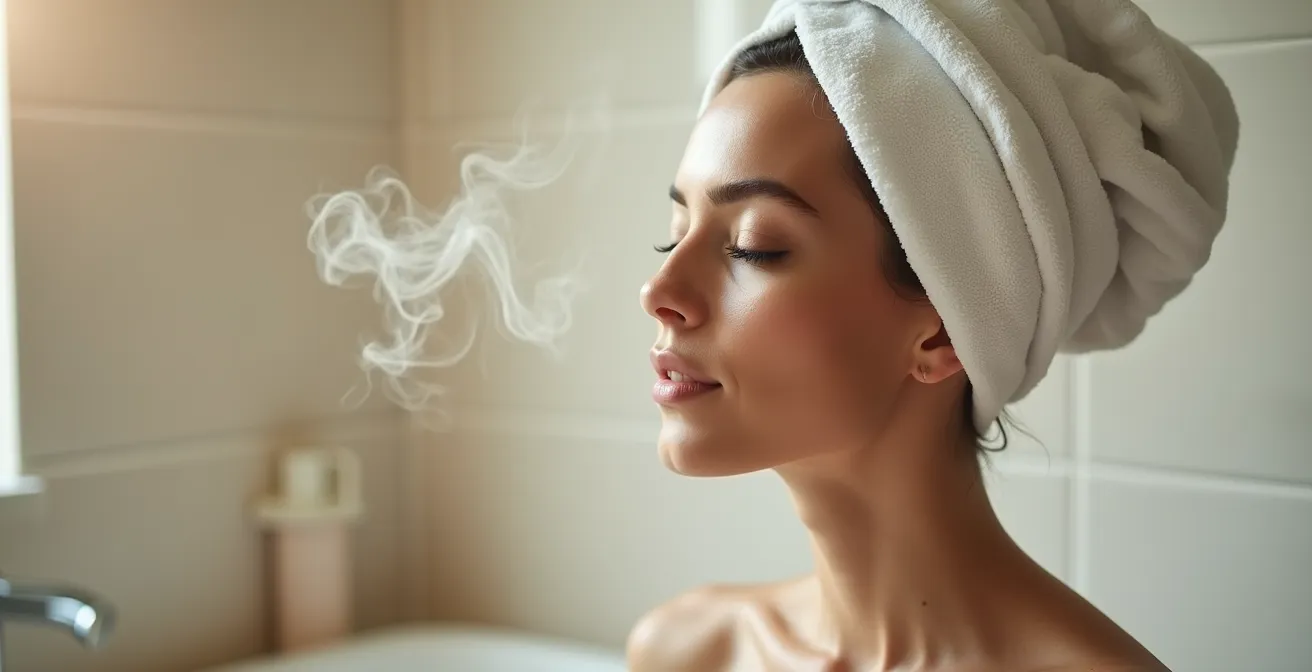
This technique is particularly beneficial for individuals with low-porosity hair. This hair type has a tightly bound, compact cuticle layer that naturally resists moisture and treatments. For these individuals, applying a mask or oil at room temperature can be ineffective, as the product may simply sit on the surface. The addition of heat is not just a booster in this case; it is often essential for the treatment to work at all.
The method is straightforward: after applying your mask or oil, cover your hair with a plastic shower cap. Then, wrap a towel that has been soaked in hot water and wrung out over the cap. Leave it on for the duration of your treatment, typically 15-20 minutes. The sustained, gentle warmth will dramatically improve the absorption and efficacy of your chosen product, turning a standard application into a salon-quality deep conditioning session.
Tightness problem: adding a few drops of oil to boost your cream
While deep treatments are essential for repair, daily styling also presents an opportunity to protect and nourish hair. A common issue with leave-in conditioners or styling creams, especially for those with dry or coarse hair, is that they can sometimes lack the richness to provide all-day moisture, leading to a feeling of tightness or dryness as the day progresses. A simple and effective solution is to boost your styling product by mixing in a few drops of a specific type of oil.
However, it is critical to distinguish between penetrating oils and sealing oils for this purpose. While a penetrating oil like coconut is ideal for a pre-shampoo treatment, using it in a styling product can lead to greasy, weighed-down hair. For boosting a leave-in cream, a sealing oil is far more effective. These oils, such as jojoba, argan, or grapeseed oil, have larger molecular structures and remain on the surface of the hair.
Their function here is not to penetrate, but to form a lightweight, non-greasy film over the hair strand. This film serves two purposes: it locks in the moisture provided by the water-based cream, preventing it from evaporating, and it smooths the cuticle to reduce frizz and add shine. As the experts at the Hair Oil Research Team note, the choice of oil is paramount:
For this specific purpose (boosting a styler/leave-in), a ‘sealing’ oil is best. Use jojoba, argan, or even a single drop of a silicone-based serum. This prevents the oil from penetrating and making the hair greasy, instead locking in the moisture from the cream.
– Hair Oil Research Team, Truuby Nature Hair Science Blog
The application method is simple. Dispense your usual amount of leave-in conditioner or cream into your palm, add 1-3 drops of your chosen sealing oil, and rub your hands together to emulsify the mixture. Apply it to your hair, focusing on the mid-lengths and ends. This simple “cocktail” approach creates a customised product that provides both the hydration of a cream and the long-lasting moisture retention of an oil, without compromising on volume or creating a greasy finish.
Why is jojoba oil ideal for regulating the scalp?
While much of hair care focuses on the hair shaft, a healthy scalp is the foundation for healthy hair growth. An imbalanced scalp—whether too oily or too dry and flaky—can lead to a host of problems. Jojoba oil stands out as a uniquely effective ingredient for scalp regulation due to a remarkable feat of natural chemistry: its molecular structure is incredibly similar to that of human sebum, the natural oil produced by our skin.
This concept is known as biomimicry. Because the scalp recognizes jojoba oil as being similar to its own sebum, the oil can help balance oil production in two ways. For an oily scalp that is over-producing sebum, applying jojoba oil can send a signal to the sebaceous glands that there is sufficient oil present, tricking them into slowing down production. For a dry scalp, jojoba oil provides gentle, non-comedogenic (non-pore-clogging) moisture that soothes irritation and flakiness without feeling heavy or greasy.
Unlike penetrating oils such as coconut oil, jojoba oil is a polyunsaturated wax ester. Research confirms that its more open, complex structure means it does not pass through cuticle layers well. This makes it a poor choice for deep conditioning the hair shaft, but an excellent choice for surface-level work on the scalp. It can moisturise and regulate the skin without penetrating deeply and causing greasiness at the roots.
Using jojoba oil as a pre-shampoo treatment is an effective way to leverage these properties. Applying it directly to a dry scalp and massaging it in before washing helps to dissolve and lift away excess sebum and debris, while simultaneously calming and moisturising the skin. This creates an optimal environment for hair follicles to thrive.
Your Action Plan: Pre-Shampoo Scalp Treatment Protocol
- Application: Apply 5-10 drops of pure jojoba oil directly to your dry scalp, parting the hair into sections to ensure even coverage.
- Massage: Using the pads of your fingers, massage the oil into your scalp with gentle, circular motions for 2-3 minutes to boost circulation.
- Wait: Leave the treatment on for at least 30 minutes to allow it to dissolve impurities and moisturise the skin. Do not cover with heat.
- Customise: For dandruff, add 1 drop of tea tree oil to the jojoba oil. For circulation, add 1 drop of peppermint oil. Mix well before applying.
- Cleanse: Shampoo your hair thoroughly to remove all traces of the oil. You may need to shampoo twice to ensure roots are completely clean.
Key takeaways
- The effectiveness of an oil is dictated by its molecular size; medium-chain fatty acids (e.g., in coconut oil) penetrate the hair shaft, while long-chain fatty acids (e.g., in jojoba oil) coat it.
- Diagnose your hair’s needs before treatment. The “wet stretch test” reveals whether your hair needs protein (for strength) or moisture (for elasticity).
- Avoid “hygral fatigue” by not leaving water-based masks on wet hair overnight. For overnight treatments, use a penetrating oil on dry hair instead.
Argan or Jojoba: Which Oil Stops Frizz Without Greasing Fine Hair?
For those with fine hair, the fight against frizz is a delicate balancing act. The goal is to smooth the cuticle and block humidity, but most anti-frizz products, especially oils, are too heavy and can leave fine hair looking flat, limp, and greasy. Argan oil and jojoba oil are two of the most popular lightweight oils for this purpose, but they function very differently. Choosing the right one depends on understanding their distinct properties and how they interact with the hair strand.
Argan oil is often classified as a “dry oil” due to its rapid absorption and non-greasy feel. It is rich in oleic and linoleic acids and has a molecular structure that allows for moderate penetration into the hair shaft. While not as deeply penetrating as coconut oil, studies show argan oil penetrates to approximately 30 µm depth, helping to moisturise from within as well as smooth the surface. This makes it excellent for taming frizz along the mid-lengths and ends, providing both internal moisture and external sleekness. For fine hair, a single drop is usually sufficient.
Jojoba oil, as discussed, is technically a wax ester that mimics human sebum. Its primary function is to provide a very light surface coating. It does not penetrate the hair shaft in any significant way. This makes it exceptionally lightweight, and ideal for someone whose primary concern is a very light seal against humidity without any risk of weighing the hair down. It is less effective at deep smoothing than argan oil but excels at providing a subtle hold and shine with a near-weightless finish.
The following table provides a direct comparison to help you choose based on your specific needs.
| Property | Argan Oil | Jojoba Oil |
|---|---|---|
| Classification | Dry oil (quick absorption) | Wax ester (sebum mimic) |
| Best for | Mid-lengths and ends | Scalp and light sealing |
| Penetration | Moderate penetration | Surface coating |
| Weight on Fine Hair | Light to medium | Very light |
| Frizz Control | Excellent for smoothing | Good for light hold |
| Application Amount | 1-2 drops max | 1 drop max |
In summary, for effective frizz control on the lengths of fine hair, argan oil is generally the superior choice due to its balance of moderate penetration and surface smoothing. For someone extremely sensitive to product weight who needs only the lightest possible seal, or for scalp regulation, jojoba oil is the winner.
Now that you are equipped with the scientific knowledge to diagnose your hair and select the right ingredients, you can move beyond expensive marketing claims. Start today by performing a ‘wet stretch test’ and choosing your next treatment based on evidence, not hype, to build a truly effective and affordable hair care routine.