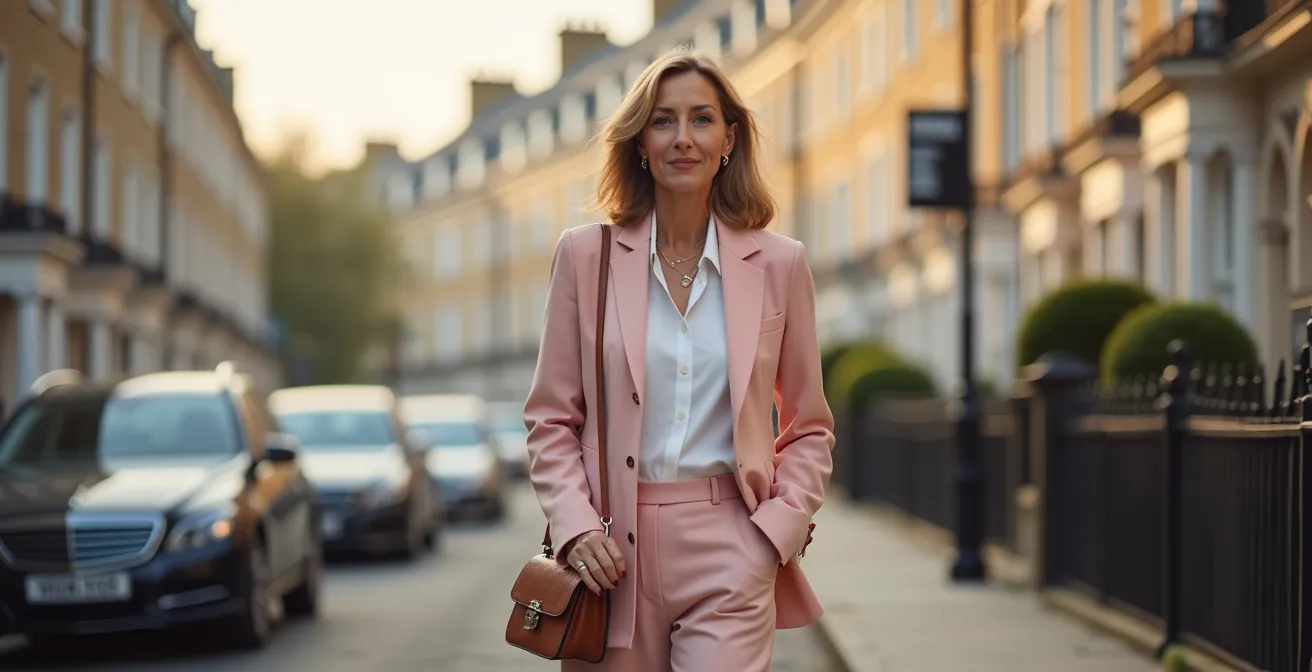
Mastering modern style after 50 is not about following rules, but about learning the art of ‘trend deconstruction’.
- Select one element from a trend (a colour, a cut) instead of the whole look.
- Prioritise ‘Cost-Per-Wear’ over fast fashion for a smarter, more sustainable wardrobe.
Recommendation: Define your UK style persona (e.g., ‘Cotswolds Weekender’, ‘London Arts Patron’) to filter trends effectively and with purpose.
Navigating the world of contemporary fashion after 50 can feel like a delicate balancing act. On one hand, there’s a desire to remain current, engaged, and modern. On the other, there’s a deep-seated fear of looking like you’re trying too hard, of adopting trends that don’t honour your life experience. The magazines are filled with advice, but it often falls into predictable categories: “invest in timeless classics,” “ensure a perfect fit,” or the vague encouragement to “embrace colour.” While well-intentioned, this advice often misses the point and can lead to a wardrobe that feels safe, but ultimately uninspired and disconnected from the present moment.
The real challenge isn’t about avoiding trends, but understanding how to engage with them on your own terms. It’s about moving beyond the binary choice of either chasing youth or retreating into a uniform of so-called “age-appropriate” classics. The secret lies in a more nuanced, strategic approach. What if the key wasn’t to follow or reject trends, but to master the art of deconstructing them? This is the core of sophisticated, modern style: the ability to look at a current trend, identify its core essence, and selectively weave just one element into your established personal style.
This guide is designed to give you that power. We won’t give you a list of “dos and don’ts.” Instead, we will provide a framework for thinking about fashion differently. We’ll explore how to handle tricky colour palettes, embrace modern silhouettes without losing your shape, and make intelligent investment choices. You’ll learn how to break down a runway look into its components and adopt only what serves you, ensuring your style remains both personal and contemporary. This is about building a wardrobe that reflects not just where you’ve been, but also the vibrant, stylish person you are today.
To help you navigate this journey with confidence, we have structured this guide to address the most common style dilemmas. The following sections offer practical, UK-centric advice for building a wardrobe that is both modern and authentically you.
Contents: A Guide to Mastering Modern Style
- Why do pastel tones risk ageing you when placed near the face?
- How can you wear the oversized trend without looking messy or wider?
- TikTok micro-trend or a fundamental shift: what should you invest in this season?
- The mistake of copying a runway look without adapting it to your body shape
- The footwear dilemma: how to embrace sneakers with elegance after 50
- The style problem: modernising a classic look with a contemporary watch
- Why is the ‘Modular’ watch face choice crucial for readability?
- Online made-to-measure or tailored high street: which offers the best value?
Why do pastel tones risk ageing you when placed near the face?
Pastel shades like baby pink, mint green, or powder blue are often presented as soft and feminine, yet they can be notoriously difficult to wear as we mature. The reason isn’t the colour itself, but the effect it has next to the skin. As we age, the natural contrast in our skin tone, hair, and eye colour tends to soften. A low-contrast, pale pastel worn close to the face can fail to provide the necessary definition, leading to a washed-out effect that can inadvertently highlight fine lines and shadows rather than illuminating the complexion.
However, this doesn’t mean you must banish these beautiful shades from your wardrobe. The solution is to create a “colour buffer.” By placing a scarf, a statement necklace, or even the collar of a shirt in a more flattering, richer tone between the pastel garment and your skin, you reintroduce the contrast your complexion needs. It’s about strategically controlling where the colour sits. For instance, a pastel blazer can look stunning when layered over a crisp white or navy top, which frames the face more effectively.
To find the pastels that work for you, consider their saturation. A muted, ‘dusty’ rose might be far more flattering than a bright, ‘baby’ pink. The key is experimentation and understanding your personal colour palette. Many find that booking a professional colour analysis session, available at UK department stores like John Lewis & Partners or Selfridges, provides an invaluable roadmap for navigating colour with confidence at any age.
Case Study: Sandra Bullock’s Powder Pink Success
Observe how stylists approach this challenge with celebrities. Actress Sandra Bullock, for example, has been seen pairing the very on-trend powder pink colour with deep, midnight blues. This creates a sophisticated and balanced look, where the pastel provides a touch of modern softness, while the darker neutral anchors the outfit and provides the necessary contrast near her face and neckline.
How can you wear the oversized trend without looking messy or wider?
The move towards looser, more relaxed silhouettes is one of the most significant shifts in modern fashion. For anyone accustomed to more tailored fits, it can be intimidating. The fear is that “ample” will translate to “shapeless,” making one appear larger or less put-together. The secret to mastering this trend is not in the volume itself, but in the structure of the fabric and the precision of the cut. This is what we call creating an ‘architectural’ silhouette.
To achieve this, choose heavyweight fabrics that have their own inherent shape. Think of a structured knit from a brand like Jigsaw or a crisp cotton poplin. These materials create clean lines and drape over the body, suggesting shape rather than clinging or adding bulk. Flimsy, lightweight fabrics are the true culprits of the ‘negligé’ look, as they lack the integrity to hold a defined form. This principle is perfectly captured in the combination of wide-leg trousers with a structured blazer, a look that is both modern and powerful.
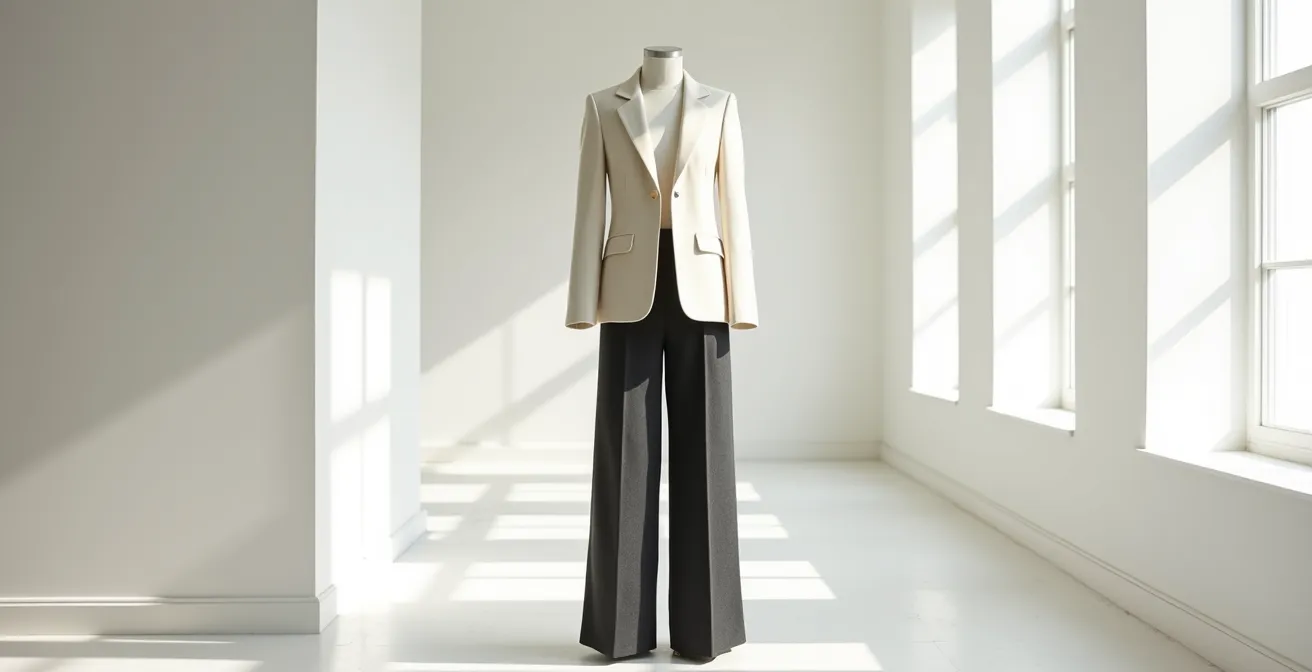
As this image demonstrates, the volume is deliberate and controlled. The blazer’s sharp shoulders and defined waist create a focal point, while the trousers fall cleanly to the floor. UK brands like COS excel at this kind of structured volume, and ME+EM are masters of strategic layering. Furthermore, don’t underestimate the power of tailoring. A simple alteration can transform an oversized piece. Ask your tailor to ‘taper the sleeve’ on a voluminous coat or ‘add a waist dart’ to a boxy shirt to introduce definition exactly where you need it.
TikTok micro-trend or a fundamental shift: what should you invest in this season?
In today’s fast-paced fashion landscape, it’s harder than ever to distinguish between a fleeting micro-trend and a genuine evolution of style. Before investing in a new piece, the most powerful tool at your disposal is the concept of Cost-Per-Wear (CPW). This simple calculation—dividing the item’s price by the number of times you realistically expect to wear it—shifts the focus from the initial price tag to the long-term value. A £400 trench coat worn 120 times over five years has a CPW of £3.33, offering far better value than a £70 fast-fashion version that lasts one season.
This investment mindset is crucial. The UK apparel market is a formidable economic force; projections suggest it will generate £85.85 billion in revenue in 2024, making it one of the largest in the world. Within this vast market, longevity and quality are your best allies. Look for indicators of quality like natural fibres (wool, cotton, silk), reinforced seams, and quality linings. These details are the hallmarks of garments designed to last, ensuring a lower CPW over time.
When evaluating a trend, ask yourself if it connects to a larger, more fundamental shift. For example, the resurgence of leopard print is not just a fleeting fad; it’s part of a broader return to bold, confident dressing and can be treated as a “new neutral.” A well-made leopard print coat from a heritage brand like Hobbs will remain stylish for years, while a cheap, synthetic version will likely date itself quickly, as the following analysis shows.
| Item | Heritage Brand (Hobbs) | Fast Fashion Alternative | CPW After 2 Years |
|---|---|---|---|
| Trench Coat | £400 | £70 | £3.33 vs £5.83* |
| Leopard Print Coat | £350 | £60 | £2.92 vs £10.00 |
| Quality Indicators | Natural fibers, reinforced seams | Synthetic blend, basic construction | Longevity: 5+ years vs 1-2 years |
| *Based on 120 wears for heritage, 12 for fast fashion | Based on 120 wears for heritage, 6 for fast fashion | |||
The mistake of copying a runway look without adapting it to your body shape
The single biggest mistake anyone can make with fashion is to see a look on a runway or in a magazine and attempt to replicate it wholesale. These looks are designed for a specific context—a 19-year-old model under dramatic lighting—and are meant to sell a fantasy, not a practical outfit. The truly stylish individual understands that a runway look is a suggestion, not a prescription. The key is to apply the ‘Trend Deconstruction Method’: breaking the look down into its core components and adopting only one.
A runway outfit is a combination of elements: the silhouette, the colour palette, the print, the fabric, and the styling. Instead of trying to wear all of them, choose the single element that excites you most and integrate it into your existing wardrobe. For example, if you love the bold floral print from an Erdem runway show, don’t buy the head-to-toe matching suit. Instead, find that print in a simple, beautifully cut blouse from the high street and pair it with your favourite tailored trousers. You’ve captured the essence of the trend without sacrificing your personal style or silhouette.
To make this process even more effective, it helps to define your personal UK style persona. Are you a ‘Cotswolds Weekender,’ drawn to classic textures and practical elegance? Or a ‘London Arts Patron,’ comfortable with more avant-garde shapes and intellectual style? Perhaps a ‘Brighton Creative,’ who loves eclectic mixes and bold colours. By understanding your own style identity, you create a filter through which you can assess trends, making it easier to decide what to adopt and what to admire from afar. As Lindsay, a fashion expert at Silver Magazine, wisely puts it:
Age is not a factor, and certainly not a barrier to looking incredible.
– Lindsay, Silver Magazine Fashion Expert
Your Action Plan: The Trend Deconstruction Method
- Break it Down: Look at a trend and identify its core elements. Is it the print, the silhouette, the colour, or the texture that truly defines it?
- Select One Element: Choose only the single component that resonates with you and that you can realistically integrate into your life.
- Integrate with Your Persona: Adapt that one element to fit your established style persona. A ‘Cotswolds Weekender’ might adopt a trendy colour in a classic Barbour jacket, while a ‘London Arts Patron’ might choose a new silhouette in a neutral fabric.
- Anchor with Classics: Pair your chosen trend element with the trusted, high-quality classic pieces already in your wardrobe. This grounds the look and makes it yours.
- Assess and Refine: Wear the combination and see how it feels. Style is an ongoing conversation, not a final verdict. Adjust as needed.
The footwear dilemma: how to embrace sneakers with elegance after 50
For many, sneakers—or ‘trainers’ as they’re known in the UK—represent the final frontier of modern dressing. The comfort is undeniable, but the fear of looking either too casual or, worse, like you’re trying to reclaim your youth, is real. The key to wearing trainers with elegance lies in two principles: investing in premium materials and understanding contextual styling. Forget chunky, athletic-performance styles and instead opt for minimalist, low-profile designs in premium materials like smooth leather or suede.
Think of these elevated trainers not as sportswear, but as a modern alternative to a loafer or a flat. The sleek, clean lines of a brand like Veja or a premium offering from Grenson can seamlessly integrate into a sophisticated wardrobe. The textural contrast between pristine white leather and fine wool trousers, for instance, is inherently chic and contemporary. It signals an understanding of modern comfort without sacrificing an ounce of polish.
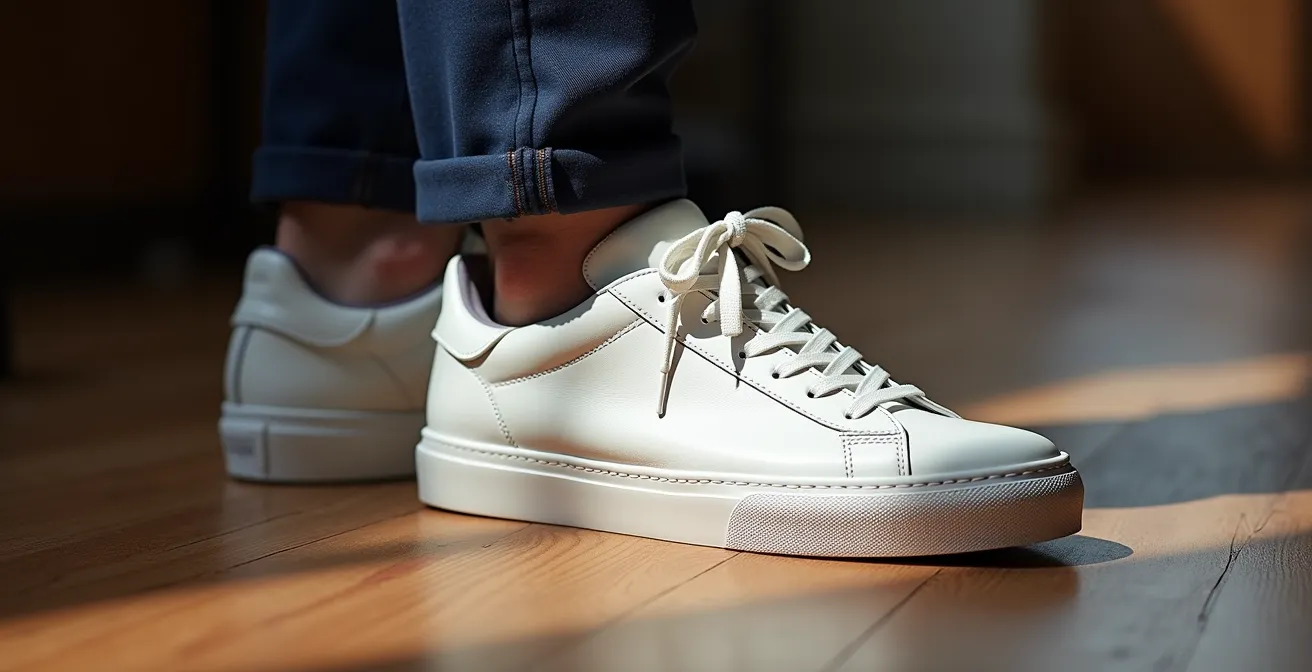
Once you have the right pair, the magic is in the styling. The goal is to create a deliberate and stylish juxtaposition. A pair of smart trainers can dress down a formal outfit, or elevate a casual one. It’s about consciously mixing codes. The beauty of this approach is its versatility, allowing you to adapt the trainer trend to various aspects of a modern British lifestyle, from the office to a weekend in the country.
Case Study: Three UK-Specific Sneaker Styling Contexts
To make this tangible, consider three distinct scenarios. For a ‘smart casual Friday’ in the City, pair sleek Veja trainers with tailored trousers from a brand like Reiss for a look that is sharp yet comfortable. For a relaxed pub garden lunch, style a pair of classic Stan Smiths with a floral midi dress from Ghost, creating a perfect high-low balance. And for a stylish country walk, combine premium Grenson sneakers with dark denim and a classic Barbour jacket for a look that is both practical and effortlessly chic.
The style problem: modernising a classic look with a contemporary watch
Even the most classic wardrobe can feel dated if the details aren’t right. One of the most effective ways to inject a dose of modernity into a timeless look is through your choice of watch. A contemporary timepiece, whether a minimalist analogue design or a feature-rich smartwatch, can act as a powerful anchor, instantly updating everything from a tweed blazer to a cashmere knit. It sends a clear signal that your style is current and considered, not stuck in the past.
The key is to think of your watch not as a standalone item, but as the centre of a small ‘accessory ecosystem.’ This is particularly effective with modern smartwatches, where the strap can be changed to suit your outfit or mood. You can build a collection of straps that coordinate with your handbag colour palette or match the texture of your shoes. This considered approach elevates the watch from a simple gadget to a core component of your personal style. UK retailers like The Watch Strap Co UK offer a vast selection, making it easy to customise your look.
The power of this strategy lies in the juxtaposition of old and new. Pairing a high-tech smartwatch with quintessentially British classics creates a compelling style narrative. Imagine a sleek, modern watch face peeking out from the cuff of a Harris Tweed blazer, a Pringle cashmere jumper, or a timeless Burberry scarf. This single detail bridges the gap between classic heritage and contemporary life. The same principle applies to coordinating textures: a leather strap looks impeccable with L.K.Bennett pumps, while a woven fabric strap pairs beautifully with casual Boden flats.
Why is the ‘Modular’ watch face choice crucial for readability?
For those who embrace a smartwatch, the choice of watch face is as much a functional decision as it is a stylistic one. While a minimalist analogue face might appeal to classic sensibilities, it forgoes the primary benefit of the technology: at-a-glance information. As we get older, eyesight can change, and the ability to see key information clearly and quickly becomes paramount. This is where the ‘Modular’ watch face, or similar information-rich designs, proves its worth.
A modular face is designed for maximum information density and legibility. It allows you to customise ‘complications’—small widgets that display data from your favourite apps—directly on the main screen. Instead of squinting at tiny icons or swiping through menus, you can see the time, date, your next appointment, the weather, and your activity progress all in one clear, organised layout. This is not just about convenience; it’s about making technology work for you, reducing friction and enhancing your day-to-day life.
The beauty of this system is its adaptability to a UK-specific lifestyle. You can configure your watch face to show updates from the Met Office, live departure times from the Trainline app, or even opening times for a nearby National Trust property. It becomes a personalised dashboard for your life. While other faces like the ‘California’ or ‘Meridian’ offer aesthetic appeal, they prioritise form over this essential function. For active professionals and anyone who values efficiency, the modular face is an elegant fusion of style and substance.
| Watch Face | Style Profile | Best For | UK-Specific Features |
|---|---|---|---|
| Modular | Information-rich elegance | Active professionals | Met Office weather, Trainline app, National Trust app |
| California | Classic analogue aesthetic | Traditional style lovers | Simple time display, minimal complications |
| Meridian | Modern minimalist | Fashion-forward users | Clean lines, subtle complications |
Key Takeaways
- Deconstruct, Don’t Copy: Isolate a single element of a trend (a colour, a print, a silhouette) and integrate it into your personal style, rather than adopting a full runway look.
- Prioritise Structure Over Volume: When wearing looser fits, choose structured, heavyweight fabrics that create an ‘architectural’ silhouette, avoiding shapelessness.
- Invest with ‘Cost-Per-Wear’: Evaluate potential purchases based on their long-term value and quality, not just their initial price tag. A higher initial investment in a quality piece often yields better value over time.
Online made-to-measure or tailored high street: which offers the best value?
Achieving a perfect fit is the cornerstone of great style, but the path to get there has diverged. Today, the choice is often between buying a quality off-the-peg item from a high street brand and having it professionally altered, or ordering a fully customised piece from an online made-to-measure (M2M) service. While M2M promises a bespoke fit from the outset, the combination of high street retail plus professional tailoring often provides superior value, convenience, and reliability for most wardrobe staples.
Consider the real-world economics. A £150 blazer from a trusted UK brand like Jigsaw, known for its quality construction, can be perfected with £50 of professional tailoring. The resulting £200 garment offers a comparable, if not better, fit to a £250 online M2M alternative. The high street option has the added benefits of immediate gratification, the ability to feel the fabric and see the colour in person, and a much simpler returns process if the base garment isn’t right. This makes it the most economical and practical choice for everyday workhorses like trousers, shirts, and blazers.
Online M2M services still have their place, but they are best reserved for ‘hero pieces’ where a truly unique fit is paramount and the higher Cost-Per-Wear is justified. Think of a special occasion dress or a classic winter coat that you intend to wear for a decade. For these investment items, the complete customisation offered by M2M can be worth the extra cost and longer lead time. The challenge for the mature consumer is that this choice exists in a market that often fails to represent them. In fact, a study highlighted that 78% of people over 50 in the UK feel unrepresented by the fashion industry, making the quest for a good fit even more of a personal endeavour.
By embracing the art of trend deconstruction and focusing on quality, fit, and personal expression, you can build a wardrobe that is not only stylish and modern but is also a true reflection of your confidence and individuality. Start today by looking at your wardrobe not as a collection of clothes, but as a toolkit for expressing the best version of yourself.