
For most people in the UK with non-coloured hair, the “sulphate-free” trend is a distraction from the real issue: buildup.
- Sulphates are often necessary to remove stubborn mineral deposits from hard water and non-soluble silicones from styling products.
- An itchy, oily, or dull scalp is more likely a sign of residue buildup than a reaction to sulphates, especially in hard water areas.
Recommendation: Instead of going 100% sulphate-free, adopt a “Strategic Cleansing Cycle”—using a clarifying sulphate shampoo periodically to reset your scalp, and a gentle formula for regular washes.
As a studio stylist, I see the same confusion every day. Clients come in, convinced that switching to a sulphate-free shampoo is the magic bullet for all their hair woes, even when their hair isn’t coloured. The internet is saturated with advice screaming that sulphates are harsh, stripping villains that must be avoided at all costs. You’ve been told they cause frizz, irritate the scalp, and ruin your hair’s natural balance. So, you dutifully make the switch, but the promised silky, vibrant hair never quite materialises. In fact, sometimes it feels worse: greasier, flatter, or strangely dull.
Here’s the honest truth they don’t tell you: the debate isn’t that simple, especially here in the UK. The real enemy hiding in plain sight isn’t always the sulphate in your shampoo; it’s often the calcium in your water and the silicones in your conditioner. For non-coloured hair, blindly abandoning sulphates without understanding this wider “product ecosystem” can lead to a cycle of frustration and what I call ‘build-up blindness’—blaming your shampoo for problems it didn’t create.
But what if the key wasn’t about completely eliminating one ingredient, but about using it strategically? What if a targeted dose of a “harsher” cleanser was exactly what your hair needed to truly thrive? This guide will demystify the science behind cleansing. We’ll explore why oily hair can benefit from sulphates, how to diagnose scalp issues correctly, and the crucial mistakes to avoid when building your hair care routine. It’s time to move beyond the marketing myths and understand what your hair actually needs to be clean, healthy, and full of life.
To help you navigate this complex topic, this article breaks down the essential factors to consider, from your scalp’s specific needs to the hidden impact of your environment. You’ll find practical advice and clear explanations to build a routine that truly works for you.
Summary: Your Complete Guide to Shampoos for Non-Coloured Hair
- Why do oily hair sometimes need sulphates to be really clean?
- How to know if your scalp is itching because of your shampoo?
- Low-Poo or Co-Wash: which method for the curly hair?
- The error of using non-soluble silicones with a sulphate-free shampoo
- Volume problem: why do two shampoos successively change everything?
- Why does your skin shine abnormally while being sensitive to the touch?
- Why does your hair fall out 3 months after an emotional shock (Telogen Effluvium)?
- Kitchen Oils vs. Salon Masks: Which Actually Penetrates the Hair Shaft?
Why do oily hair sometimes need sulphates to be really clean?
Let’s tackle the biggest myth head-on: sulphates are not inherently evil, especially if you have oily hair or live in certain parts of the UK. Sulphates (like Sodium Lauryl Sulphate or SLS) are powerful detergents. Their job is to bind to oil, dirt, and product residue, allowing water to wash them away effectively. While this can be too much for dry or colour-treated hair, it’s often essential for those with naturally oily scalps. A sulphate-free formula may be too gentle to break down the excess sebum, leaving your hair feeling unclean and limp even after washing.
The problem is compounded by a major environmental factor in the UK: hard water. When you see limescale in your kettle, that’s a clue to what’s happening on your head. Research shows that around 60% of the UK uses hard water, with cities like London, Oxford, and Newcastle being severely affected. These high levels of calcium and magnesium minerals create a film on the hair shaft, preventing moisture from getting in and causing dullness, brittleness, and a perpetually “unclean” feeling. A gentle sulphate-free shampoo often isn’t strong enough to remove this mineral buildup, which is where a strategic scalp reset with a sulphate shampoo becomes necessary.
Think of it as a deep clean, not a daily wash. Using a clarifying sulphate shampoo once a week or every fortnight can effectively remove the stubborn mineral and product buildup that gentle cleansers leave behind. This allows your regular, gentler shampoo to work properly and your hair to finally feel soft and look shiny. It’s not about choosing one type over the other; it’s about creating a strategic cleansing cycle that addresses all the challenges your hair faces.
Your Action Plan: Strategic Cleansing for Hard Water Areas
- Test your water: Use your local council’s website or simple home testing strips to confirm your water hardness.
- Incorporate a clarifying wash: Use a clarifying sulphate shampoo once every 1-2 weeks for a deep scalp reset.
- Use gentle for daily care: Stick with a quality sulphate-free shampoo for your regular washes in between clarifying sessions.
- Add a chelating treatment: Once a month, use a specific chelating product designed to bind to and remove mineral buildup.
- Filter the source: For a long-term solution, consider installing a filtering shower head to soften the water from the start.
How to know if your scalp is itching because of your shampoo?
An itchy scalp is one of the most common complaints I hear, and the shampoo is always the first suspect. Sometimes, it’s a straightforward sensitivity to an ingredient, like a fragrance or a harsh sulphate. But often, the cause is more complex. Before you throw out your entire product lineup, it’s crucial to play detective. The itchiness might not be from the product you’re using, but from the residue it’s failing to remove. This is particularly true if you’ve recently switched to a very gentle, sulphate-free shampoo.
The ‘unclean’ feeling from hard water mineral buildup can manifest as scalp irritation and itchiness. Likewise, if your styling products contain non-soluble silicones, a sulphate-free shampoo can’t wash them out, leading to a suffocating layer on your scalp that can cause inflammation and itching. The first step is to differentiate between true allergic irritation and buildup-related issues. A true sensitivity often appears as redness, persistent itching immediately after washing, or even small bumps.
To help diagnose the issue, the visual difference between a healthy and an irritated scalp can be stark, even if not always visible to the naked eye.
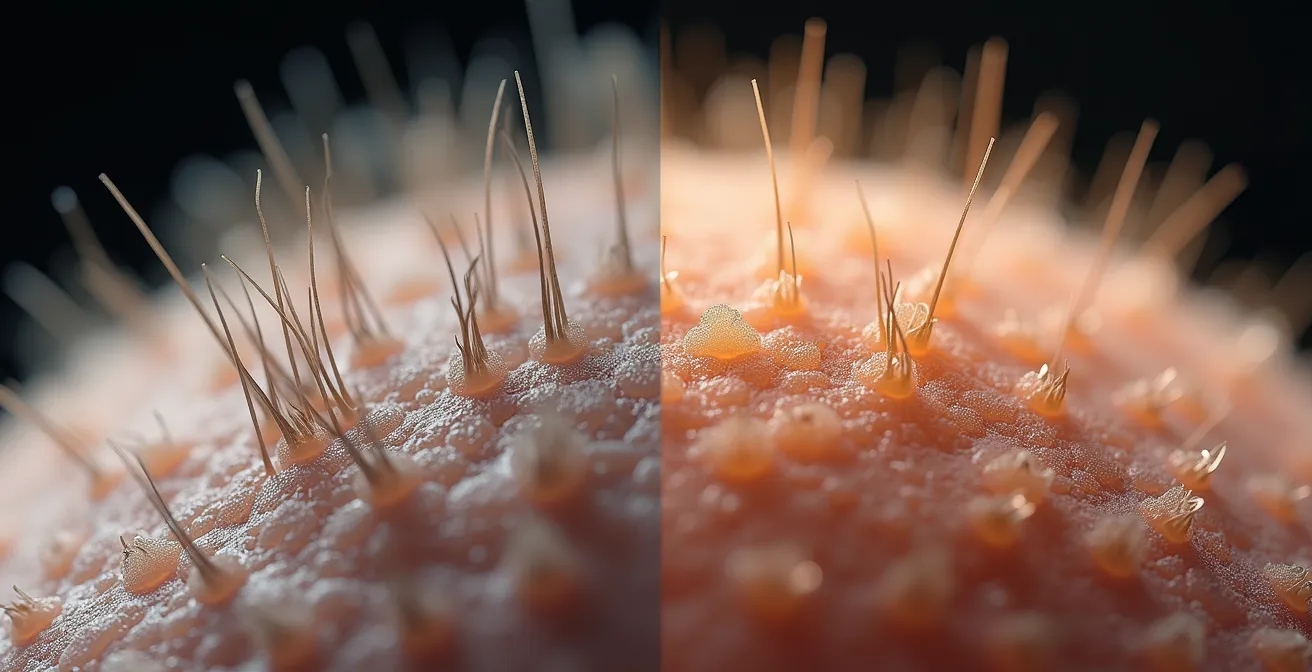
As you can see, an irritated scalp often presents with flakiness and redness around the follicle, whereas a healthy scalp is clear and calm. A simple at-home diagnostic is the “split-wash test”. For a few days, wash one half of your head with your current shampoo and the other half with a simple, hypoallergenic formula or even just distilled water. If the irritation subsides on one side, you’ve likely found your culprit. If both sides remain itchy, the problem may be environmental (like hard water) or an underlying scalp condition that requires a professional opinion.
Low-Poo or Co-Wash: which method for the curly hair?
For those with curly hair, the sulphate debate takes on another level of complexity. The structure of curly hair makes it naturally drier and more prone to frizz, as natural oils from the scalp struggle to travel down the winding hair shaft. This is why many in the curly community have long championed sulphate-free methods. As the experts at Curlsmith UK note, traditional sulphates can indeed be “too harsh on curls.” However, “sulphate-free” isn’t a single category; it encompasses different methods like “Low-Poo” and “Co-Wash,” and choosing the right one depends heavily on your curl type and, once again, your local environment.
A “Low-Poo” is a sulphate-free shampoo that still contains other, milder cleansing agents. It lathers lightly and provides a gentle clean, making it a great starting point for most curl types. A “Co-Wash” (conditioner-only washing) involves washing your hair only with a specific cleansing conditioner that has very few, if any, detergents. It’s incredibly moisturising but offers minimal cleansing power. While popular, co-washing in a hard water area can be a recipe for disaster, leading to a waxy, heavy buildup on the hair that weighs curls down.
One user’s experience highlights the transformative effect of finding the right product. After struggling with damaged ends, she shared her story: “After seeing this shampoo in Superdrug, I thought I’d try it because it’s sulphate free. After just TWO WASHES, my hair is so much softer at the ends and felt so nourished, that I immediately went back to Superdrug and bought the whole range!” This shows that the right gentle cleanser can make a huge difference.
To make the best choice, especially considering the UK’s variable climate and water types, it’s helpful to compare these methods directly.
| Method | Best For | UK Climate Challenges | Recommended Frequency |
|---|---|---|---|
| Low-Poo | All curl types, especially in humid UK weather | Better foundation against humidity-induced frizz | 2-3 times weekly |
| Co-Wash | Very dry, coarse curls | Can cause waxy buildup in hard water areas | 1-2 times weekly with monthly clarifying |
The takeaway is clear: even the most ardent co-wash users in the UK will likely need to incorporate a monthly clarifying wash with a stronger shampoo to combat the inevitable buildup from hard water and products. This reinforces the core principle of a strategic, cyclical approach to cleansing.
The error of using non-soluble silicones with a sulphate-free shampoo
This is the single biggest mistake I see clients make when they go “sulphate-free.” They diligently switch their shampoo but continue using their favourite conditioners, serums, or heat protectants, unaware that they are creating a vicious cycle of buildup. Many of these styling and conditioning products contain non-soluble silicones, such as `dimethicone`, `amodimethicone`, and `cyclopentasiloxane`. These ingredients are fantastic for creating slip, shine, and a protective barrier, but their downside is in their name: they don’t dissolve in water.
The only thing that can effectively remove most non-soluble silicones is a stronger detergent—namely, a sulphate. When you use a sulphate shampoo, you wash away the silicones from your previous wash, creating a clean slate. However, when you switch to a gentle, sulphate-free shampoo, it lacks the power to remove them. With each use, a new layer of silicone builds upon the last, suffocating the hair shaft. This leads to hair that is dull, limp, heavy, and unable to absorb moisture or nutrients from masks and treatments. It’s the definition of build-up blindness.
This buildup also exacerbates the effects of hard water. According to Kérastase research, damaged hair absorbs 3x more calcium than healthy hair. The silicone coating damages the hair’s integrity over time, making it a magnet for the mineral deposits in UK tap water. To break this cycle, you have two options: either re-introduce a sulphate shampoo periodically to clarify your hair, or meticulously eliminate all non-soluble silicones from your entire routine and switch to water-soluble alternatives (often listed with a “PEG-” prefix).
To identify if this is your problem, start by checking the ingredient lists of all your post-shampoo products. If you see ingredients ending in “-cone,” “-conol,” or “-xane” near the top of the list, they are likely non-soluble silicones. A practical step is to perform a clarifying wash with a sulphate shampoo once, then switch to a fully silicone-free routine and see if your hair’s texture and volume improve over the next few weeks.
Volume problem: why do two shampoos successively change everything?
If your main complaint is a lack of volume, especially at the roots, the technique of “double-shampooing” or double cleansing can be a complete game-changer. It’s a simple concept that professional stylists use constantly, but it’s often overlooked at home. The idea is to wash your hair twice in the same shower session. The first wash isn’t about getting your hair “squeaky clean”; it’s about breaking down the initial layer of grime.
As the experts at FFØR Hair Care explain, “The first cleanse basically removes the majority of the build-up, composed of natural oils, dead skin cells and day-to-day pollution.” You’ll often notice that the first shampoo doesn’t lather very much. This is because the detergents are busy binding to all the oil and product residue. This initial wash does the heavy lifting, clearing the way for the second shampoo to do its real job.
The second wash is where the magic happens. With the surface layer of buildup gone, the shampoo can now properly cleanse the scalp and hair, and you’ll notice a much richer, more satisfying lather. This ensures that all residue is completely removed, leaving your hair roots light, lifted, and full of volume. For those with long or thick hair, which tends to hold more oil and buildup, this method is particularly effective. It’s also crucial in hard water regions like the South and East of England. The mineral residue left by hard water makes it difficult to rinse products effectively, but a double cleanse helps ensure everything is washed away properly, preventing the buildup that weighs hair down.
This technique can be adapted to your strategic cleansing cycle. On your regular wash days, you can double-shampoo with your gentle sulphate-free formula. On your clarifying day, you might do the first wash with your sulphate shampoo to break down heavy buildup, and the second with your gentler shampoo to cleanse without over-stripping. It’s a versatile tool that tackles the root cause of flatness: residue.
Why does your skin shine abnormally while being sensitive to the touch?
One of the most confusing scalp issues is the oily-yet-sensitive paradox: your scalp feels greasy and looks shiny, yet it’s also tender, itchy, or flaky. This is a classic sign that your scalp’s natural barrier has been compromised, often by a well-intentioned but misguided attempt to control oil. When you use an overly harsh shampoo to combat grease, you strip the scalp of its natural protective oils. In response, your sebaceous glands panic and go into overdrive to compensate, producing even more oil. This creates a vicious cycle of stripping and over-production.
You’re left with a scalp that is oily on the surface but dehydrated and irritated underneath. The sensitivity and flakiness are signs of a compromised moisture barrier, which is struggling to protect itself. This phenomenon is surprisingly common; one German study on a harsh detergent found that 42% of patients had an irritant reaction. While you might not have a true allergy, the constant stripping action is creating a state of chronic irritation.
Switching to a gentle, pH-balanced, sulphate-free shampoo is often the correct move in this situation. It allows you to cleanse away the excess surface oil without sending your scalp’s oil production into a panic. It can take a few weeks for your scalp to rebalance. Initially, you might feel your hair gets greasy faster, as your oil glands are still in overdrive. But with consistent, gentle cleansing, they will gradually calm down, and you’ll find your scalp becomes less oily and significantly less sensitive over time.
In the UK, this issue can be exacerbated during winter. The dry air from central heating dehydrates the surface of your skin, including your scalp, while your head, snug under a hat, might sweat and produce more oil. This widens the gap between the dehydrated skin barrier and the oily surface, making the paradox even more pronounced. The key is to soothe and balance, not to attack and strip.
Why does your hair fall out 3 months after an emotional shock (Telogen Effluvium)?
Sometimes, hair health issues have nothing to do with the products you’re using. If you experience a sudden, noticeable increase in hair shedding across your entire scalp, it could be a condition called Telogen Effluvium. The most perplexing thing about it is the delay: the shedding doesn’t happen at the time of the trigger, but typically about three months later. This is because a significant stressor—be it an emotional shock, a serious illness, surgery, or even a drastic change in diet—can prematurely push a large number of your hair follicles from the growing phase (anagen) into the resting phase (telogen).
Hair stays in the telogen phase for about 100 days before it naturally sheds to make way for a new hair. When many hairs enter this phase at once, they all shed at roughly the same time, leading to a period of alarming hair loss. It’s the body’s way of diverting energy away from non-essential functions like hair growth to deal with a perceived crisis. While distressing, the good news is that in most cases, Telogen Effluvium is temporary and the hair will grow back once the underlying stressor is resolved.
During the recovery phase, it’s crucial to treat your scalp and hair with extreme care to avoid causing further stress to the follicles. This is a situation where switching to a gentle, sulphate-free shampoo is non-negotiable to minimise any potential for irritation. Supporting your body from the inside out is just as important. If you suspect you’re experiencing this, it’s wise to take action with a careful recovery plan.
- Immediately switch to a gentle, sulphate-free shampoo to avoid any further scalp irritation.
- Consult your GP for blood tests to rule out any underlying nutritional deficiencies (like iron or vitamin D) that could be contributing.
- Consider using scalp treatments containing ingredients known to support hair growth, such as caffeine and rosemary oil, which are widely available at retailers like Boots.
- Gently massage your scalp daily for a few minutes to stimulate blood flow to the follicles.
- If the shedding persists for more than six months, seek a referral to a dermatologist or a private trichologist for a specialist diagnosis.
Key takeaways
- The “sulphate-free” debate is misleading; the real goal is to be “buildup-free” from hard water and product residue.
- In the UK’s hard water areas, a sulphate-based clarifying shampoo used periodically is often a necessity, not a sin.
- Your shampoo’s effectiveness is directly linked to your other products. Sulphate-free formulas cannot remove non-soluble silicones.
Kitchen Oils vs. Salon Masks: Which Actually Penetrates the Hair Shaft?
In the quest for healthy hair, many people turn to their kitchen cupboards, with coconut and olive oil being popular DIY treatment choices. At the same time, the market is full of sophisticated salon masks promising miraculous repair. But which actually works? The answer lies in molecular science: it all comes down to the size of the oil’s molecules and their ability to penetrate the hair shaft versus simply coating it.
Oils with smaller molecules, like coconut oil, have been shown to be able to penetrate the hair’s cuticle and enter the cortex. This allows them to moisturise and strengthen the hair from within, making it an excellent pre-shampoo treatment to prevent the hair from swelling excessively with water (hygral fatigue). On the other hand, oils with larger molecules, like olive oil, cannot penetrate the hair shaft. They remain on the surface, acting as a sealant to lock in moisture and add shine. This is useful, but it doesn’t repair or internally moisturise the hair.
So where do salon masks fit in? Professional formulations are designed with a varied range of molecule sizes and delivery systems to both penetrate and coat the hair. However, their effectiveness is massively reduced if they are applied to hair that is coated in mineral or product buildup. Applying an expensive mask on top of a layer of silicone and calcium carbonate is like trying to water a plant by pouring water on a plastic sheet covering the soil—it’s a complete waste. This is why a proper cleansing protocol is the most important step in any hair care routine. For any treatment to be effective, it must be applied to truly clean hair.
To maximize the benefits of any mask or oil, it should be applied after a clarifying wash. As Kérastase notes in its protocol for a pre-mask treatment containing citric acid, properly cleansing to remove calcium buildup can reverse stiffness and dullness, leading to a 75% increase in shine. This demonstrates that penetration is everything.
| Oil Type | Molecular Size | Penetration Ability | Best Use |
|---|---|---|---|
| Coconut Oil | Small | High – penetrates shaft | Pre-shampoo treatment |
| Olive Oil | Large | Low – coats surface | Sealing treatment |
| Salon Masks | Varied | Medium – with clean hair | Post-clarifying treatment |
Ultimately, the path to healthy hair isn’t about dogma; it’s about diagnosis. By understanding the unique challenges your hair faces—from your scalp’s oil production to the hardness of your water—you can build an intelligent, flexible routine. Stop asking if sulphates are “good” or “bad” and start asking what your hair needs to be truly clean. Evaluate your entire product ecosystem and embrace a strategic cleansing cycle to finally achieve the healthy, vibrant hair you’ve been aiming for.
Frequently Asked Questions about Shampoo and Scalp Health
How can I tell if my itching is from hard water vs shampoo ingredients?
A simple clue is the feeling of residue. If you’ve ever washed your hands in hard water and noticed a slight film on them afterward, imagine that same effect building up on your hair and scalp over time. This buildup can cause dullness and irritation that you might mistake for a reaction to your shampoo.
When should I consult a GP about scalp issues?
If you experience persistent irritation, significant flaking, or noticeable hair loss that lasts for more than two weeks despite changing your products, it’s time to seek professional advice. Your GP can help rule out underlying conditions and can refer you to a dermatologist if needed.
What’s the split-wash test method?
This is an effective home diagnostic tool. For three consecutive washes, use your current shampoo on one half of your head and a very basic, hypoallergenic formula (or even just distilled water) on the other half. If the irritation is clearly localized to the side using your regular product, you’ve likely identified the culprit.
Why does my scalp produce excess oil when using harsh shampoos?
This is a classic rebound effect. When you use overly harsh cleansers that strip away all natural moisture, your scalp’s oil glands go into overdrive to compensate for the dryness. This creates a vicious cycle where your scalp is both oily and dehydrated.
Can UK central heating worsen the oily-yet-dry scalp paradox?
Absolutely. Indoor heating during the winter months significantly dries out the air. This environmental dryness can dehydrate the surface of your scalp, making it flaky and tight, while simultaneously encouraging your oil glands to produce more sebum to protect itself, worsening the oily-yet-sensitive condition.