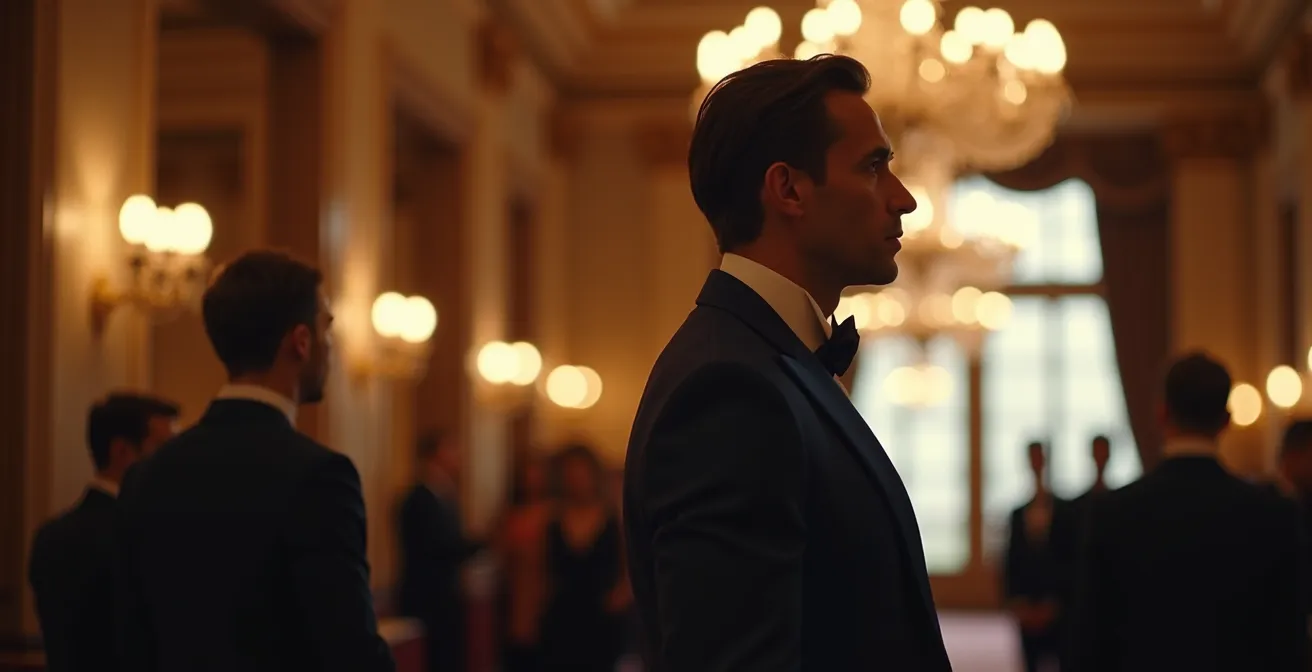
True British black-tie elegance is not about what you wear, but about the social grammar you demonstrate.
- The most significant statements are often omissions, such as forgoing a wristwatch to show respect for your host.
- Modern compromises, like smartwatches, are permissible only when rendered almost invisible, mimicking traditional aesthetics.
Recommendation: Prioritise discretion and context over fleeting trends to achieve an air of effortless propriety at your next formal engagement.
The arrival of a gilt-edged invitation can send a tremor of both excitement and anxiety through even the most seasoned socialite. The dress code is stated in two stark words: Black Tie. Immediately, the mind cycles through the basics—a black dinner jacket, a white dress shirt, a hand-tied bow tie. These are the elementary components, the notes of the scale. But assembling them correctly does not guarantee music; more often than not, it produces mere noise.
The common advice to “accessorise subtly” or “ensure a good fit” is true, yet utterly insufficient. It fails to address the far more complex challenge of navigating the unspoken, deeply ingrained sartorial grammar of British high society. True elegance in this context is not a checklist to be completed, but a language to be spoken fluently. It is a nuanced performance where confidence is derived from a deep understanding of tradition, not from the price tag of your suit.
But what if the key to mastering this language lies not in accumulation, but in restraint? What if the most powerful statement one can make is through intentional omission? This guide decodes the subtle yet non-negotiable rules of formal accessories. We will move beyond the obvious and explore the philosophy of discretion that separates the adept from the amateur, ensuring your presence at any gala, wedding, or opera evening is remembered for its quiet, unassailable correctness.
To navigate this intricate world, we will dissect the critical details that define true formal elegance. This guide provides a clear framework for understanding the logic behind each rule, empowering you to dress with an air of inevitability.
Summary: Decoding British Black Tie Accessories
- Why Is Wearing a Watch Traditionally Discouraged with a Tuxedo?
- How to Use Cufflinks to Enhance Without Overwhelming?
- Ultra-Thin Watch or Pocket Watch: Which Option for Maximum Elegance?
- The Mistake of Wearing a Bulky Sports Watch with a Three-Piece Suit
- When to Switch from a Black to a Brown Leather Strap: The Seasonal Rules
- How to Create a Minimalist Dial That Mimics a Classic Evening Watch?
- The Mistake of Wearing Runway Transparencies to a Client Meeting
- Styling Wearables Without Ruining a Formal Wedding Guest Outfit
Why Is Wearing a Watch Traditionally Discouraged with a Tuxedo?
The most fundamental rule of black tie, and the one most frequently misunderstood, concerns the wrist. Traditional etiquette dictates that a gentleman should never wear a wristwatch with a dinner jacket. This is not an arbitrary decree but a powerful piece of sartorial grammar. To wear a watch is to suggest that you have a more pressing engagement elsewhere; it implies that your attention is divided and that you are conscious of the time passing. At a formal event, your sole focus should be on your host and fellow guests. The absence of a timepiece is an act of respect, a quiet, deliberate signal that you are entirely present.
This principle of intentional omission is the bedrock of high-society dressing. It communicates a level of social grace that no expensive accessory ever could. As the experts at the Gentleman’s Gazette note, the philosophy is one of total immersion in the occasion:
A century ago one should never wear a wrist watch with a dinner jacket. The idea behind it was that your sole focus should be on the host and other guests, not on the time.
– Gentleman’s Gazette, Black Tie Watch Guide
While modern standards have softened slightly, allowing for the inclusion of a discreet dress watch, the traditional purist understands the power of a bare wrist. It is a subtle but clear statement of sophistication, demonstrating that you understand the event is not merely an appointment in a diary but an occasion to be honoured with your full and undivided attention. To forget this is to commit the first, and perhaps most telling, faux pas.
How to Use Cufflinks to Enhance Without Overwhelming?
If the wristwatch represents a potential misstep, cufflinks are an opportunity for a masterful, yet discreet, statement. They are one of the few pieces of jewellery permitted within the rigid framework of black tie, and as such, their selection is fraught with significance. The goal is not to draw attention but to complete the ensemble with an air of inevitability. Your choice of cufflink is a discreet signifier, speaking volumes about your understanding of context and tradition.
The key is contextual integrity. A pair of novelty cufflinks that might be amusing at a less formal gathering becomes a mark of profound ignorance at a society wedding. Conversely, simple silk knots, perfectly appropriate for a university formal, would appear juvenile at a corporate gala. The metal, style, and finish must be in complete harmony with the formality of the event and your other accessories. This requires a level of discernment that separates the truly elegant from the merely dressed-up.
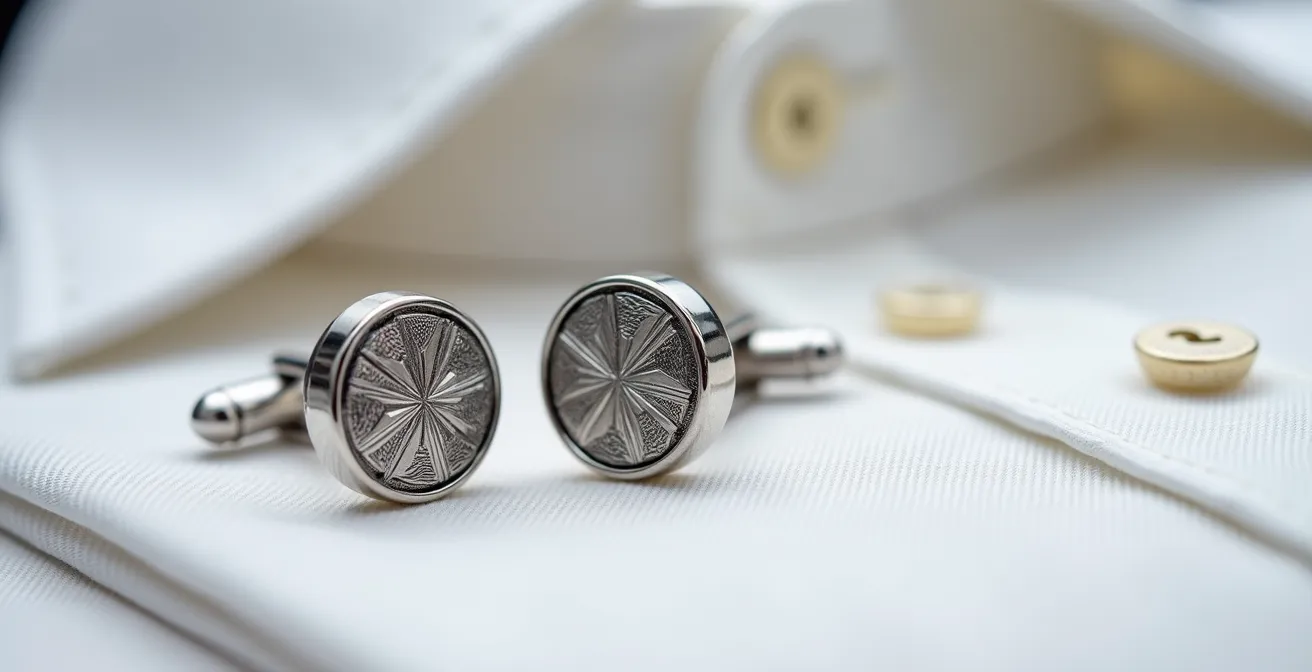
The materials themselves carry meaning. Polished sterling silver communicates understated professionalism, while gold suggests a more established, classic sensibility. Enamel allows for a touch of personality, but only when rooted in tradition, such as a family or regimental crest. Anything ostentatious or branded is to be avoided at all costs; it is the sartorial equivalent of shouting in a library.
Action Plan: Selecting the Correct Cufflinks for UK Social Contexts
- Assess the Event Formality: For university formals or more relaxed occasions, choose silk knots for a touch of relaxed, youthful elegance.
- Select for Corporate Black Tie: At professional galas or award dinners, opt for simple, classic designs like sterling silver or plain gold ovals. They signal seriousness and taste.
- Choose for Society Weddings: This is an occasion for more personal expression. Enamel with a family crest or a subtle, meaningful motif is appropriate and shows an understanding of heritage.
- Ensure Metal Cohesion: The metal of your cufflinks must precisely match your shirt studs and, if worn, the case of your dress watch. This non-negotiable rule creates a seamless, considered look.
- Prioritise Understated Quality: For any professional or highly formal setting, invest in solid sterling silver. Its weight and lustre provide an unmatched sense of quality that is felt rather than seen.
Ultra-Thin Watch or Pocket Watch: Which Option for Maximum Elegance?
While the purest form of black tie etiquette demands a bare wrist, modern convention has conceded to the wearing of a timepiece, provided it adheres to stringent criteria. The choice is not between any watch, but between two highly specific options: the ultra-thin dress watch or the traditional pocket watch. Each carries a different connotation and is appropriate for different echelons of formality, particularly within the UK’s social landscape. Understanding this distinction is a critical test of one’s sartorial fluency.
A Study in Evolution: From Pocket to Wrist in British Formal Wear
Historically, the pocket watch was the only acceptable timepiece for a Victorian or Edwardian gentleman attending a formal event. It was concealed within a waistcoat, consulted discreetly, and spoke of a deep-rooted tradition. The wristwatch, by contrast, was initially a military tool and considered far too utilitarian for evening wear. Over the 20th century, as dinner jackets became more streamlined (and often worn without waistcoats), etiquette evolved. It now accepts the ultra-thin dress watch—specifically on a black leather strap—as a suitable, if not strictly traditional, alternative for black-tie functions. However, for the pinnacle of formality, such as white tie events, the pocket watch remains the undisputed, purist’s choice.
The decision between the two depends entirely on the principle of contextual integrity. An ultra-thin watch is a nod to modernity and practicality, perfectly acceptable at corporate galas, London premieres, or contemporary weddings. A pocket watch, however, signals a deference to history and is the superior choice for events steeped in tradition, such as aristocratic balls or state functions, where it complements the formal waistcoat required for such occasions.
The following table clarifies the distinct roles these timepieces play in a British formal wardrobe, a distinction that must be understood, as a comparative analysis of formal etiquette reveals.
| Aspect | Ultra-thin Dress Watch | Pocket Watch |
|---|---|---|
| Formality Level | Appropriate for most black-tie events | Ultimate choice for white tie and traditional events |
| Practicality | Easy to wear with modern dinner jackets | Requires waistcoat with fob pocket |
| UK Context | Accepted at corporate galas and weddings | Preferred at aristocratic balls and state functions |
| Heritage Value | Contemporary refinement | Traditional British heritage |
The Mistake of Wearing a Bulky Sports Watch with a Three-Piece Suit
There exists a sartorial transgression so jarring it can undermine an otherwise impeccable outfit: the pairing of a bulky, functional sports watch with formal wear. This is not merely a minor error; it is a fundamental misunderstanding of the purpose of clothing. A dinner jacket or a fine three-piece suit is designed to create a clean, elegant silhouette. A thick diving or pilot’s watch utterly destroys this line, catching on the shirt cuff and creating an unsightly bulge. It is the sartorial equivalent of wearing hiking boots with a ballgown.
This mistake is often seen as a status symbol—the “City bonus” look—where an expensive timepiece is worn to signal wealth. In the world of true elegance, however, it signals only a lack of refinement. It suggests the wearer is more concerned with displaying a brand than respecting the occasion. This is a profound miscalculation.
Far too often, we see men adopting the 007 stances of wearing a dive watch with their tuxedo or a timepiece that is far too casual for an evening out on the town.
– Gentleman’s Gazette, Black Tie Watch Guide
A sports watch is a tool. Its purpose is to signal activity, ruggedness, and function. Formal wear, by contrast, is about leisure, celebration, and social grace. The two are philosophically opposed. To combine them is to create a jarring visual and social contradiction. For formal events, one must possess a dedicated evening watch: something slim, simple, and unobtrusive. Affordable elegance can be found in vintage Omega pieces or the refined designs of British makers like Christopher Ward. The watch should slip unnoticed under the cuff, a discreet signifier for those who know, rather than a blatant advertisement for those who do not.
- Never wear a recognisable sports watch (such as a Rolex Submariner or Audemars Piguet Royal Oak) with black tie. Reserve them for business or casual settings.
- Maintain a dedicated, slim evening watch for formal use. It is a necessary part of a gentleman’s wardrobe.
- Ensure your chosen timepiece does not disrupt the clean, unbroken line of your shirt cuff. If it is visible when your arm is relaxed, it is too large.
- Remember the core principle: a sports watch signals ‘work’ or ‘action’; an evening watch signals ‘leisure’ and ‘elegance’. Do not confuse the two.
When to Switch from a Black to a Brown Leather Strap: The Seasonal Rules
For the gentleman navigating the broader world of sartorial rules, the question of leather colour is a frequent point of confusion. The answer, within the specific and unyielding context of UK black tie, is brutally simple: you do not. The rule is rigid and absolute. For formal evening wear, the watch strap—and indeed, any leather accessory such as your shoes—must be black. There are no seasonal variations. There are no exceptions.
This edict is an extension of the traditional English style adage, “no brown in town.” While this once applied to business dress in the City of London, its spirit carries over with even greater force into evening wear. Brown leather, in all its wonderful shades from tan to chocolate, is associated with the countryside, with daytime, with a more relaxed and rustic sensibility. Black is the colour of formality, of the evening, of urban sophistication. To introduce brown into a black-tie ensemble is to commit a categorical error, demonstrating a fundamental ignorance of this sartorial grammar.

The only acceptable material for a dress watch strap is leather, and the only acceptable colour is black. The texture may vary—a high-gloss alligator or crocodile for maximum formality, or a more subdued matte calfskin for a modern, understated elegance—but the colour is non-negotiable. Even the buckle must adhere to the rules, its metal matching your cufflinks and shirt studs precisely. Any deviation, such as an oxblood or dark navy strap, would only be permissible at an event explicitly labelled “Creative Black Tie,” and even then, it would be a considerable risk.
As the definitive guidelines on the British black-tie dress code make clear, this is not a matter of personal taste but of established protocol. One must adhere to it without question to maintain contextual integrity. The strap must be black. The shoes must be black. The bow tie must be black. This trinity is the foundation upon which the entire edifice of evening elegance is built.
How to Create a Minimalist Dial That Mimics a Classic Evening Watch?
The incursion of the smartwatch into every facet of modern life presents a unique challenge to formal etiquette. While the ideal remains a classic mechanical timepiece or none at all, reality dictates that some may find it impossible to part with their wearable technology. If one absolutely must wear a smartwatch to a black-tie event, the only acceptable strategy is one of radical, uncompromising camouflage. The goal is to make the device so discreet that it ceases to read as “technology” and instead mimics the appearance of a classic, minimalist evening watch.
This is not a task to be taken lightly. The default, data-rich faces of most smartwatches are anathema to formal wear. They are cluttered, bright, and distracting—the very antithesis of evening elegance. One must actively strip the device of its digital identity. This means selecting the most austere, analogue-style watch face available and disabling every single complication. The screen should display nothing more than two or three hands against a stark black background. Any colour, animation, or data point (steps, heart rate, weather) is strictly forbidden.
The best options on a device like the Apple Watch are faces such as ‘Meridian’, ‘California’, or ‘Typograph’, all set to their black, minimalist configurations. Third-party applications like Facer can even provide replicas of classic, understated dials from makers like Patek Philippe or Jaeger-LeCoultre, offering a more convincing illusion. According to a thorough guide on watches for black tie, this digital mimicry is the only path to acceptability. Paired with a high-quality black leather strap from a British maker, the smartwatch may just pass muster—but only if its owner has the discipline never to interact with it during the event.
The Mistake of Wearing Runway Transparencies to a Client Meeting
While one might assume a sartorial error as blatant as wearing runway trends to a corporate pitch is confined to the business world, a similar, more insidious mistake is frequently made within the realm of black tie. This is the misinterpretation of “Creative Black Tie.” All too often, an invitation bearing this modifier is seen as a license for high-fashion experimentation—a chance to incorporate the dramatic, avant-garde looks of the moment. This is a grave misunderstanding of the term, especially within a British context.
As the esteemed guide Debrett’s notes, much of modern dress sense is plagued by “social confusion and insecurity.” “Creative Black Tie” is a prime example. It does not mean “fashionable” or “trendy.” It is a call for personal expression *within the established framework* of formal wear. It is an invitation to swap a black dinner jacket for one in a rich velvet, perhaps in bottle green or burgundy. It might permit a tastefully patterned bow tie or a dress shirt with elegant pleats. It is not, under any circumstances, an invitation to wear the latest conceptual piece from a Shoreditch design collective.
A Study in Context: ‘Creative’ Does Not Mean ‘Runway’
The critical factor is, as always, contextual integrity. What works at a London Fashion Week party would mark you as a rank amateur at a charity ball at the V&A or a formal dinner at Annabel’s. As a perceptive analysis in Elle UK points out, creativity in this sphere is about sophisticated variations on a classic theme, not a wholesale rejection of it. The goal is to show personality and wit, not to become a spectacle. Wearing something that screams “this season’s trend” demonstrates that your allegiance is to the fleeting whims of fashion, not to the timeless principles of elegance and respect for the occasion.
The truly well-dressed individual understands that “creative” is an adjective modifying “black tie,” not replacing it. The fundamental structure must remain intact. The mistake of wearing something overly fashionable is the same as wearing a bulky sports watch: it prioritises personal display over social grace, a fatal error in the delicate ecosystem of formal British society.
Key Takeaways
- Discretion is Paramount: True elegance lies in what is left unsaid and unworn. The absence of a watch is often a more powerful statement than the presence of one.
- Context is Non-Negotiable: Every accessory, from cufflinks to watch straps, must be chosen in strict accordance with the event’s formality and British sartorial tradition.
- Modernity Requires Camouflage: If modern technology like a smartwatch must be worn, it must be disguised to mimic classic aesthetics, stripping it of all distracting digital features.
Styling Wearables Without Ruining a Formal Wedding Guest Outfit
Having established that a smartwatch is a significant compromise, styling it for an event as important as a formal wedding requires the utmost care. The primary objective is to minimise its presence to the point of near-invisibility. This goes beyond simply choosing a minimalist dial; it involves a holistic approach to rendering the device inert and unobtrusive, ensuring it does not shatter the carefully constructed elegance of your formal attire.
First, one must engage the device’s software to eliminate its most jarring feature: the illuminated screen. On an Apple Watch, this is known as “Theatre Mode.” Activating it ensures the screen remains dark unless deliberately tapped, preventing it from lighting up with every gesture and drawing unwanted attention. This is not a suggestion; it is a mandatory prerequisite. A screen that flashes to life during the exchange of vows or a heartfelt speech is an unforgivable breach of etiquette.
Secondly, the physical strap is as important as the digital face. The standard silicone or fabric strap that accompanies most wearables is utterly unacceptable. It must be replaced with a high-quality, plain black leather strap. The hardware—the buckle and lugs—must be of a metal that matches your cufflinks and shirt studs. This integration is key to creating the illusion that the device is a cohesive part of your formal accessories, rather than a jarring technological appendage.
Ultimately, for those who are truly committed to impeccable etiquette but feel the need for a discreet technological companion, the best solution may be to abandon the screen altogether. Devices like the Oura Ring offer health and activity tracking in a form that is far more aligned with the principles of formal discretion. It is the ultimate modern expression of intentional omission—gaining the function of a wearable without sacrificing an ounce of sartorial integrity. This is the future of formal tech: heard, but not seen.
Your next formal event is an opportunity not for anxiety, but for a masterful display of sartorial intelligence. Begin today by auditing your own accessories against these principles of discretion and context, ensuring your presentation is one of quiet, unassailable confidence.