
Contrary to common belief, your watch losing time after five years isn’t just a sign it needs a generic service. It is often a symptom of specific, preventable stresses like environmental magnetism and lubricant degradation, particularly prevalent in the UK. This guide moves beyond the platitudes to give you the diagnostic knowledge of a master horologist, empowering you to identify the true cause and become the first line of defence in preserving your timepiece’s precision and value.
There is a unique anxiety reserved for the owner of a fine mechanical watch when they notice it’s happened. The seconds hand, once a faithful marker of time’s passage, now lags. First by a few seconds a day, then more. It’s a subtle but profound betrayal. For an object that is a marvel of micro-engineering, a symphony of gears and springs working in harmony, this loss of precision feels like the first sign of a terminal decline. The immediate, conventional wisdom is simple: “It’s been five years, it just needs a service.”
While regular servicing is undeniably crucial, this advice often masks a more complex reality. It treats the symptom, not the cause. As a horologist, I can assure you that time loss is rarely a simple matter of age. It is the cumulative result of a series of hidden battles waged within the watch case. These are battles against invisible forces like magnetism from our daily devices, against the subtle environmental assault of a damp British climate, and against the natural but manageable process of mechanical fatigue. To truly be a custodian of your timepiece, you must become its first diagnostician.
But what if the key to long-term precision wasn’t just adhering to a service schedule, but understanding the specific stresses your watch endures daily? This guide is designed to take you beyond the surface-level advice. We will dissect the most common yet misunderstood reasons your watch’s performance degrades. We will explore the specific environmental and handling mistakes that accelerate wear, and provide you with the knowledge to identify them. The goal is not to turn you into a watchmaker, but to empower you to be an informed owner who can protect their investment and appreciate the intricate life of the machine on their wrist.
For those who prefer a visual introduction to the magic inside your watch, this classic film from Hamilton offers a foundational look into the mechanical marvel we are about to discuss. It provides an excellent context for the components and principles that we will explore in detail.
In the following sections, we will move from the most common external influences to the internal mechanics, providing a clear path to understanding your watch’s health. This article is structured to build your knowledge step-by-step, from diagnosis to making informed decisions about servicing and long-term value.
Summary: A Horologist’s Guide to Watch Precision
- Why does magnetism from smartphones disrupt your balance spring?
- How to adjust your perpetual calendar without breaking the mechanism?
- COSC vs METAS: which certification guarantees the best daily precision?
- The storage mistake that dries out your movement’s oils
- When to send your watch for a full service: the audible signals
- Why does 9-carat Victorian gold become brittle over time?
- Why does a manufacture calibre cost 3 times more to service?
- In-House vs. ETA Calibres: Which Movement Holds Value Better?
Why does magnetism from smartphones disrupt your balance spring?
In my workshop, the most common cause of a modern, well-maintained watch suddenly running fast—sometimes by minutes a day—is magnetism. This is the primary invisible enemy. Your watch’s “heart” is the balance wheel, which oscillates back and forth thanks to a delicate, coiled hairspring. For a standard movement beating at 28,800 vibrations per hour, this tiny spring expands and contracts 691,200 times a day. If this hairspring becomes magnetised from proximity to a smartphone, a laptop speaker, or a magnetic clasp on a bag, its coils can stick together. This effectively shortens the spring, causing the balance wheel to oscillate much faster and your watch to gain significant time.
Most modern luxury watches use anti-magnetic alloys like Nivarox for their hairsprings, which offers good resistance. However, the powerful neodymium magnets in today’s electronics can still affect them. The issue is one of proximity and duration. Placing your watch directly on your tablet or laptop for hours is a common mistake that can lead to magnetisation. While the effect is reversible, it is the most frequent environmental assault a modern watch faces. Recognising the symptoms is the first step in avoiding an unnecessary and expensive service when a simple, quick demagnetisation is all that’s required.
Many owners are unaware their watch is magnetised, assuming the poor timekeeping is a sign of a major mechanical fault. Before considering a full service for a watch that is running excessively fast, performing a simple diagnostic check is essential. It’s a professional-level step you can take at home. Major UK jewellers are well-equipped to handle this common issue, often as a quick, while-you-wait procedure. For instance, many Goldsmiths stores offer free checks and professional demagnetisation can be performed for a modest fee.
Your Action Plan: Checking Your Watch for Magnetisation
- Compass Test: Place a simple analogue compass flat. Slowly bring your watch close to it. If the compass needle deflects or spins erratically, your watch is almost certainly magnetised.
- Smartphone App: For a more technical check, download a magnetometer app on your phone (like Lepsi or Physics Toolbox Suite). Measure the baseline magnetic field in your room, then bring the watch near the phone’s sensor. A significant spike indicates magnetisation.
- Observe the Rate: A magnetised hairspring typically causes a watch to run very fast, often gaining more than 30 seconds or even several minutes per day. This is a classic symptom of isochronism drift caused by magnetism.
- Seek Professional Confirmation: Visit a reputable UK jeweller like Ernest Jones or an independent watchmaker certified by the British Horological Institute (BHI). Most offer free magnetisation checks.
- Professional Demagnetisation: If magnetised, have it professionally demagnetised. While DIY demagnetisers are available online, a botched attempt can sometimes worsen the problem. A professional service is quick, safe, and typically costs between £30-£50.
How to adjust your perpetual calendar without breaking the mechanism?
If magnetism is the invisible enemy, incorrect handling of complex functions is the enemy within. The perpetual calendar is one of watchmaking’s great achievements, a mechanical computer that correctly displays the date, day, month, and even leap years. However, its complexity is matched by its fragility during adjustment. The most critical rule, known to every watchmaker, is to never adjust the date or day using the pushers or crown between the hours of 9 PM and 3 AM. This is the “danger zone.”
During this window, a series of gears and levers in the movement are already engaged, slowly preparing to advance the date displays at midnight. Forcing a manual change with a pusher during this time is like trying to shift gears in a car without using the clutch. You are pushing against an engaged mechanism, which can bend or break a delicate lever or tooth on a date wheel. The result is a costly and complex repair that is entirely avoidable. The first sign of damage is often a date that no longer changes, or changes at the wrong time.

The correct procedure, as shown in the delicate interaction above, is to always advance the time past 3 AM before making any calendar adjustments. Once you are out of the danger zone, you can set the date, day, and month freely. Then, you can set the correct time. For owners of such exquisite timepieces, investing in a high-quality watch winder is not a luxury but a form of insurance. A properly programmed winder ensures the watch never stops, completely eliminating the need for manual date adjustments and their associated risks.
COSC vs METAS: which certification guarantees the best daily precision?
For many owners, a key part of their watch’s value lies in its “chronometer” certification. This promises a high degree of precision. For decades, the gold standard has been the Contrôle Officiel Suisse des Chronomètres (COSC). It tests an uncased movement for 15 days in five positions and at three temperatures, certifying it if its average daily rate is within -4 to +6 seconds. This is a rigorous standard of precision. However, a new, even more demanding certification has emerged: the Master Chronometer certification from the Swiss Federal Institute of Metrology (METAS), pioneered by Omega.
METAS testing goes significantly further. It tests the fully cased watch, not just the movement, ensuring that the assembly process hasn’t affected performance. Its precision requirement is stricter, at 0 to +5 seconds per day, meaning a METAS-certified watch will never run slow. Crucially, METAS includes tests that COSC does not, most notably for magnetic resistance. A Master Chronometer must function flawlessly when exposed to a magnetic field of 15,000 gauss, the equivalent of a clinical MRI scanner. This is a direct response to the environmental assault of modern electronics we discussed earlier.
For a watch owner in the UK, the differences in how these certifications perform in real-world conditions can be tangible. The following table, based on data from industry analysis, breaks down the key distinctions.
This comparative data, drawn from an in-depth analysis of watch maintenance standards, highlights the practical advantages of the METAS certification in daily life, especially concerning modern magnetic threats.
| Certification | Daily Rate Standard | Temperature Testing | UK Climate Performance | Magnetic Resistance |
|---|---|---|---|---|
| COSC | -4/+6 seconds | 8°C, 23°C, 38°C | May drift in damp winters | Not tested |
| METAS | 0/+5 seconds | 8°C to 38°C continuous | Better humidity resistance | 15,000 gauss tested |
Ultimately, while a COSC-certified watch is a high-precision instrument, a METAS-certified Master Chronometer offers a superior guarantee of real-world resilience, particularly against magnetism and with a tighter accuracy tolerance. Understanding this difference helps an owner manage their expectations and appreciate the robust engineering they have invested in.
The storage mistake that dries out your movement’s oils
A mechanical watch is a living machine. It is designed to be in motion. When a watch is left unworn in a drawer for months or years, a slow and damaging process begins: lubricant viscosity degradation. A standard mechanical movement contains between 50 and 100 lubrication points, each using specific oils and greases to minimise friction between moving parts. As the technical team at CODE41 notes, “The components of the movement are coated with lubricating oil in order to alleviate friction between the parts.” When the watch is stationary, these oils can congeal, migrate away from critical friction points, or dry out, especially if storage conditions are poor.
The most common storage mistake is keeping a valuable watch in its original beautiful, but often unsealed, wooden presentation box. In the UK’s typically humid climate, especially in older period properties, this is a recipe for disaster. The wood can absorb moisture, creating a micro-climate that can cause spotting on the dial and, more insidiously, accelerate the breakdown of lubricants within the movement. Storing a watch near a radiator or on a sunny windowsill is equally damaging, as temperature fluctuations cause the oils to thin and thicken, impairing their function.
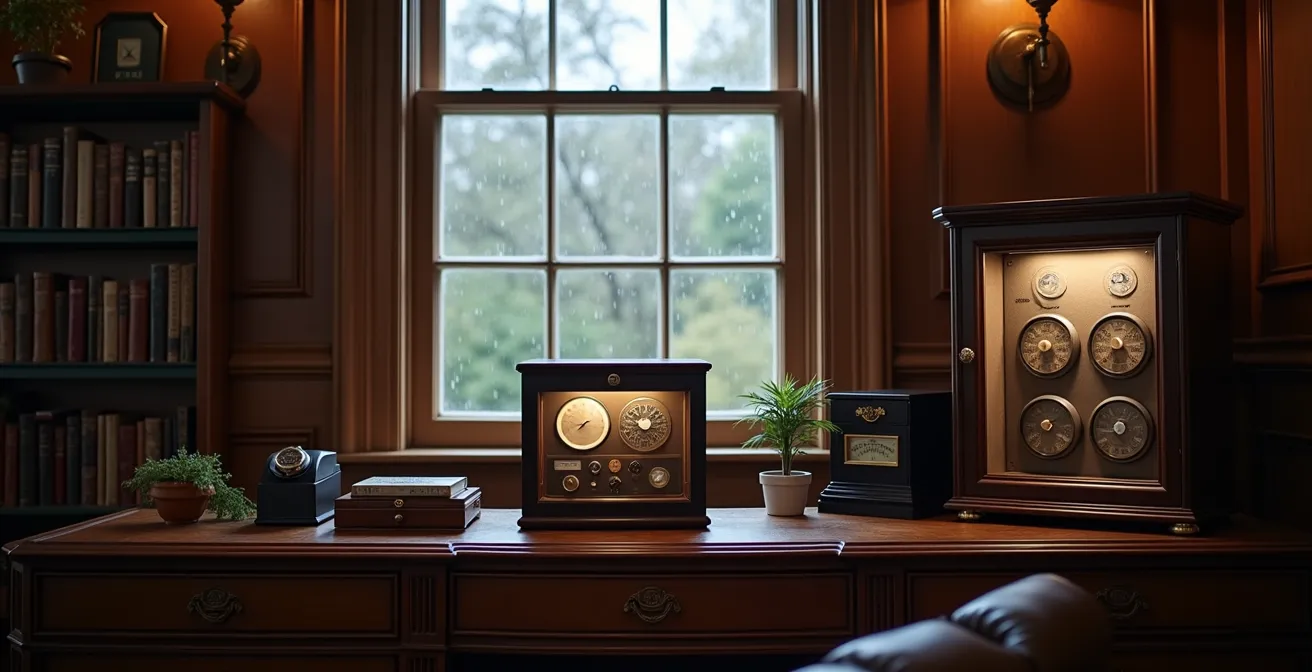
The result of this neglect is increased friction. When you finally wear the watch again, the gear train and escapement are operating with sub-optimal lubrication. This causes excessive wear on the components and is a primary cause of time loss. A watchmaker can often tell if a watch has been stored poorly simply by the sound it makes on a timegrapher—the amplitude (the swing of the balance wheel) will be low and erratic. The solution is proper storage in a dedicated, dry watch box with silica gel packets, and running the watch at least once a month to keep the lubricants distributed.
When to send your watch for a full service: the audible signals
The “five to seven year” service interval is a useful guideline, but it’s not an absolute rule. A watch’s need for service is dictated by its use and performance, not just the calendar. A well-cared-for watch worn in rotation might comfortably exceed this interval, while a daily-worn watch subjected to sports might need attention sooner. Rather than relying on a date, an astute owner should learn to recognise the signals the watch itself provides. One of the most telling signs is a change in the sound of the movement.
A healthy mechanical watch has a crisp, consistent, and energetic ticking sound. As lubricants degrade and parts wear, this sound can change. A “wobbly” or uneven tick-tock can indicate a problem with the escapement or a low amplitude in the balance wheel. A grinding or scraping noise when the automatic rotor is spinning is a clear sign that the rotor’s bearing is dry or worn and needs immediate attention to prevent further damage. These are not sounds you need a special tool to hear; you can often detect them by holding the watch close to your ear in a quiet room.
Another key indicator is a significant decrease in the power reserve. If your fully-wound watch, which used to run for 48 hours, now stops after only 24, it’s a sign of increased friction in the gear train. The mainspring’s energy is being wasted overcoming this resistance instead of powering the watch. A comprehensive service, such as the process at major UK centres, addresses all these issues. For example, at Goldsmiths, timepieces are tested on wrist simulators and power reserve is monitored for 24 hours to diagnose these very problems before any work begins. This ensures the service targets the specific points of failure, restoring the movement to its original factory specifications.
Why does 9-carat Victorian gold become brittle over time?
While modern watches face modern problems, vintage timepieces present their own unique challenges, rooted in the metallurgy of their era. A common and heartbreaking issue I see in the workshop is with beautiful 9-carat gold watch cases from the Victorian period (1837-1901). An owner might bring in a family heirloom that has developed a crack or a lug has snapped off with no apparent impact. This is not due to misuse; it’s a result of the inherent nature of the alloy itself, a phenomenon known as component brittleness.
As experts in historical restoration, The Goldsmiths’ Centre in London clarifies the root cause. In their guidelines on Victorian watch restoration, they explain, ” The specific low-carat gold alloys popular in 19th-century British watchmaking often contained more zinc and copper, making them prone to stress-corrosion cracking.” These base metals, used to make the gold harder and more affordable, can react with airborne pollutants (like ammonia) and ambient humidity over many decades. This reaction causes microscopic cracks to form along the metal’s grain boundaries, dramatically reducing its ductility and making it brittle.
This inherent risk has a direct impact on the watch’s modern-day life, particularly in terms of insurance. The risk is so well-known that specialist UK insurers have specific protocols for these pieces. According to an industry maintenance guide, data from T.H. March, a leading UK specialist insurer, shows that policies for these timepieces can carry 40% higher premiums for pre-1900 low-carat cases compared to modern gold cases of similar weight. They often mandate annual condition reports from BHI-certified assessors to monitor for the early signs of this degradation. This isn’t just about timekeeping; it’s about the structural integrity of a piece of history.
Why does a manufacture calibre cost 3 times more to service?
When a watch does require a full service, the cost can vary dramatically. One of the biggest factors is whether the movement is a standard, third-party calibre (like those from ETA or Sellita) or an “in-house” or “manufacture” calibre, developed and built exclusively by the brand itself. While an in-house movement is a mark of horological prestige, that exclusivity comes at a significant long-term cost. A service for a manufacture calibre can easily be three times more expensive than for its ETA-based equivalent.
There are several reasons for this price disparity. Firstly, exclusivity and parts control. Brands that produce in-house movements tightly control the supply of spare parts, meaning only their own service centres or a handful of accredited independents can perform the work. This lack of competition naturally leads to higher prices. In contrast, parts for an ETA movement are widely available, allowing any competent independent watchmaker in the UK to source them easily and offer competitive pricing. Secondly, the complexity and specialised tooling required for in-house movements add to the labour cost. Each calibre may require its own set of tools and specific knowledge, which is not the case for standardised ETA movements.
This table, using typical UK service pricing, clearly illustrates the financial commitment required for an in-house movement. The trade-off is between the ubiquity and affordable maintenance of a standard calibre versus the prestige and higher running costs of a manufacture one.
The data, compiled from pricing at UK service centres like specialists who service both types of movements, shows a clear financial divergence. The turnaround time is also a critical factor; sending a watch back to Switzerland for a brand service can take months, whereas a local independent can often complete the work in weeks.
| Service Type | Standard ETA | Manufacture Calibre | Turnaround Time | Parts Availability |
|---|---|---|---|---|
| UK Independent | £250-350 | £600-900 | 2-3 weeks | Immediate |
| Brand Boutique | N/A | £800-1500 | 8-12 weeks | Switzerland order |
| Authorized Dealer | £300-400 | £700-1200 | 6-8 weeks | Variable |
This isn’t a judgement on which is “better,” but a crucial piece of information for any prospective or current owner. The initial purchase price is only the beginning of the financial journey with a mechanical watch.
Key takeaways
- Precision loss is rarely due to age alone; it’s a symptom of specific, often preventable environmental and mechanical stresses.
- Magnetism from daily electronics is the most common cause of a modern watch running fast, and is easily diagnosed and reversed.
- The long-term cost of ownership is significantly higher for prestigious in-house calibres compared to robust, standardised ETA movements due to parts control and service exclusivity.
In-House vs. ETA Calibres: Which Movement Holds Value Better?
For many collectors, a primary concern is the long-term value of their investment. A common assumption is that the horological prestige and higher initial cost of an in-house movement will translate directly into better value retention over time. However, the reality of the pre-owned market, particularly in the savvy UK market, is far more nuanced. While in-house movements are celebrated by enthusiasts, the practicality and lower running costs of standardised calibres like those from ETA have a strong appeal to a broader base of buyers.
A pragmatic buyer on the secondary market weighs not just the brand name, but the total cost of ownership. They are aware that a watch with an in-house movement will soon require a service costing upwards of £800, whereas an ETA-powered equivalent can be fully serviced by any trusted local watchmaker for a fraction of that price. This future liability is factored into the price they are willing to pay. Consequently, a well-maintained watch with a reliable ETA movement and a documented service history often holds its value remarkably well.
Case Study: Tudor Black Bay Market Analysis
The Tudor Black Bay provides a perfect real-world example. The original version used a modified ETA 2824 movement, while later models switched to Tudor’s own in-house manufacture calibre. An analysis of pre-owned market data in the UK from retailers like Watchfinder reveals a surprising trend. According to one report on the used watch market, ETA-powered Black Bays with a documented service history command prices that are only around 8% lower than their in-house counterparts. This is despite the fact that their servicing costs over a 10-year period can be 40-50% lower. This indicates that the market places a significant premium on serviceability and lower running costs, nearly offsetting the perceived prestige of the in-house movement.
This demonstrates that “value” is not just about brand prestige. For a significant portion of the market, it’s about reliability, accessibility of service, and predictable long-term costs. An ETA movement is a known quantity: robust, reliable, and serviceable by thousands of watchmakers worldwide. This ‘future-proof’ quality is a powerful asset that directly supports its long-term value proposition.
By understanding these hidden stresses, you have transformed from a passive owner into an informed custodian. You now possess the diagnostic mindset of a watchmaker, capable of protecting your investment not just by adhering to a schedule, but by actively managing its life. The next logical step is to apply this knowledge to your own collection, ensuring each timepiece receives the specific care it requires to perform for generations to come.
Frequently Asked Questions About Mechanical Watch Care
What are the ‘danger hours’ for perpetual calendar adjustment?
Never adjust the date, day, or month on a perpetual calendar between 9 PM and 3 AM. During this period, the date-changing mechanism is actively engaged, and forcing a manual adjustment can cause significant damage to the movement. This applies to most perpetual calendars, including popular models from IWC and Patek Philippe.
If I’ve adjusted my watch during the danger hours, what should I do?
Stop immediately. Do not try to force the crown or continue with any adjustments. The best course of action is to contact the boutique where you purchased the watch or a British Horological Institute (BHI) certified specialist for assessment. Attempting to ‘fix’ it yourself can exacerbate the damage.
How can a watch winder prevent adjustment complications?
A quality watch winder keeps your automatic watch constantly running, which is particularly beneficial for complex pieces like perpetual calendars. By programming a winder (from a reputable UK brand like Rapport London) to your watch’s specific Turns Per Day (TPD) requirement, you ensure it never stops. This completely eliminates the need for manual date adjustments, thereby preventing the risk of accidental damage during setting.